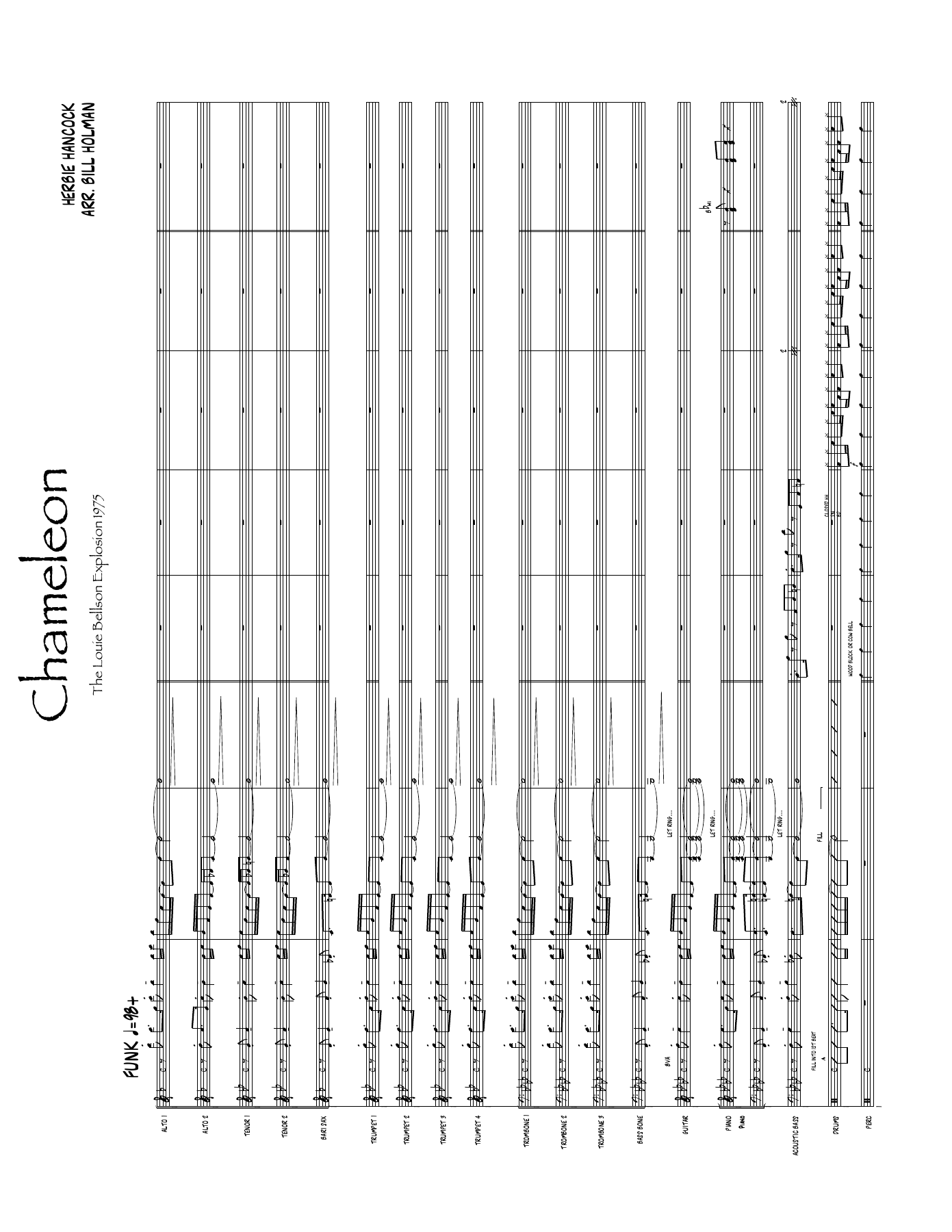
Chameleon (B.Holman)
Composed by Herbie Hancock
Arranged by Bill Holman
- Ensemble: Big Band
- Style: Jazz Standard
- Pages: 48
- Instruments (17): Alto 1, Alto 2, Tenor 1, Tenor 2, Bari Sax, Trumpet 1, Trumpet 2, Trumpet 3, Trumpet 4, Trombone 1, Trombone 2, Trombone 3, Bass Trombone, Guitar, Piano, Acoustic Bass, Drums
- Difficulty: medium
- Content: Individual Parts
- Format: PDF Download (Instant)
- Price: $24.99
Herbie Hancock's "Chameleon" emerged as a foundational track in the jazz-funk fusion genre, first appearing on his groundbreaking 1973 album *Head Hunters*. This era marked a significant departure for Hancock, moving from his earlier acoustic jazz work to embrace electronic instruments and a more earthy, funk-driven sound. Co-composed with Bennie Maupin, Paul Jackson, and Harvey Mason, the original 15-minute recording quickly became a jazz standard, celebrated for its innovative blend of jazz improvisation with the infectious grooves of funk. Its characteristic 12-note bass line, famously played by Hancock on an ARP Odyssey synthesizer, was revolutionary for its time, marking one of the first prominent uses of a synthesizer as a bass instrument in jazz and influencing countless musicians across genres. The piece is built primarily on a hypnotic two-chord vamp in B♭ Dorian (B♭m7 and E♭7), creating a minimalist yet compelling harmonic structure that provides ample space for extended improvisation. Bill Holman's arrangement of "Chameleon" reimagines this iconic funk anthem for the big band, infusing it with his signature sophisticated harmonic language and masterful orchestration while retaining the original's irresistible groove. Holman, renowned for his ability to transform well-known melodies into compelling new works, approaches "Chameleon" with a keen understanding of its rhythmic core. The arrangement maintains the driving, medium-funk tempo and the B♭ Dorian modal feel, ensuring the infectious energy of the original is preserved. However, Holman's distinctive voicings in the brass and saxophone sections add layers of complexity and richness, elevating the piece beyond a mere transcription. Expect expertly crafted soli sections that showcase the full power and precision of the ensemble, along with dynamic contrasts that build tension and release throughout. This arrangement is a testament to Holman's genius for making big bands "swing" with both power and nuance. While the iconic bass line remains central, Holman weaves intricate counter-melodies and reharmonizations through the ensemble, creating a fresh perspective on a familiar classic. There are featured solo opportunities, allowing individual instrumentalists to shine within the collective. The technical challenges lie in maintaining the tight funk rhythmic precision across all sections, especially in the brass articulations and the saxophone soli passages, which demand excellent ensemble blend and intonation. The rewarding aspect is the sheer joy of performing a piece that is both musically intelligent and undeniably groovy, captivating audiences with its blend of historical significance and contemporary big band flair. This arrangement is ideally suited for advanced high school, college, community, and professional big bands seeking a challenging yet deeply satisfying addition to their repertoire. To capture the authentic feel of this Bill Holman arrangement of "Chameleon," conductors should emphasize a precise, driving medium-funk groove from the rhythm section. The iconic bass line must be locked in with the drums, providing a solid foundation for the entire ensemble. Technical challenges include maintaining crisp, unified articulations in the brass, particularly in the syncopated figures, and ensuring clean execution of the intricate saxophone soli passages. Rehearsal should focus on rhythmic accuracy and blend within these sections. While the tempo is steady, encourage dynamic shaping to build excitement, especially leading into and out of the shout choruses. No special techniques like plunger mutes or doits are explicitly required, but brass players should be prepared for strong, clear attacks and releases. Attention to balance is crucial to allow Holman's rich harmonic voicings to speak clearly without overpowering the melodic lines. Q: What instruments and parts are included in this arrangement? A: This arrangement includes parts for 18 instruments: Alto Saxophone 1, Alto Saxophone 2, Tenor Saxophone 1, Tenor Saxophone 2, Baritone Saxophone, Trumpet 1, Trumpet 2, Trumpet 3, Trumpet 4, Trumpet 5, Trombone 1, Trombone 2, Trombone 3, Trombone 4, Guitar, Piano, Bass, and Drums. A full conductor score is also included. Q: What is the difficulty level of this arrangement? A: This arrangement is considered advanced, suitable for experienced high school, college, community, and professional big bands. It requires strong rhythmic precision, advanced ensemble playing, and solid improvisational skills. Q: What is the musical style and historical context of "Chameleon"? A: "Chameleon" is a seminal jazz-funk fusion piece originally composed by Herbie Hancock and released in 1973 on his *Head Hunters* album. It is known for its infectious funk groove, modal harmony, and pioneering use of synthesizers in jazz. Q: What makes Bill Holman's arrangement of "Chameleon" unique? A: Bill Holman's arrangement distinguishes itself by applying his sophisticated big band orchestration and harmonic ingenuity to Hancock's funk classic. He maintains the original's groove while adding complex voicings, intricate soli sections, and dynamic contrasts that elevate the piece to a new level of big band artistry. Q: What is the typical performance duration or tempo for this arrangement? A: While the original recording is quite long, this big band arrangement is typically performed at a medium-funk tempo, allowing for an engaging performance duration that balances the iconic groove with opportunities for ensemble features and solos.
Questions and answers
- What is included in the Chameleon (B.Holman) PDF?
- The verified current file contains a conductor score and individual parts across 48 pages.
- How many instruments or parts are listed for Chameleon (B.Holman)?
- The verified instrumentation list contains 17 entries for this Big Band arrangement.
- Who is credited for Chameleon (B.Holman)?
- Composer: Herbie Hancock. Arranger: Bill Holman.
- What difficulty is listed for Chameleon (B.Holman)?
- The verified difficulty level is medium.
- What style is listed for Chameleon (B.Holman)?
- The catalog lists the style as Jazz Standard.
- Can I preview Chameleon (B.Holman) before buying?
- Yes. The product page provides a preview generated from the current PDF file.
- How is Chameleon (B.Holman) delivered?
- After successful payment, the digital PDF is made available for download. The displayed price is $24.99.
Musicians Also Search For
Chameleon Bill Holman PDF • Chameleon Bill Holman sheet music • Chameleon arranged by Bill Holman • Bill Holman big band charts • Bill Holman jazz arrangements PDF • Chameleon Herbie Hancock sheet music • Chameleon Herbie Hancock big band arrangements • Herbie Hancock big band charts • Chameleon big band arrangements • Chameleon big band PDF download • Chameleon jazz sheet music • big band sheet music download • Chameleon conductor score PDF • Chameleon individual parts download • Chameleon sheet music PDF • Chameleon Jazz Standard charts • Jazz Standard big band arrangements • buy Chameleon sheet music • download Chameleon PDF • Chameleon jazz charts • best Bill Holman big band arrangements • Herbie Hancock arranged by Bill Holman • Chameleon printable sheet music • big band repertoire PDF