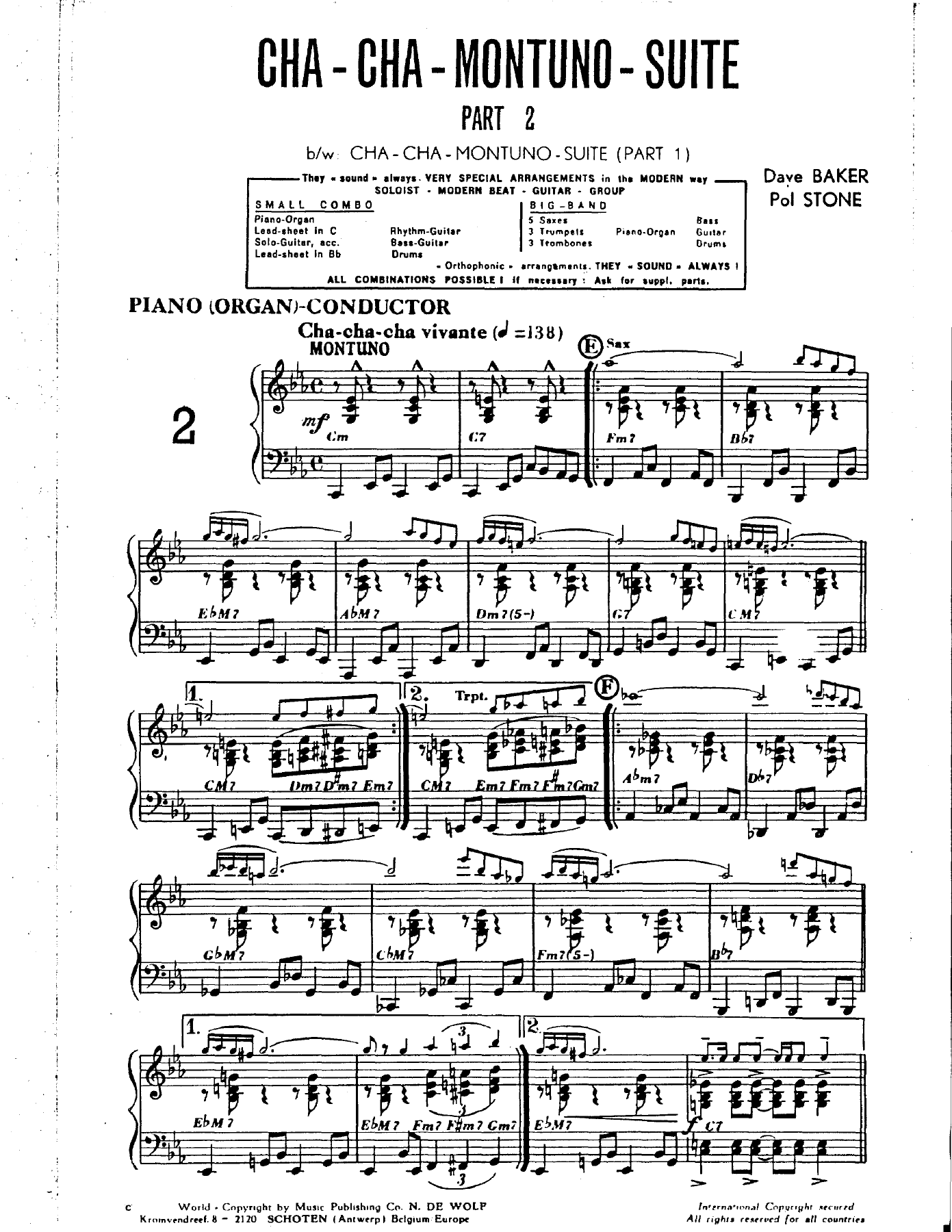
Cha Cha Montuno 2 (D.Baker)
Composed by David Baker
Arranged by D.Baker
- Ensemble: Big Band
- Style: Jazz Standard
- Pages: 21
- Instruments (15): Piano (Organ)-Conductor, 1st Alto Saxophone, 2nd Tenor Saxophone, 3rd Alto Saxophone, 4th Tenor Saxophone, Baritone Saxophone, 1st Trumpet, 2nd Trumpet, 3rd Trumpet, 1st Trombone, 2nd Trombone, 3rd Trombone, Rhythm Guitar, Bass Guitar, Drums
- Difficulty: medium
- Content: Individual Parts
- Format: PDF Download (Instant)
- Price: $24.99
David Baker's "Cha Cha Montuno 2" emerges from a rich tradition of Latin jazz exploration, a genre he masterfully contributed to throughout his illustrious career. While the original composition's exact release date is less critical than its stylistic roots, it embodies the vibrant, infectious energy characteristic of the Latin jazz movement that gained significant traction from the 1950s onwards. Baker, a towering figure in jazz education and composition, was renowned for his ability to seamlessly blend diverse musical idioms, and this piece stands as a testament to his deep understanding of Afro-Cuban rhythms integrated into a large ensemble jazz framework. It's a piece that speaks to the sophistication and rhythmic vitality that defines the "jazz standard" in a Latin context, celebrated for its intricate yet accessible groove. This arrangement by D.Baker captures the essence of a medium-fast cha-cha, firmly rooted in a 4/4 time signature with an undeniable Latin groove. The overall mood is exhilarating and sophisticated, evoking images of a bustling Havana club or a vibrant dance floor. The piece is primarily in a minor key, likely D minor or G minor, which lends a cool, slightly mysterious edge to its otherwise bright rhythmic drive. The energy is consistently high, driven by the insistent percussion and a pulsating bass line that underpins the entire structure. Expect a dynamic interplay between the sections, creating a rich tapestry of sound that is both complex and irresistibly danceable. D.Baker's treatment of "Cha Cha Montuno 2" is characterized by a meticulous attention to detail and a profound respect for the original's rhythmic integrity. The arrangement features intricate horn voicings that are both harmonically rich and rhythmically precise, often employing tight, unison lines that break into layered harmonies. Expect well-crafted soli sections for the saxophones and brass, showcasing the ensemble's precision and blend. A hallmark of this arrangement is the prominent use of the montuno piano vamp, which acts as a rhythmic anchor and harmonic foundation throughout much of the piece, particularly under solo sections. While specific modulations are subtle, the harmonic language is sophisticated, incorporating extended harmonies and colorful alterations typical of modern jazz. The arrangement builds to a powerful shout chorus, characteristic of D.Baker's ability to create climactic moments that showcase the full power of the big band. The melody is primarily carried by the saxophone section, often in unison or tight octaves, with brass interjections providing rhythmic punctuation and counter-melodies. Featured solo sections are strategically placed, offering opportunities for improvisation over the driving montuno vamp, likely for tenor saxophone and trumpet, though flexible for other instruments. Technical challenges include maintaining rhythmic precision in the fast cha-cha groove, executing complex horn voicings with clean articulation, and navigating dynamic contrasts. The rewarding aspect lies in the sheer infectious energy of the piece, the opportunity to lock into a powerful Latin rhythm section, and the satisfying blend achieved in the intricate horn passages. A standout musical moment is the transition from a tight ensemble section into a soaring solo over the insistent montuno, creating a compelling dialogue between improvisation and arrangement. This arrangement is ideally suited for college-level jazz ensembles, advanced high school bands, and community big bands with strong rhythmic sections and experienced horn players. Its demands for rhythmic accuracy, ensemble blend, and improvisational skill make it an excellent vehicle for developing sophisticated musicality and a deep understanding of Latin jazz idioms. Professional ensembles will also find it a vibrant and engaging addition to their repertoire, offering both challenge and audience appeal. "Cha Cha Montuno 2" demands a precise and unwavering cha-cha feel, maintaining a consistent medium-fast tempo around 180-200 BPM. The rhythm section must establish a rock-solid foundation, with the bass providing a driving tumbao and the piano locking into the montuno vamp with rhythmic accuracy and harmonic clarity. Horn sections should focus on crisp articulation, particularly in the unison and soli passages, ensuring rhythmic precision. Dynamics are crucial; observe the written markings to build tension and release. Soloists should embrace the Latin rhythmic framework, utilizing melodic and rhythmic motifs that complement the cha-cha groove. Rehearsal time should be dedicated to isolating the montuno piano part, ensuring rhythmic lock with bass and drums, and practicing the horn soli sections slowly to achieve clean attacks and releases before bringing them up to tempo. No special mutes or extended techniques are explicitly required, allowing the focus to remain on rhythmic integrity and ensemble blend. Q: What instruments are included in this arrangement? A: This big band arrangement is scored for 17 instruments, including Alto Saxophone 1 & 2, Tenor Saxophone 1 & 2, Baritone Saxophone, Trumpet 1-4, Trombone 1-4, Piano, Bass, Drums, and Guitar. Q: What is the difficulty level of "Cha Cha Montuno 2 (D.Baker)"? A: This arrangement is considered advanced intermediate to advanced, suitable for college-level jazz ensembles, professional bands, and highly proficient high school groups due to its rhythmic complexity and intricate voicings. Q: What is the musical style and historical context of this piece? A: "Cha Cha Montuno 2" is a Latin jazz standard, originally composed by David Baker. It embodies the vibrant cha-cha rhythm and montuno piano vamp, reflecting the rich Afro-Cuban influences prevalent in jazz from the mid-20th century onwards. Q: What makes D.Baker's arrangement of "Cha Cha Montuno 2" unique? A: D.Baker's arrangement is distinguished by its meticulous horn voicings, prominent use of the montuno piano vamp as a harmonic and rhythmic anchor, and well-crafted soli sections that highlight the ensemble's precision and blend. Q: What is the typical performance duration and tempo for this arrangement? A: The typical performance duration for "Cha Cha Montuno 2" is approximately 4-6 minutes, depending on the length of improvised solos. It should be performed at a medium-fast cha-cha tempo, generally between 180-200 BPM.
Questions and answers
- What is included in the Cha Cha Montuno 2 (D.Baker) PDF?
- The verified current file contains a conductor score and individual parts across 21 pages.
- How many instruments or parts are listed for Cha Cha Montuno 2 (D.Baker)?
- The verified instrumentation list contains 15 entries for this Big Band arrangement.
- Who is credited for Cha Cha Montuno 2 (D.Baker)?
- Composer: David Baker. Arranger: D.Baker.
- What difficulty is listed for Cha Cha Montuno 2 (D.Baker)?
- The verified difficulty level is medium.
- What style is listed for Cha Cha Montuno 2 (D.Baker)?
- The catalog lists the style as Jazz Standard.
- Can I preview Cha Cha Montuno 2 (D.Baker) before buying?
- Yes. The product page provides a preview generated from the current PDF file.
- How is Cha Cha Montuno 2 (D.Baker) delivered?
- After successful payment, the digital PDF is made available for download. The displayed price is $24.99.
Musicians Also Search For
Cha Cha Montuno 2 D.Baker PDF • Cha Cha Montuno 2 D.Baker sheet music • Cha Cha Montuno 2 arranged by D.Baker • D.Baker big band charts • D.Baker jazz arrangements PDF • Cha Cha Montuno 2 David Baker sheet music • Cha Cha Montuno 2 David Baker big band arrangements • David Baker big band charts • Cha Cha Montuno 2 big band arrangements • Cha Cha Montuno 2 big band PDF download • Cha Cha Montuno 2 jazz sheet music • big band sheet music download • Cha Cha Montuno 2 conductor score PDF • Cha Cha Montuno 2 individual parts download • Cha Cha Montuno 2 sheet music PDF • Cha Cha Montuno 2 Jazz Standard charts • Jazz Standard big band arrangements • buy Cha Cha Montuno 2 sheet music • download Cha Cha Montuno 2 PDF • Cha Cha Montuno 2 jazz charts • best D.Baker big band arrangements • David Baker arranged by D.Baker • Cha Cha Montuno 2 printable sheet music • big band repertoire PDF