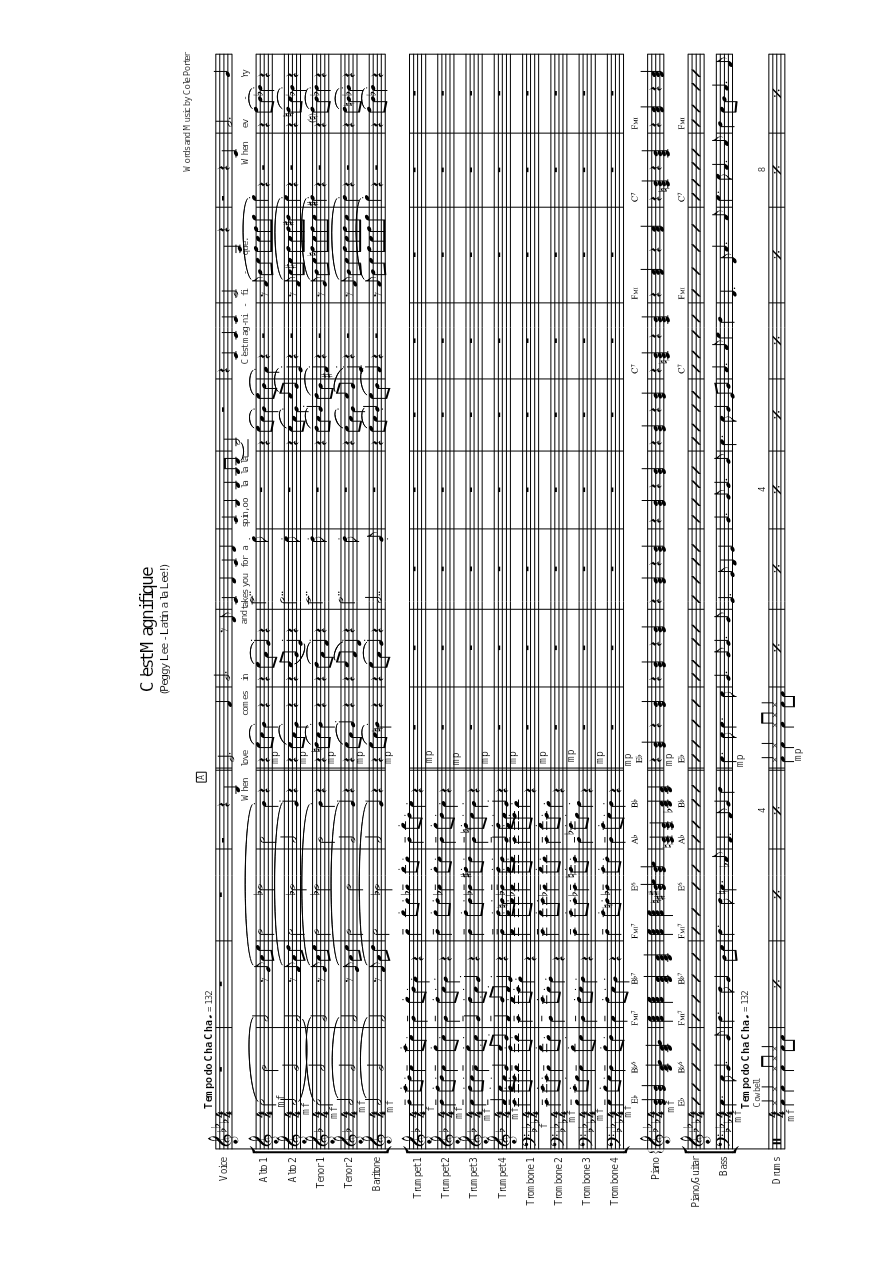
C'est Magnifique (J.Farley)
Composed by Cole Porter
Arranged by John Farley
- Ensemble: Big Band Vocal
- Style: Jazz Standard
- Pages: 27
- Instruments (18): Voice, Alto Saxophone 1, Alto Saxophone 2, Tenor Saxophone 1, Tenor Saxophone 2, Baritone Saxophone, Trumpet 1, Trumpet 2, Trumpet 3, Trumpet 4, Trombone 1, Trombone 2, Trombone 3, Trombone 4, Piano, Guitar, Bass, Drums
- Difficulty: easy
- Content: Individual Parts
- Format: PDF Download (Instant)
- Price: $24.99
"C'est Magnifique," penned by the legendary Cole Porter for his 1953 Broadway musical *Can-Can*, stands as a quintessential example of the sophisticated American Songbook. This era, often dubbed the Golden Age of Broadway, produced timeless melodies and witty lyrics that have transcended their original theatrical settings to become enduring jazz standards. Porter's genius lay in his ability to craft elegant, memorable tunes that, while deceptively simple, offered rich harmonic possibilities for improvisation and reinterpretation. The song's initial popularity was cemented by the Broadway production and subsequent film adaptation, featuring stars like Frank Sinatra and Shirley MacLaine, ensuring its place in the popular consciousness and making it a beloved staple for vocalists and instrumentalists alike. Its charm lies in its lyrical celebration of love and its inherently romantic, yet often playful, melodic contour, making it a perfect vehicle for jazz interpretation. John Farley's arrangement of "C'est Magnifique" for big band and vocal soloist reimagines this classic with a medium swing feel, setting it firmly in the tradition of sophisticated jazz ensemble writing. The arrangement is primarily in the key of F Major, offering a bright yet comfortable tessitura for the vocalist and brass. Farley's signature approach is evident in his meticulous voicings, which provide a lush, supportive harmonic bed without ever overshadowing the soloist. Expect rich, full-bodied brass and saxophone sections, often moving in tight, expressive soli passages that echo the elegance of the original while infusing it with a distinctly swinging pulse. The mood is one of joyful romance, maintaining the original's lighthearted spirit but elevating it with the power and dynamic range of a full jazz orchestra. This arrangement masterfully balances the vocal feature with compelling instrumental sections. The melody is introduced by the vocalist, often with subtle, harmonically interesting figures from the ensemble. Featured solos are strategically placed, typically for tenor saxophone and trumpet, allowing for improvisational showcases that build on the arrangement's established mood. Farley employs a dynamic arc, building from a gentle opening to a powerful, swinging shout chorus that provides an exhilarating climax before returning to a more intimate closing statement. Technical challenges include precise ensemble articulation, particularly in the brass, and maintaining a consistent, relaxed medium swing feel throughout. The rewarding aspect lies in the ensemble's ability to convey the song's inherent charm and sophistication, creating a cohesive and engaging performance that delights both musicians and audiences. "C'est Magnifique (J.Farley)" is ideally suited for college and community jazz ensembles, as well as semi-professional bands seeking a polished and engaging vocal feature. The charts are thoughtfully notated, providing clear guidance for articulation and dynamics, making it accessible for developing musicians while still offering ample opportunity for experienced players to shine. The blend of a beloved standard with a fresh, swinging arrangement makes it a versatile addition to any concert program, appealing to a wide range of listeners and providing a rewarding experience for all involved. Conductors should emphasize a relaxed, medium swing feel from the outset, ensuring the rhythm section lays down a solid, unhurried groove that supports the vocalist without rushing. Pay close attention to the dynamic contrasts, particularly in the soli sections and the build-up to the shout chorus, allowing for a natural ebb and flow. Brass articulations, especially in the trumpet section, require crispness and uniformity to achieve the desired punch and clarity. The saxophone section should aim for a warm, blended sound in their soli passages, with careful attention to phrasing. No special techniques like plunger mutes or falls are explicitly notated, but tasteful, idiomatic embellishments can be encouraged during solo sections. Rehearsal time should focus on balancing the ensemble with the vocalist, ensuring the accompaniment is supportive and never overwhelming, and finessing the transitions between the vocal and instrumental features. Q: What instruments and parts are included in this arrangement? A: This arrangement includes parts for a standard big band lineup: 5 saxophones (AATTB), 4 trumpets, 4 trombones, guitar, piano, bass, drums, and a dedicated vocal lead sheet. Q: What is the difficulty level of "C'est Magnifique (J.Farley)"? A: This arrangement is rated as medium difficulty, suitable for college, advanced high school, and community jazz ensembles. It requires solid rhythm section players and competent section leaders. Q: What is the musical style and historical context of this arrangement? A: This is a medium swing jazz standard arrangement of Cole Porter's "C'est Magnifique," originally from the 1953 Broadway musical *Can-Can*. It embodies the sophisticated big band sound of the mid-20th century. Q: What makes John Farley's arrangement of "C'est Magnifique" unique? A: Farley's arrangement is distinguished by its lush, supportive voicings, dynamic contour, and the seamless integration of a vocal soloist with compelling instrumental soli sections and a powerful shout chorus, all while maintaining a classic medium swing feel. Q: What is the approximate performance duration and tempo for this piece? A: The approximate performance duration for this arrangement is 3 minutes and 30 seconds to 4 minutes, depending on the length of improvised solos. It is designed to be performed at a comfortable medium swing tempo, typically around 130-140 BPM.
Questions and answers
- What is included in the C'est Magnifique (J.Farley) PDF?
- The verified current file contains a conductor score and individual parts across 27 pages.
- How many instruments or parts are listed for C'est Magnifique (J.Farley)?
- The verified instrumentation list contains 18 entries for this Big Band Vocal arrangement.
- Who is credited for C'est Magnifique (J.Farley)?
- Composer: Cole Porter. Arranger: John Farley.
- What difficulty is listed for C'est Magnifique (J.Farley)?
- The verified difficulty level is easy.
- What style is listed for C'est Magnifique (J.Farley)?
- The catalog lists the style as Jazz Standard.
- Can I preview C'est Magnifique (J.Farley) before buying?
- Yes. The product page provides a preview generated from the current PDF file.
- How is C'est Magnifique (J.Farley) delivered?
- After successful payment, the digital PDF is made available for download. The displayed price is $24.99.
Musicians Also Search For
C'est Magnifique John Farley PDF • C'est Magnifique John Farley sheet music • C'est Magnifique arranged by John Farley • John Farley big band vocal charts • John Farley jazz arrangements PDF • C'est Magnifique Cole Porter sheet music • C'est Magnifique Cole Porter big band vocal arrangements • Cole Porter big band vocal charts • C'est Magnifique big band vocal arrangements • C'est Magnifique big band vocal PDF download • C'est Magnifique jazz sheet music • big band vocal sheet music download • C'est Magnifique conductor score PDF • C'est Magnifique individual parts download • C'est Magnifique sheet music PDF • C'est Magnifique Jazz Standard charts • Jazz Standard big band vocal arrangements • buy C'est Magnifique sheet music • download C'est Magnifique PDF • C'est Magnifique jazz charts • best John Farley big band vocal arrangements • Cole Porter arranged by John Farley • C'est Magnifique printable sheet music • big band vocal repertoire PDF