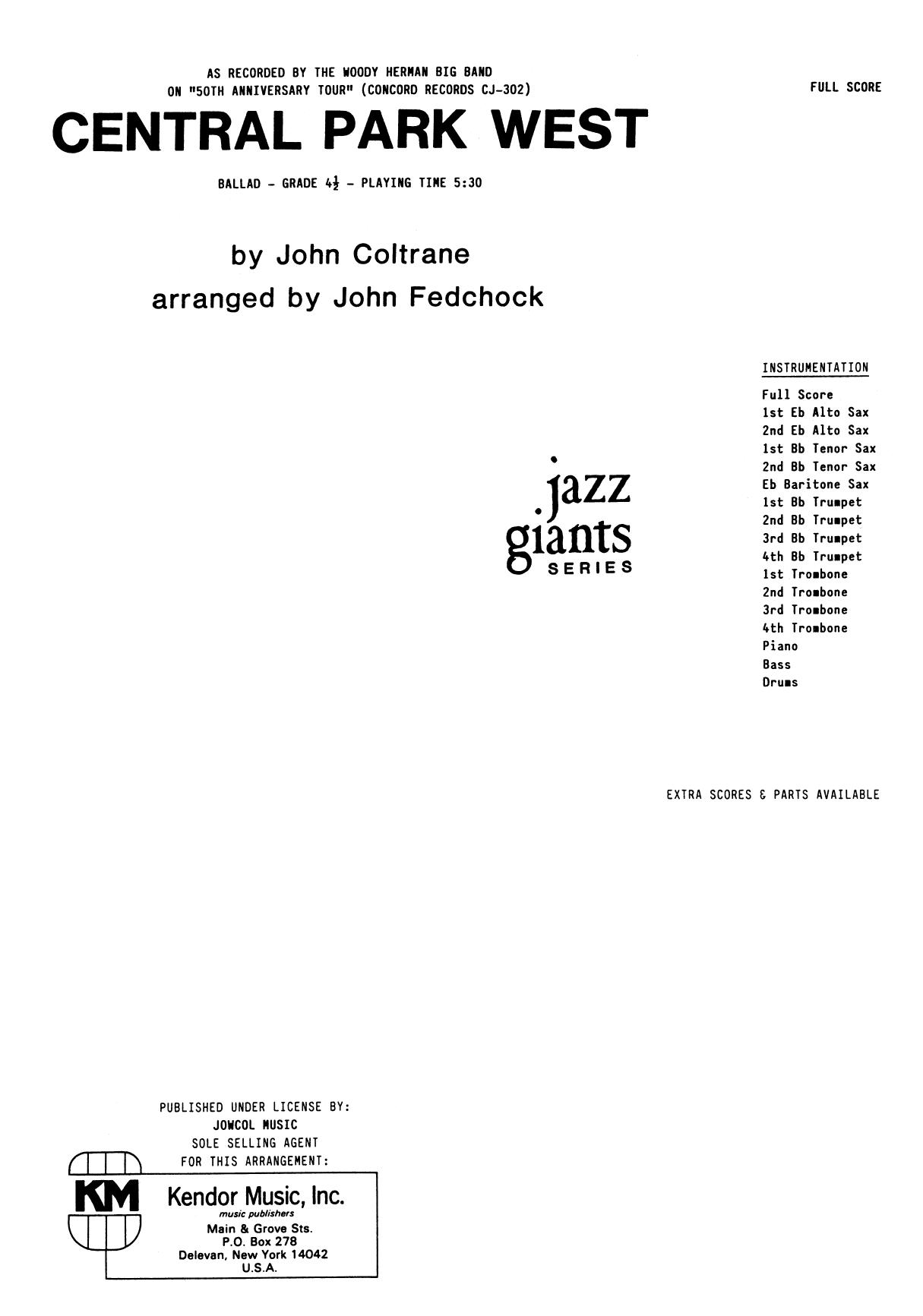
Central Park West (J.Fedchock)
Composed by John Coltrane
Arranged by John Fedchock
- Ensemble: Big Band
- Pages: 25
- Instruments (16): 1st Eb Alto Sax, 2nd Eb Alto Sax, 1st Bb Tenor Sax, 2nd Bb Tenor Sax, Eb Baritone Sax, 1st Bb Trumpet, 2nd Bb Trumpet, 3rd Bb Trumpet, 4th Bb Trumpet, 1st Trombone, 2nd Trombone, 3rd Trombone, 4th Trombone, Piano, Bass, Drums
- Difficulty: medium
- Content: Individual Parts
- Format: PDF Download (Instant)
- Price: $24.99
John Coltrane’s captivating modal composition "Central Park West," originally introduced to the jazz canon on his landmark 1960 Atlantic album *Coltrane's Sound*, stands as a masterclass in sophisticated harmonic movement and lyrical economy. Unlike the dense, rapid-fire chord changes of Coltrane's earlier bebop excursions, this contemplative masterpiece utilizes cyclical, shifting major tonalities and a serene, floating 4/4 meter that evokes the tranquil, introspective atmosphere of its namesake urban sanctuary. The piece has evolved into a revered modern jazz standard, cherished by improvisers for its deceptively simple melody that masks a deeply challenging harmonic architecture. Acclaimed trombonist, arranger, and bandleader John Fedchock transforms Coltrane’s intimate quartet conception into a lush, expansive canvas for modern big band. Executed with a graceful medium-tempo ballad or floating rubato-leaning swing feel, Fedchock’s chart explores rich, extended chord voicings that maximize the expressive potential of a standard 16-piece jazz orchestra. The arrangement trades the original's starkness for a warm, shimmering harmonic palette, utilizing contemporary woodwind-doubling textures and dense, chromatic horn voicings to create an overarching mood of urban reflection, bittersweet nostalgia, and restrained emotional intensity. Fedchock’s signature arranging style shines through brilliant sectional writing, masterfully balancing thick, chordal block-harmonization with transparent counterpoint. The melody is introduced with exquisite delicacy, frequently carried by the saxophones or a featured soloist before expanding into soaring, full-ensemble textures. Rather than forcing a high-octane shout chorus, Fedchock maintains the introspective gravity of Coltrane's original vision, utilizing subtle dynamic swells, expressive harmonic modulations, and a spacious improvised solo section that allows featured performers to explore the shifting modal centers. The chart demands exceptional breath control, pristine intonation on tight voicings, and an advanced understanding of modern harmonic phrasing. Advanced collegiate ensembles, professional repertory orchestras, and top-tier community big bands will find this sophisticated chart an extraordinary centerpiece for a concert program. Because the arrangement relies heavily on subtle rubato pacing, dynamic shading, and mature stylistic sensitivity rather than sheer velocity, it offers a premier vehicle for developing an ensemble’s collective listening skills, blend, and tonal beauty. Performing this version of "Central Park West" rewards musicians with a profound sense of dynamic interplay and a deeper appreciation for translating small-group modal jazz into a rich orchestral vocabulary. Navigating John Fedchock’s arrangement of "Central Park West" requires a high degree of listening integration and stylistic restraint from the entire ensemble. The conductor must establish a fluid, breathing tempo that feels unhurried yet forward-moving, avoiding a rigid mechanical beat in favor of a flexible, modern ballad pulse. A primary technical challenge lies in the complex, extended chord voicings; sections must practice tuning internal chord tones meticulously, especially when the harmonies shift rapidly through remote key centers. Brass players should focus on producing a warm, velvety tone without edge, while saxophones must blend seamlessly during unison and harmonized soli passages. Dynamic control is paramount—sub-tone playing in the low woodwinds and soft, pillowy brass pads form the foundation of the arrangement's sonic landscape. Rehearsals should begin by isolating the rhythm section to lock in the subtle, undulating harmonic groove before layering in the horns, ensuring that the soloist has a transparent, supportive cushion to navigate the sophisticated harmonic terrain. Q: What instruments and parts are included in this big band arrangement? A: The arrangement is scored for a standard 16-piece jazz orchestra, including 2 alto saxophones, 2 tenor saxophones, 1 baritone saxophone, 4 trumpets, 4 trombones, and a standard rhythm section of piano, bass, and drums, accompanied by a comprehensive conductor score across 25 pages. Q: What is the difficulty level of this chart? A: This arrangement is designated as advanced, making it best suited for collegiate, professional, and top-tier high school or community big bands that possess strong reading skills and mature ensemble intonation. Q: What is the style and historical context of this music? A: Based on John Coltrane’s 1960 modal composition from *Coltrane's Sound*, this chart translates a classic small-group jazz standard into a modern, sophisticated big band idiom characterized by lush harmonies and a reflective atmosphere. Q: What makes John Fedchock’s treatment of "Central Park West" unique? A: Fedchock avoids a traditional aggressive big band approach, instead preserving the intimate, introspective beauty of Coltrane's original melody while expanding it through contemporary extended voicings, subtle dynamic shading, and exquisite harmonic counterpoint. Q: What is the performance duration and tempo feel of the piece? A: The arrangement is set at a contemplative medium tempo with a floating, flexible swing and ballad feel, typically lasting between 5 to 7 minutes depending on the length of the improvised solos.
Questions and answers
- What is included in the Central Park West (J.Fedchock) PDF?
- The verified current file contains a conductor score and individual parts across 25 pages.
- How many instruments or parts are listed for Central Park West (J.Fedchock)?
- The verified instrumentation list contains 16 entries for this Big Band arrangement.
- Who is credited for Central Park West (J.Fedchock)?
- Composer: John Coltrane. Arranger: John Fedchock.
- What difficulty is listed for Central Park West (J.Fedchock)?
- The verified difficulty level is medium.
- Can I preview Central Park West (J.Fedchock) before buying?
- Yes. The product page provides a preview generated from the current PDF file.
- How is Central Park West (J.Fedchock) delivered?
- After successful payment, the digital PDF is made available for download. The displayed price is $24.99.
Musicians Also Search For
Central Park West John Fedchock PDF • Central Park West John Fedchock sheet music • Central Park West arranged by John Fedchock • John Fedchock big band charts • John Fedchock jazz arrangements PDF • Central Park West John Coltrane sheet music • Central Park West John Coltrane big band arrangements • John Coltrane big band charts • Central Park West big band arrangements • Central Park West big band PDF download • Central Park West jazz sheet music • big band sheet music download • Central Park West conductor score PDF • Central Park West individual parts download • Central Park West sheet music PDF • buy Central Park West sheet music • download Central Park West PDF • Central Park West jazz charts • best John Fedchock big band arrangements • John Coltrane arranged by John Fedchock • Central Park West printable sheet music • big band repertoire PDF