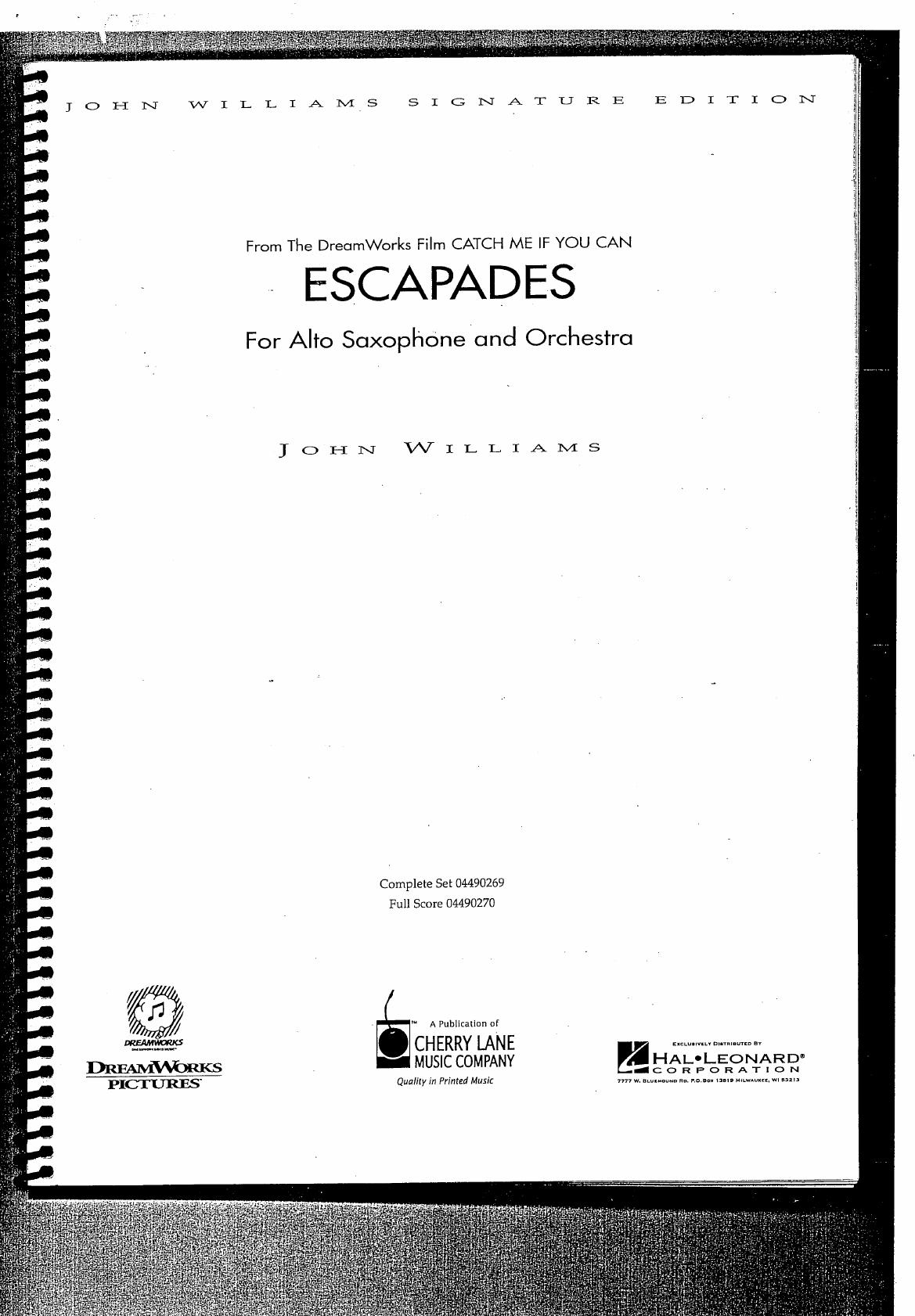
Catch Me If You Can (J.Williams) sheet music preview

Catch Me If You Can (J.Williams)

Composed by John Williams

Arranged by John Williams

  • Ensemble: Concert Band
  • Style: Film Music
  • Pages: 59
  • Instruments (35): Flute 1, Flute 2, Flute 3 (Piccolo), Oboe 1, Oboe 2 (English Horn), Bb Clarinet 1, Bb Clarinet 2, Bb Bass Clarinet, Eb Alto Saxophone (Soloist), Bb Tenor Saxophone (Optional), Bassoon 1, Bassoon 2 (Contra Bassoon), F Horn 1, F Horn 2, F Horn 3, F Horn 4, Bb Trumpet 1, Bb Trumpet 2, Bb Trumpet 3, Trombone 1, Trombone 2, Bass Trombone, Tuba, Timpani, Percussion 1 (Vibraphone, Glockenspiel), Percussion 2 (Marimba, Chimes), Percussion 3 (Xylophone, Suspended Cymbal, Bass Drum, Bell Tree, Sleigh Bells, Triangle, Chimes, Tambourine), Harp, Piano, Celeste, Violin 1, Violin 2, Viola, Violoncello, Contrabass
  • Difficulty: advanced
  • Content: Individual Parts
  • Format: PDF Download (Instant)
  • Price: $22.99

The iconic main theme from the 2002 film *Catch Me If You Can*, originally composed by John Williams, emerges as a captivating concert band arrangement, showcasing Williams's lesser-known but equally brilliant jazz sensibilities. The original score was a significant departure for Williams, who is primarily celebrated for his grand orchestral film scores. Released in 2002, the film, directed by Steven Spielberg, is set in the 1960s and chronicles the true story of con artist Frank Abagnale Jr. Williams consciously crafted a score that evoked the "progressive jazz" idiom prevalent in that era, a style he was intimately familiar with from his early career as a studio pianist and arranger in Hollywood. This piece represents a fascinating facet of Williams's prolific output, demonstrating his versatility and deep roots in jazz. Musically, this arrangement captures the cool, sophisticated, and often whimsical character of the original film score. It embodies a medium swing feel, often propelled by a walking bass line and understated drum work, creating a sense of effortless motion and suave intrigue. The primary melodic material is often carried by the alto saxophone, reflecting the film's prominent use of the instrument to define its jazzy atmosphere. The mood oscillates between playful and slightly melancholic, mirroring the complex narrative of Abagnale's escapades and the underlying emotional currents. Williams's signature use of chromaticism, often employed to evoke suspense or a sense of unease in his more dramatic scores, here lends a subtle tension and sophistication to the jazz harmonies. The arrangement is typically set in a comfortable key, allowing for expressive phrasing and nuanced dynamics. John Williams's approach to arranging this piece for concert band is marked by his characteristic meticulous orchestration and keen understanding of instrumental color. While the original score utilized a unique jazz orchestral ensemble featuring prominent saxophones, vibraphone, and electric piano, this concert band rendition thoughtfully translates those textures. Expect rich woodwind voicings, particularly in the saxophone section, which often takes on the role of a jazz combo within the larger ensemble. Soli sections for the saxophones and brass are likely to feature Williams's distinctive harmonic language, blending jazz inflections with symphonic depth. The arrangement may include moments of intricate counterpoint, a hallmark of Williams's style, ensuring that each section contributes meaningfully to the overall tapestry. Featured solos, particularly for alto saxophone, are integral, providing opportunities for expressive improvisation or interpretation of written lines that capture the cool, understated virtuosity of the original. Performing "Catch Me If You Can" is a rewarding experience that offers both technical and interpretive challenges. The primary melody is often presented by the alto saxophone, requiring a soloist with a strong command of jazz phrasing and tone. Other woodwind sections, particularly clarinets and flutes, will have intricate, bubbling passages that demand precision and blend. The brass sections contribute with sustained harmonies and occasional punchy interjections, requiring excellent control and articulation. The rhythm section, while not explicitly a jazz big band setup in a concert band, must maintain a consistent and authentic swing feel, often with subtle rhythmic figures that add to the piece's character. The overall ensemble must achieve a balance that allows the jazz elements to shine while maintaining the richness of the concert band sound. This arrangement is well-suited for college and advanced high school concert bands, as well as community ensembles seeking to explore a sophisticated and engaging piece of film music with a jazz flair. Its blend of technical demands and expressive opportunities makes it a standout choice for concert programming. Conductors should emphasize a relaxed, yet precise, medium swing feel throughout the piece, avoiding a rigid interpretation of the rhythm. The tempo should allow for the subtle nuances of the melodic lines to emerge, particularly in the alto saxophone solo sections. Technical challenges include maintaining consistent articulation in the woodwind runs and ensuring clean brass attacks and releases. Rehearsal should focus on balancing the ensemble, allowing the featured saxophone lines to project without overpowering the underlying harmonies. Encourage musicians to listen across sections to achieve Williams's characteristic blend of orchestral color and jazz inflection. Special attention should be paid to dynamic contrasts, which are crucial for conveying the piece's shifting moods. Any written solo passages for alto saxophone should be approached with a lyrical, improvisatory feel, even if played as written. Percussionists should aim for a light, driving swing pattern, utilizing brushes or appropriate stick work to support the overall jazz aesthetic. Q: What instruments are included in this arrangement? A: This concert band arrangement includes a full conductor score and standard concert band instrumentation, typically encompassing flutes, oboes, bassoons, clarinets, saxophones (alto, tenor, baritone), trumpets, horns, trombones, euphonium, tuba, string bass, and a comprehensive percussion section. Q: What is the difficulty level of this arrangement? A: This arrangement is suitable for college and advanced high school concert bands, as well as skilled community ensembles. It presents moderate to advanced technical demands, particularly for featured soloists and woodwind sections. Q: What musical style and historical context does this arrangement represent? A: This arrangement is in the film music style, specifically reflecting the "progressive jazz" idiom of the 1960s, as originally composed by John Williams for the 2002 film *Catch Me If You Can*. Q: What makes this specific arrangement unique compared to other John Williams pieces? A: Unlike many of Williams's more symphonic works, this arrangement prominently features his jazz roots, offering a sophisticated blend of big band jazz elements with concert band orchestration, including significant alto saxophone features and a distinct medium swing feel. Q: What is the approximate performance duration of this piece? A: While specific timings can vary with interpretation, the original film theme and common concert band arrangements typically have a performance duration of approximately 3 to 4 minutes.

Questions and answers

What is included in the Catch Me If You Can (J.Williams) PDF?
The verified current file contains a conductor score across 59 pages.
How many instruments or parts are listed for Catch Me If You Can (J.Williams)?
The verified instrumentation list contains 35 entries for this Concert Band arrangement.
Who is credited for Catch Me If You Can (J.Williams)?
Composer: John Williams. Arranger: John Williams.
What difficulty is listed for Catch Me If You Can (J.Williams)?
The verified difficulty level is advanced.
What style is listed for Catch Me If You Can (J.Williams)?
The catalog lists the style as Film Music.
Can I preview Catch Me If You Can (J.Williams) before buying?
Yes. The product page provides a preview generated from the current PDF file.
How is Catch Me If You Can (J.Williams) delivered?
After successful payment, the digital PDF is made available for download. The displayed price is $22.99.

Musicians Also Search For

Catch Me If You Can John Williams PDFCatch Me If You Can John Williams sheet musicCatch Me If You Can arranged by John WilliamsJohn Williams concert band chartsJohn Williams jazz arrangements PDFCatch Me If You Can John Williams concert band arrangementsCatch Me If You Can concert band arrangementsCatch Me If You Can concert band PDF downloadCatch Me If You Can jazz sheet musicconcert band sheet music downloadCatch Me If You Can conductor score PDFCatch Me If You Can sheet music PDFCatch Me If You Can Film Music chartsFilm Music concert band arrangementsbuy Catch Me If You Can sheet musicdownload Catch Me If You Can PDFCatch Me If You Can jazz chartsbest John Williams concert band arrangementsCatch Me If You Can printable sheet musicconcert band repertoire PDF

All arrangements by John Williams All John Williams sheet music