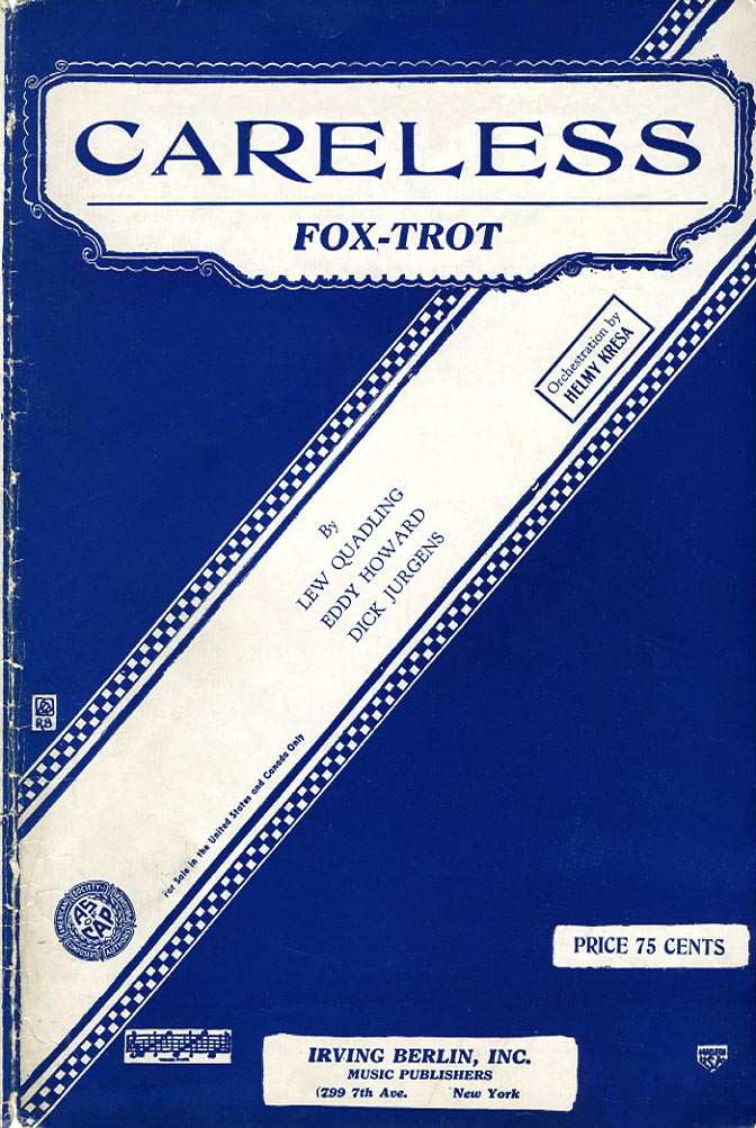
Careless (H.Kresa)
Composed by Jerry Livingston, Charles Tobias, Dick Jurgens
Arranged by H.Kresa
- Ensemble: Big Band Vocal
- Style: Jazz Standard
- Pages: 29
- Instruments (14): 1st Sax. Eb Alto, 2nd Sax. Bb Tenor, 3rd Sax. Eb Alto, 4th Sax. Bb Tenor, 1st Trombone, 2nd Trombone, 1st Trumpet in Bb, 2nd Trumpet in Bb, 3rd Trumpet in Bb, Piano, Guitar, Bass, Drums, Vocal Trio
- Difficulty: medium
- Content: Individual Parts
- Format: PDF Download (Instant)
- Price: $24.99
The jazz standard "Careless" emerged from the vibrant swing era, first gaining prominence in 1940 with recordings by artists such as Dick Jurgens and his Orchestra, and later by Glenn Miller. Composed by Jerry Livingston, Charles Tobias, and Dick Jurgens, the tune quickly resonated with audiences for its accessible melody and sentimental lyrics, embodying the romanticism and melodic charm characteristic of the pre-war big band sound. It became a staple of dance halls and radio broadcasts, cementing its place in the American Songbook as a beloved standard, often interpreted by vocalists for its expressive lyrical content. The original recordings typically featured a medium-slow foxtrot tempo, allowing for clear vocal delivery and lush orchestral accompaniment, setting a mood of tender reflection or wistful longing. H.Kresa's arrangement of "Careless" for big band with a vocal soloist masterfully captures this classic sentiment while infusing it with sophisticated harmonic and orchestrational nuances. The arrangement is set in a comfortable medium swing tempo, typically around 100-110 BPM, providing a relaxed yet propulsive rhythmic foundation. Kresa's signature approach often involves rich, close-voiced harmonies in the brass and sax sections, creating a warm, enveloping sound that supports the vocalist without overpowering. Expect elegant counter-melodies and carefully crafted voicings that highlight the melodic beauty of the original tune, often incorporating extended harmonies (9ths, 11ths, 13ths) that add a contemporary sheen while respecting the traditional aesthetic. The overall mood is one of sophisticated romance, evoking a sense of nostalgic elegance. The arrangement features the vocalist prominently, carrying the melody through the initial A sections, often with subtle, supportive ensemble figures. Kresa introduces a beautifully voiced saxophone soli section, showcasing the ensemble's blend and precision, which serves as a compelling instrumental interlude or counterpoint to the vocal. While primarily a feature for the vocalist, there are opportunities for optional improvised solos, typically over the bridge or a designated chorus, allowing a tenor saxophone or trumpet to shine. The technical challenges lie in achieving a cohesive ensemble sound, particularly in the brass articulations and the balance within the saxophone soli. The rewarding aspect is the opportunity to perform a timeless standard with an arrangement that is both historically informed and musically engaging, allowing the band to explore dynamic contrasts and expressive phrasing. This arrangement is ideally suited for college-level jazz ensembles, advanced community big bands, and professional groups seeking a polished, vocal-centric chart. Its demands on ensemble precision and musicality, particularly in dynamics and phrasing, make it an excellent vehicle for developing sophisticated performance skills. High school bands with strong lead players and a capable vocalist could also tackle this piece with dedicated rehearsal, as the challenges are primarily musical interpretation rather than extreme technical demands. The 29-page score and parts reflect a comprehensive and thoughtfully orchestrated work that will elevate any concert program or dance engagement. Conductors should aim for a relaxed, medium swing feel, establishing a consistent quarter-note pulse around 100-110 BPM from the outset. Emphasize smooth, connected phrasing in the saxophone section, particularly during the soli, ensuring a warm, blended sound rather than overly aggressive articulation. Brass players should focus on precise attacks and releases, using plunger mutes where indicated for expressive color, and employing controlled falls and doits for stylistic authenticity without becoming raucous. Balance is crucial: ensure the ensemble supports the vocalist without obscuring the melodic line, especially during the initial statements. Rehearsal time should be dedicated to shaping dynamic contours, particularly crescendo and decrescendo passages, and ensuring that all ensemble figures breathe with the vocalist's phrasing. Pay close attention to the harmonic voicings in the brass and saxes, ensuring all voices are present and balanced to achieve Kresa's intended rich sonority. Q: What instruments and parts are included in this arrangement? A: This big band vocal arrangement includes parts for a lead vocalist, 5 saxophones (AATTB), 4 trumpets, 4 trombones, piano, bass, and drums, along with a full conductor's score. Q: What is the difficulty level of H.Kresa's "Careless" arrangement? A: This arrangement is considered medium-advanced, suitable for college-level jazz ensembles, advanced community big bands, and professional groups. It requires good ensemble blend, precise articulation, and musical maturity. Q: What is the musical style and historical context of "Careless"? A: "Careless" is a classic jazz standard from the swing era (1940), known for its romantic melody and sentimental lyrics. H.Kresa's arrangement respectfully updates this style with sophisticated big band voicings. Q: What makes H.Kresa's arrangement of "Careless" unique? A: H.Kresa's treatment is distinctive for its rich, close-voiced harmonies, elegant saxophone soli sections, and sophisticated orchestration that beautifully supports the vocalist while adding modern harmonic color to a timeless standard. Q: What is the typical performance duration and recommended tempo for this piece? A: The typical performance duration for this arrangement is approximately 3-4 minutes, depending on optional solos and repeats. It is designed to be played at a comfortable medium swing tempo, around 100-110 BPM.
Questions and answers
- What is included in the Careless (H.Kresa) PDF?
- The verified current file contains individual parts across 29 pages.
- How many instruments or parts are listed for Careless (H.Kresa)?
- The verified instrumentation list contains 14 entries for this Big Band Vocal arrangement.
- Who is credited for Careless (H.Kresa)?
- Composer: Jerry Livingston, Charles Tobias, Dick Jurgens. Arranger: H.Kresa.
- What difficulty is listed for Careless (H.Kresa)?
- The verified difficulty level is medium.
- What style is listed for Careless (H.Kresa)?
- The catalog lists the style as Jazz Standard.
- Can I preview Careless (H.Kresa) before buying?
- Yes. The product page provides a preview generated from the current PDF file.
- How is Careless (H.Kresa) delivered?
- After successful payment, the digital PDF is made available for download. The displayed price is $24.99.
Musicians Also Search For
Careless H.Kresa PDF • Careless H.Kresa sheet music • Careless arranged by H.Kresa • H.Kresa big band vocal charts • H.Kresa jazz arrangements PDF • Careless Jerry Livingston, Charles Tobias, Dick Jurgens sheet music • Careless Jerry Livingston, Charles Tobias, Dick Jurgens big band vocal arrangements • Jerry Livingston, Charles Tobias, Dick Jurgens big band vocal charts • Careless big band vocal arrangements • Careless big band vocal PDF download • Careless jazz sheet music • big band vocal sheet music download • Careless individual parts download • Careless sheet music PDF • Careless Jazz Standard charts • Jazz Standard big band vocal arrangements • buy Careless sheet music • download Careless PDF • Careless jazz charts • best H.Kresa big band vocal arrangements • Jerry Livingston, Charles Tobias, Dick Jurgens arranged by H.Kresa • Careless printable sheet music • big band vocal repertoire PDF