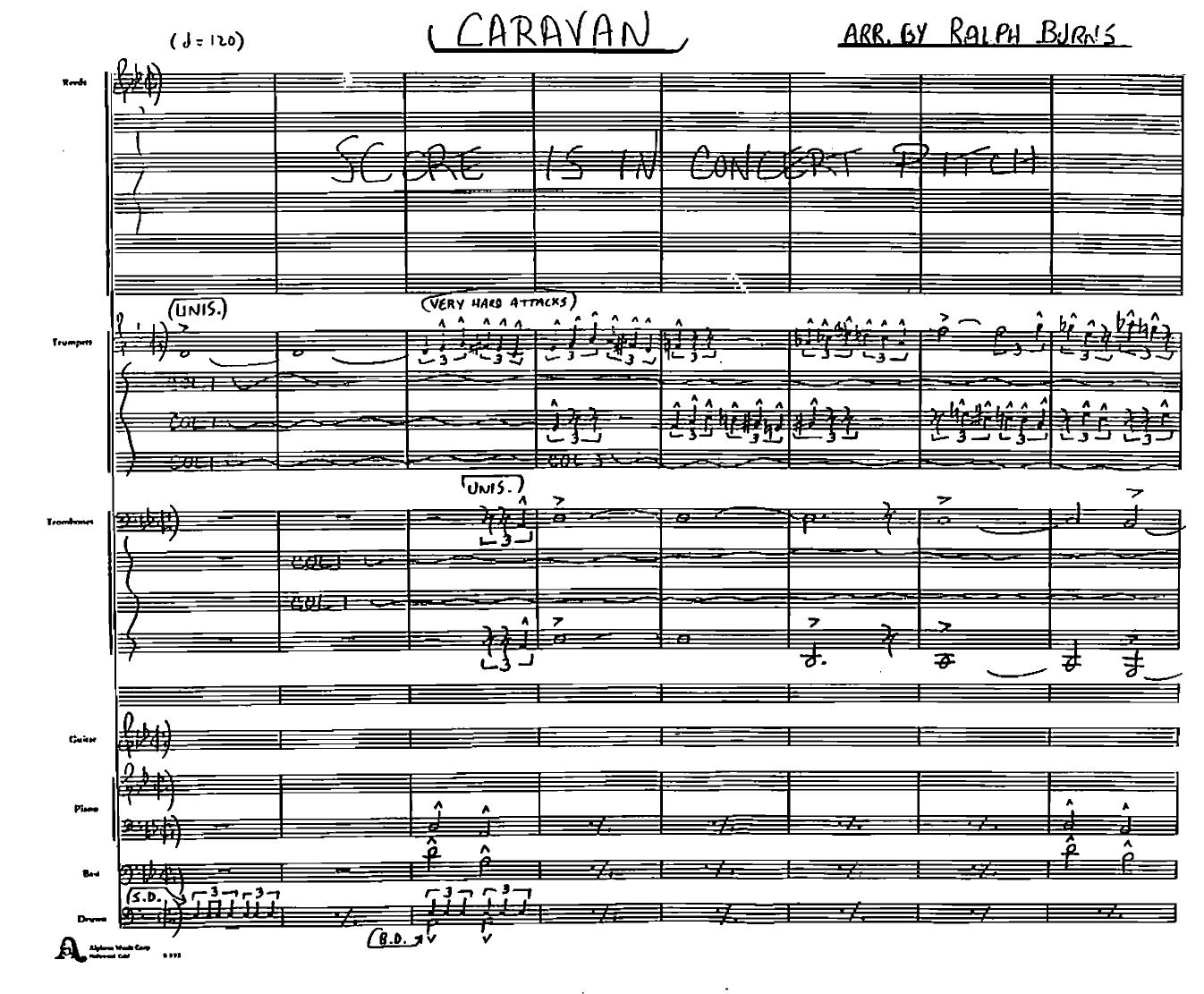
Caravan (R.Burns)
Composed by Juan Tizol, Duke Ellington
Arranged by Bob Brookmeyer
- Ensemble: Big Band
- Style: Jazz Standard
- Pages: 74
- Instruments (17): 1st Woodwind (Piccolo, Flute, Alto Saxophone), 2nd Woodwind (Clarinet, Alto Saxophone, Flute), 3rd Woodwind (Flute, Piccolo, Tenor Saxophone), 4th Woodwind (Clarinet, Tenor Saxophone), 5th Woodwind (Clarinet, Baritone Saxophone), 1st Trumpet, 2nd Trumpet, 3rd Trumpet, 4th Trumpet, 1st Trombone, 2nd Trombone, 3rd Trombone, 4th Trombone, Guitar, Piano, String Bass, Drums
- Difficulty: easy
- Content: Individual Parts
- Format: PDF Download (Instant)
- Price: $24.99
"Caravan," originally composed by Juan Tizol and Duke Ellington, first emerged in 1936, solidifying its place as a cornerstone of the jazz standard repertoire. This iconic piece represents a fascinating fusion of Middle Eastern and African musical elements with Western jazz, showcasing the global influences that shaped the genre during the swing era. Its distinctive "exotic" flavor, often characterized by a mysterious atmosphere and a strong rhythmic identity, quickly captured the imagination of audiences and musicians alike. While lyrics were later added by Irving Mills, "Caravan" is overwhelmingly known and performed as an instrumental, its allure stemming from its unique melodic and harmonic landscape. The original recording by Barney Bigard and His Jazzopaters in 1936, featuring Ellington himself, was a hit, followed shortly by Ellington's own orchestra recording, cementing its status. Bob Brookmeyer's arrangement of "Caravan" (R.Burns) transforms this classic into a sophisticated big band vehicle, maintaining the original's exotic essence while infusing it with his signature harmonic and orchestrational brilliance. Brookmeyer, known for his inventive and challenging writing for large jazz ensembles, approaches this standard not merely as a reinterpretation but as a profound exploration of its inherent musicality. His arrangements frequently feature structured drama, linear tension, and potent swing, often incorporating contemporary classical writing techniques such as chromatic harmony, tone clusters, and even elements of atonality and polytonality. This particular arrangement is likely to showcase Brookmeyer's masterful voicings, which create rich, dense textures, and his characteristic use of counterpoint, even in a piece rooted in a more traditional style. The arrangement is designed for a large jazz ensemble of 18 instruments, suggesting a comprehensive and intricate scoring. Expect a medium-fast Latin groove, likely in F minor, the original key, which then transitions to more swinging sections, creating dynamic contrast. The melody, with its distinctive minor tonality and embellished sustained notes, will likely be passed between various sections, ensuring engaging soli passages and powerful shout choruses that build intensity. Featured solos, typical of Brookmeyer's arrangements, will provide opportunities for improvisation within a meticulously crafted harmonic framework. Technical challenges will include intricate rhythmic figures, demanding ensemble precision, and nuanced dynamic control to fully realize Brookmeyer's vision. The reward lies in performing a truly artistic and intellectually stimulating arrangement that pushes the boundaries of big band jazz. This arrangement is ideally suited for advanced high school, college, community, and professional jazz ensembles. Its complexity and depth require musicians with strong technical proficiency, advanced sight-reading skills, and a mature understanding of jazz idiom and ensemble playing. The detailed scoring and sophisticated harmonic language offer an invaluable educational experience, allowing musicians to delve into the mind of one of jazz's most respected arrangers. Bands seeking a challenging yet immensely rewarding piece that stands apart from typical big band fare will find this arrangement of "Caravan" to be an exceptional addition to their repertoire. This arrangement of "Caravan" demands meticulous attention to rhythmic precision and dynamic contrast. The opening Latin groove requires a tight, unified rhythmic section, emphasizing the clave feel without being rigid. Conductors should ensure a clear distinction between the Latin and any subsequent swing sections, guiding the ensemble through seamless transitions. Pay close attention to Brookmeyer's characteristic voicings, particularly in the brass and saxophone soli passages, ensuring balance and blend to achieve the intended harmonic richness. Articulation must be precise, especially in the more intricate melodic lines and syncopated figures. Soloists should be encouraged to maintain the exotic mood of the piece while navigating the advanced harmonic structures. Rehearsal time should be dedicated to isolating challenging rhythmic figures, ensuring accurate intonation in dense chords, and practicing dynamic swells and diminuendos that are crucial to Brookmeyer's expressive intent. Q: What instruments are included in this arrangement? A: This arrangement is scored for 18 instruments, specifically Piccolo, Clarinet, Flute, Trumpet 1, Trumpet 2, and other standard big band instrumentation, totaling 74 pages including the conductor score. Q: What is the difficulty level of this arrangement? A: This arrangement is considered advanced, suitable for college, community, and professional jazz ensembles due to its complex harmonies, intricate rhythms, and demanding ensemble precision. Q: What is the musical style and historical context of "Caravan"? A: "Caravan" is a jazz standard composed by Juan Tizol and Duke Ellington in 1936, known for its exotic, Middle Eastern-influenced sound and Latin rhythmic elements, representing the global influences in early jazz. Q: What makes Bob Brookmeyer's arrangement of "Caravan" unique? A: Brookmeyer's arrangement is unique for its sophisticated harmonic voicings, intricate counterpoint, and dynamic orchestrations, transforming the classic standard into a challenging and artistically profound big band work, characteristic of his innovative compositional style. Q: What is the typical performance duration or tempo of this arrangement? A: While specific duration can vary, the arrangement likely features a medium-fast tempo, often starting with a Latin groove in F minor, transitioning to swinging sections, reflecting the original's energetic character.
Questions and answers
- What is included in the Caravan (R.Burns) PDF?
- The verified current file contains a conductor score and individual parts across 74 pages.
- How many instruments or parts are listed for Caravan (R.Burns)?
- The verified instrumentation list contains 17 entries for this Big Band arrangement.
- Who is credited for Caravan (R.Burns)?
- Composer: Juan Tizol, Duke Ellington. Arranger: Bob Brookmeyer.
- What difficulty is listed for Caravan (R.Burns)?
- The verified difficulty level is easy.
- What style is listed for Caravan (R.Burns)?
- The catalog lists the style as Jazz Standard.
- Can I preview Caravan (R.Burns) before buying?
- Yes. The product page provides a preview generated from the current PDF file.
- How is Caravan (R.Burns) delivered?
- After successful payment, the digital PDF is made available for download. The displayed price is $24.99.
Musicians Also Search For
Caravan Bob Brookmeyer PDF • Caravan Bob Brookmeyer sheet music • Caravan arranged by Bob Brookmeyer • Bob Brookmeyer big band charts • Bob Brookmeyer jazz arrangements PDF • Caravan Juan Tizol, Duke Ellington sheet music • Caravan Juan Tizol, Duke Ellington big band arrangements • Juan Tizol, Duke Ellington big band charts • Caravan big band arrangements • Caravan big band PDF download • Caravan jazz sheet music • big band sheet music download • Caravan conductor score PDF • Caravan individual parts download • Caravan sheet music PDF • Caravan Jazz Standard charts • Jazz Standard big band arrangements • buy Caravan sheet music • download Caravan PDF • Caravan jazz charts • best Bob Brookmeyer big band arrangements • Juan Tizol, Duke Ellington arranged by Bob Brookmeyer • Caravan printable sheet music • big band repertoire PDF