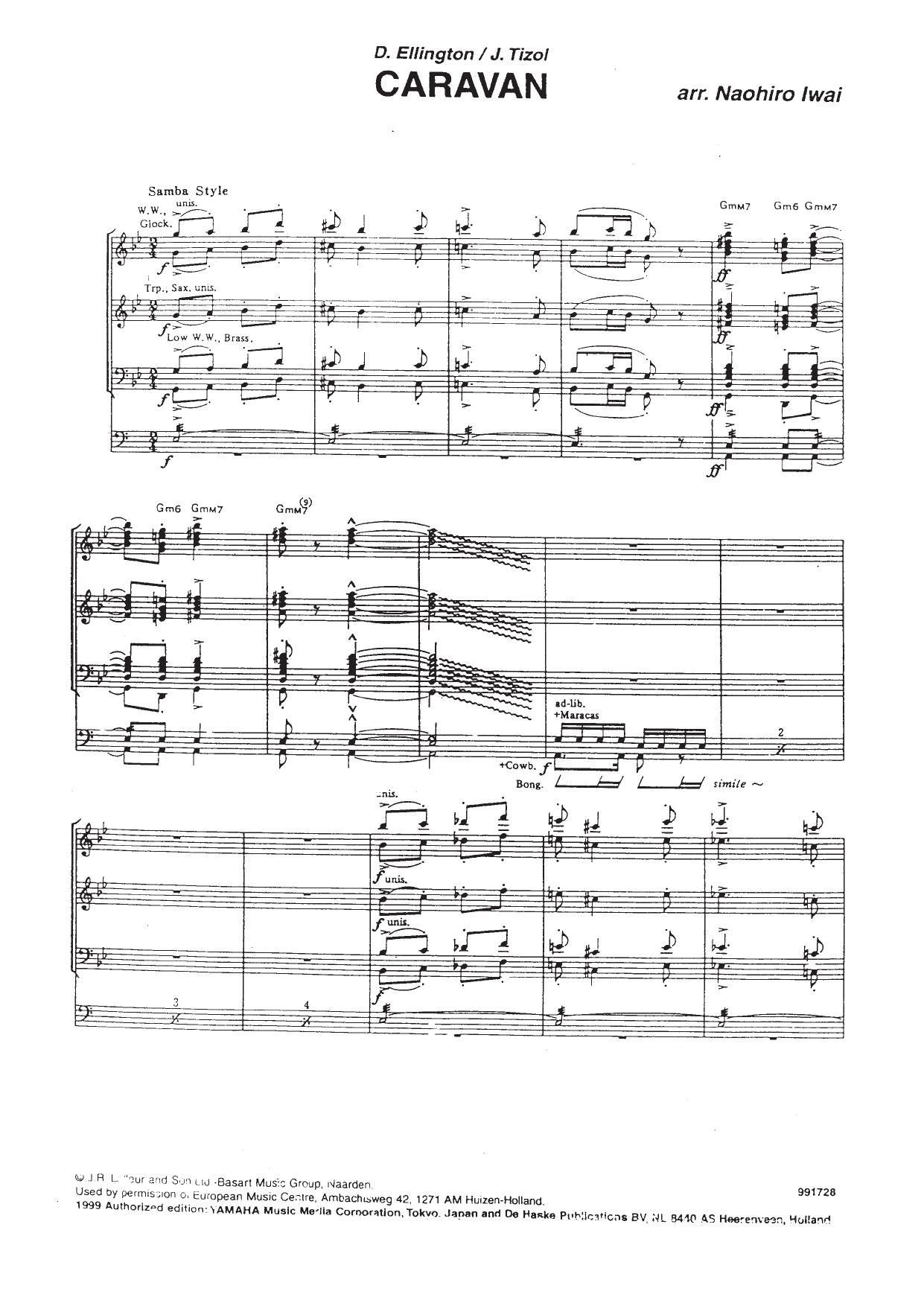
Caravan (N.Iwai)
Composed by Juan Tizol
Arranged by N.Iwai
- Ensemble: Concert Band
- Style: Jazz Standard
- Pages: 56
- Instruments (23): Piccolo, 1st and 2nd Flute, 1st Clarinet in Bb, 2nd Clarinet in Bb, 3rd Clarinet in Bb, 1st Alto Saxophone in Eb, 2nd Alto Saxophone in Eb, 1st Tenor Saxophone in Bb, 2nd Tenor Saxophone in Bb, Baritone Saxophone in Eb, 1st & 2nd Horn in F, 3rd & 4th Horn in F, 1st Trumpet in Bb, 2nd Trumpet in Bb, 3rd Trumpet in Bb, 4th Trumpet in Bb, Bb Euphonium, 1st Trombone, 2nd Trombone, 3rd Trombone, 4th Trombone, Bass in C, Drums
- Difficulty: advanced
- Content: Individual Parts
- Format: PDF Download (Instant)
- Price: $22.99
Co-written by Juan Tizol and Duke Ellington in 1936, "Caravan" stands as one of the most enduring masterworks of the jazz canon, uniquely bridging the gap between early swing, exoticism, and Latin-infused jazz symmetry. Originally popularized by the Duke Ellington Orchestra, its unmistakable chromatic motif and hypnotic groove evoke a cinematic desert journey that has captivated audiences for nearly a century. This timeless standard derives its magnetism from its unusual modal flavoring and infectious rhythmic drive, making it a staple vehicle for exploration across generations of jazz artists, from dizzying bebop interpretations to modern big band and concert band adaptations. Naohiro Iwai’s masterful concert band setting infuses this exotic classic with vibrant orchestral color, high-octane energy, and lush harmonic scoring. Operating at a brisk, driving tempo, the arrangement opens with the signature ominous bassline and percussion-heavy atmosphere before exploding into a dynamic 4/4 swing and Latin-infused hybrid groove. Iwai utilizes the full palette of the modern wind ensemble, contrasting shimmering woodwind flourishes with powerful, punchy brass statements. The mood shifts seamlessly from mysterious and suspenseful to euphoric and celebratory, propelled by syncopated ostinatos and intricate countermelodies that keep both performers and listeners completely engaged. Rather than relying on a straightforward transcription, Iwai approaches the score with a symphonic jazz sensibility, redistributing thematic material across unexpected instrument families to highlight instrumental color. Woodwinds frequently handle rapid, cascading scalar runs that mimic string glissandos, while the brass section delivers biting, syncopated accents reminiscent of a classic Ellingtonian shout chorus. Featured melodic passages travel fluidly between the clarinets, saxophones, and upper brasses, building an escalating momentum that leads to a thunderous, tutti climax. The clever integration of percussion—utilizing auxiliary Latin percussion alongside a traditional drum set setup—anchors the exotic rhythmic foundation essential to the piece's identity. Advanced high school, collegiate, and community concert bands will find this arrangement an exhilarating centerpiece for a pops or jazz-themed program. The technical demands center around rhythmic precision, clean articulation in fast tempos, and maintaining a buoyant, driving feel across changing textures. Performers will relish the sophisticated harmonic language and the sheer visceral excitement of the climactic sections. Comprehensive and meticulously edited across its 56-page conductor score and accompanying parts, Iwai’s interpretation offers a brilliant showcase for bands looking to stretch their stylistic boundaries and deliver a show-stopping performance. Navigating Naohiro Iwai’s setting of "Caravan" requires rigorous attention to rhythmic crispness and stylistic versatility, seamlessly shifting between sustained lyrical lines and sharp, percussive accents. * **Tempo and Feel:** Establish a rock-solid, driving tempo right from the outset. Avoid rushing the syncopated eighth-note figures; the illusion of forward momentum relies heavily on disciplined subdivision, particularly during the transition from the atmospheric intro into the main groove. * **Technical Challenges:** Woodwinds must execute rapid chromatic runs with absolute clarity, ensuring fingers stay close to the keys. Brass players should focus on controlled, punchy articulations without forcing the tone during loud ensemble peaks. * **Percussion Integration:** The rhythm section and auxiliary percussionists must lock in tightly, balancing the Latin groove elements with a traditional jazz swing feel. Clean dampening on suspended cymbals and precise timpani pitch shifts are crucial for maintaining the exotic atmosphere. * **Rehearsal Strategy:** Rehearse sections statically at a reduced tempo to clean up internal countermelodies before layering them into the full ensemble texture. Emphasize dynamic contrasts to let the underlying harmonic colors breathe beneath the primary melody. Q: What instruments and parts are included in this publication? A: This publication includes a comprehensive 56-page conductor score alongside a full complement of standard concert band parts, encompassing complete woodwind, brass, and percussion instrumentation optimized for modern wind ensembles. Q: What is the difficulty level of this arrangement? A: This piece is best suited for advanced high school, collegiate, and community concert bands capable of handling rapid technical passages, syncopated rhythms, and demanding dynamic contrasts. Q: What is the musical style and historical context of the piece? A: Originally composed by Juan Tizol and Duke Ellington in 1936, this arrangement reimagines the iconic jazz standard through a vibrant, symphonic-jazz concert band lens that bridges swing and exotic Latin grooves. Q: What makes Naohiro Iwai's arrangement unique compared to others? A: Iwai's treatment stands out for its brilliant orchestral color, innovative redistribution of thematic material across woodwind and brass families, and sophisticated integration of auxiliary Latin percussion within a symphonic wind band framework. Q: What is the approximate performance duration and tempo of the work? A: The piece is written at a brisk, driving tempo—typically around 160-176 BPM—and generally runs for approximately 4 to 5 minutes, making it an ideal high-energy opener or closer for a concert program.
Questions and answers
- What is included in the Caravan (N.Iwai) PDF?
- The verified current file contains a conductor score and individual parts across 56 pages.
- How many instruments or parts are listed for Caravan (N.Iwai)?
- The verified instrumentation list contains 23 entries for this Concert Band arrangement.
- Who is credited for Caravan (N.Iwai)?
- Composer: Juan Tizol. Arranger: N.Iwai.
- What difficulty is listed for Caravan (N.Iwai)?
- The verified difficulty level is advanced.
- What style is listed for Caravan (N.Iwai)?
- The catalog lists the style as Jazz Standard.
- Can I preview Caravan (N.Iwai) before buying?
- Yes. The product page provides a preview generated from the current PDF file.
- How is Caravan (N.Iwai) delivered?
- After successful payment, the digital PDF is made available for download. The displayed price is $22.99.
Musicians Also Search For
Caravan N.Iwai PDF • Caravan N.Iwai sheet music • Caravan arranged by N.Iwai • N.Iwai concert band charts • N.Iwai jazz arrangements PDF • Caravan Juan Tizol sheet music • Caravan Juan Tizol concert band arrangements • Juan Tizol concert band charts • Caravan concert band arrangements • Caravan concert band PDF download • Caravan jazz sheet music • concert band sheet music download • Caravan conductor score PDF • Caravan individual parts download • Caravan sheet music PDF • Caravan Jazz Standard charts • Jazz Standard concert band arrangements • buy Caravan sheet music • download Caravan PDF • Caravan jazz charts • best N.Iwai concert band arrangements • Juan Tizol arranged by N.Iwai • Caravan printable sheet music • concert band repertoire PDF