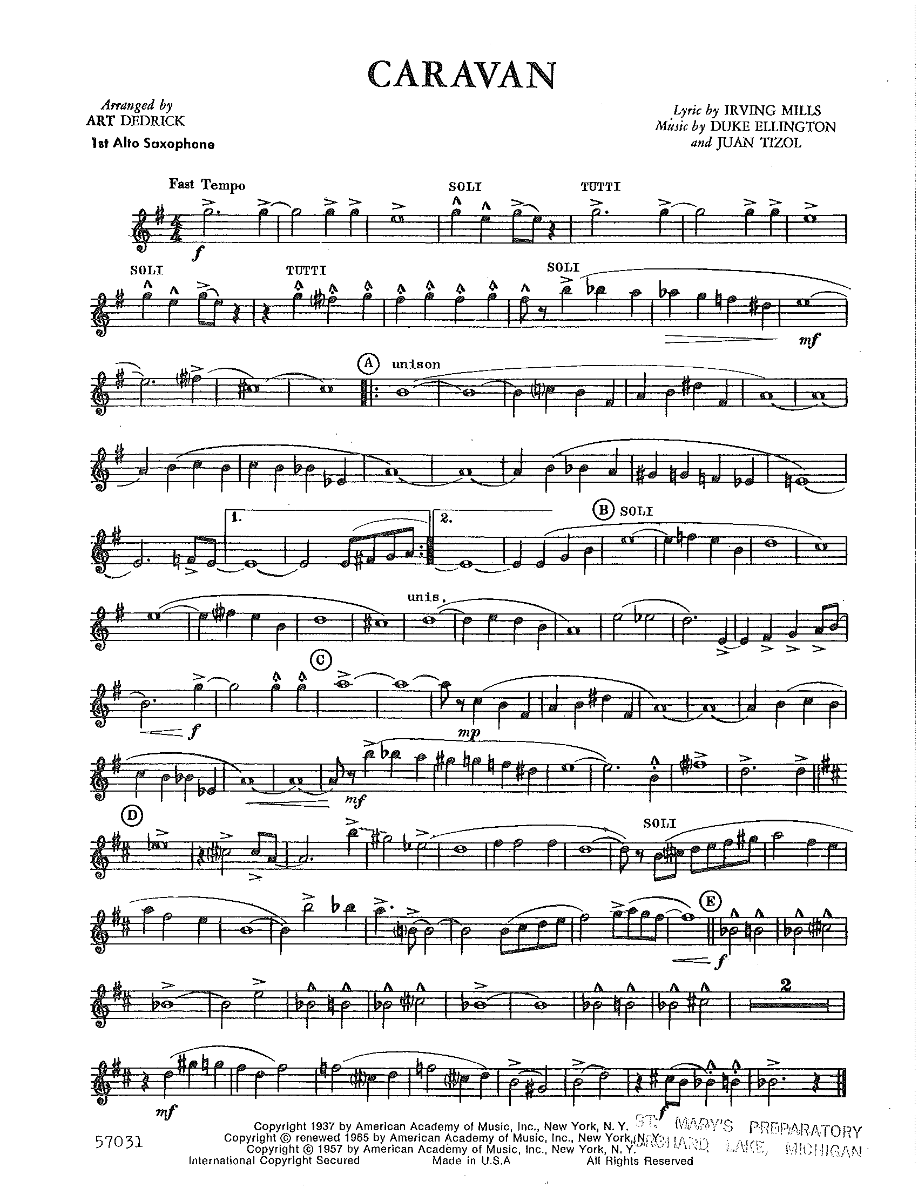
Caravan (A.Dedrick) sheet music preview

Caravan (A.Dedrick)

Composed by Juan Tizol, Duke Ellington

Arranged by Art Dedrick

  • Ensemble: Big Band
  • Style: Jazz Standard
  • Pages: 21
  • Instruments (18): Alto Saxophone 1, Tenor Saxophone 2, Alto Saxophone 3, Tenor Saxophone 4, Baritone Saxophone 5, Trumpet 1, Trumpet 2, Trumpet 3, Trumpet 4, Trombone 1, Trombone 2, Trombone 3, Trombone 4, Guitar, Piano, String Bass & Tuba, Drums, Vocal
  • Difficulty: medium
  • Content: Individual Parts
  • Format: PDF Download (Instant)
  • Price: $24.99

"Caravan," a cornerstone of the jazz repertoire, emerged from the fertile creative environment of Duke Ellington's orchestra in 1936, co-composed by trombonist Juan Tizol and Ellington himself. This iconic piece is celebrated for its pioneering integration of Afro-Cuban rhythms and exotic melodicism into the big band sound, predating the widespread Latin jazz movement. It quickly became a signature tune for Ellington, showcasing his orchestra's unparalleled ability to blend sophisticated harmonies with compelling rhythmic drive. Its distinctive minor-key melody, often played with a Middle Eastern or Spanish flair, evokes images of mystery and adventure, cementing its status as a timeless jazz standard that has been interpreted by countless artists across genres. The piece's enduring appeal lies in its unique harmonic landscape and its capacity to transport listeners to distant, evocative soundscapes. Art Dedrick's arrangement of "Caravan" for big band masterfully captures the essence of this classic while infusing it with his characteristic clarity and thoughtful orchestration. Dedrick, known for his ability to craft arrangements that are both accessible and musically substantial, approaches "Caravan" with a focus on rhythmic precision and dynamic contrast. While retaining the original's brooding minor tonality and Latin-infused groove, Dedrick employs clean, well-voiced brass and saxophone soli sections that provide a contemporary sheen without sacrificing the piece's historical integrity. His treatment emphasizes the interplay between sections, building tension and release through carefully placed dynamic swells and rhythmic punctuations. The arrangement is primarily set in a medium Latin groove, maintaining the exotic feel, but Dedrick might introduce subtle swing elements or shifts in texture to keep the performance engaging. This arrangement features the instantly recognizable melody initially carried by the alto saxophone, often doubled or harmonized by other woodwinds, before being passed to the brass. Dedrick frequently utilizes call-and-response patterns between the brass and saxophones, creating a vibrant textural dialogue. While specific solo sections are typically indicated, allowing for improvisation over the piece's distinctive harmonic progression, Dedrick's charts often include written-out soli passages that challenge the ensemble's precision and blend. Technical challenges include maintaining the tight rhythmic integrity of the Latin groove, particularly in the rhythm section, and achieving precise articulation and dynamic control within the soli sections. The rewarding aspect lies in the ensemble's ability to collectively evoke the piece's dramatic mood and rhythmic intensity, culminating in a powerful shout chorus that brings the arrangement to a thrilling conclusion. Art Dedrick's "Caravan" is ideally suited for high school and college jazz ensembles, as well as community big bands seeking a sophisticated yet playable arrangement of a foundational jazz standard. The clear notation and logical voicings make it an excellent vehicle for developing ensemble precision, rhythmic accuracy, and dynamic sensitivity. It offers a fantastic opportunity to explore Latin jazz rhythms and the unique harmonic language of "Caravan" within a structured and rewarding big band setting. Conductors should emphasize a consistent, driving medium Latin groove throughout, ensuring the rhythm section locks into a precise, yet flexible, feel. The tempo should be steady but allow for subtle push and pull, avoiding a rigid, metronomic approach. Key technical challenges include maintaining rhythmic tightness in the syncopated figures across all sections, especially during brass and saxophone soli passages. Articulation must be crisp and unified, particularly for dotted eighth-sixteenth note patterns. Encourage dynamic contrast, building from subdued, mysterious openings to powerful, full-ensemble climaxes. Pay close attention to blend and balance in the harmonized melody lines and soli sections. Rehearsal tips include isolating rhythm section grooves, practicing soli sections slowly to ensure precision, and focusing on dynamic shaping to enhance the piece's dramatic narrative. Q: What instruments are included in this arrangement? A: This big band arrangement includes parts for 17 instruments: Alto Saxophone 1, Alto Saxophone 2, Tenor Saxophone 1, Tenor Saxophone 2, Baritone Saxophone, Trumpet 1, Trumpet 2, Trumpet 3, Trumpet 4, Trombone 1, Trombone 2, Trombone 3, Trombone 4, Piano, Bass, Drums, and Guitar. Q: What is the difficulty level of Art Dedrick's "Caravan" arrangement? A: This arrangement is generally considered suitable for intermediate to advanced high school, college, and community big bands. It presents challenges in rhythmic precision, dynamic control, and ensemble blend, making it an excellent piece for developing musicianship. Q: What is the musical style and historical context of this arrangement? A: This is an arrangement of the jazz standard "Caravan," originally composed by Juan Tizol and Duke Ellington in 1936. It is characterized by its medium Latin groove, minor key, and exotic, often Middle Eastern-influenced melodic lines, pioneering the integration of Afro-Cuban rhythms into big band jazz. Q: What makes Art Dedrick's arrangement of "Caravan" unique? A: Art Dedrick's approach combines the original's iconic Latin feel and brooding atmosphere with his signature clear voicings and thoughtful orchestration. His arrangement emphasizes rhythmic precision, dynamic contrast, and well-crafted soli sections, making it both accessible and musically engaging for performers and audiences. Q: What is the typical performance duration and tempo for this arrangement? A: The typical performance duration for this arrangement is approximately 3-4 minutes, depending on the number and length of improvised solos. It is designed to be played at a medium Latin groove tempo, generally ranging from around 120-140 beats per minute.

Musicians Also Search For

Caravan Art Dedrick PDFCaravan Art Dedrick sheet musicCaravan arranged by Art DedrickArt Dedrick big band chartsArt Dedrick jazz arrangements PDFCaravan Juan Tizol, Duke Ellington sheet musicCaravan Juan Tizol, Duke Ellington big band arrangementJuan Tizol, Duke Ellington big band chartsCaravan big band arrangementCaravan big band PDF downloadCaravan jazz ensemble sheet musicbig band sheet music instant downloadCaravan conductor score PDFCaravan individual parts downloadCaravan sheet music with partsCaravan Jazz Standard chartJazz Standard big band arrangementsbuy Caravan sheet music onlinedownload Caravan PDFCaravan jazz chartbest Art Dedrick big band arrangementsJuan Tizol, Duke Ellington songs arranged by Art DedrickCaravan printable sheet musicbig band repertoire PDF

All arrangements by Art Dedrick All Juan Tizol, Duke Ellington sheet music