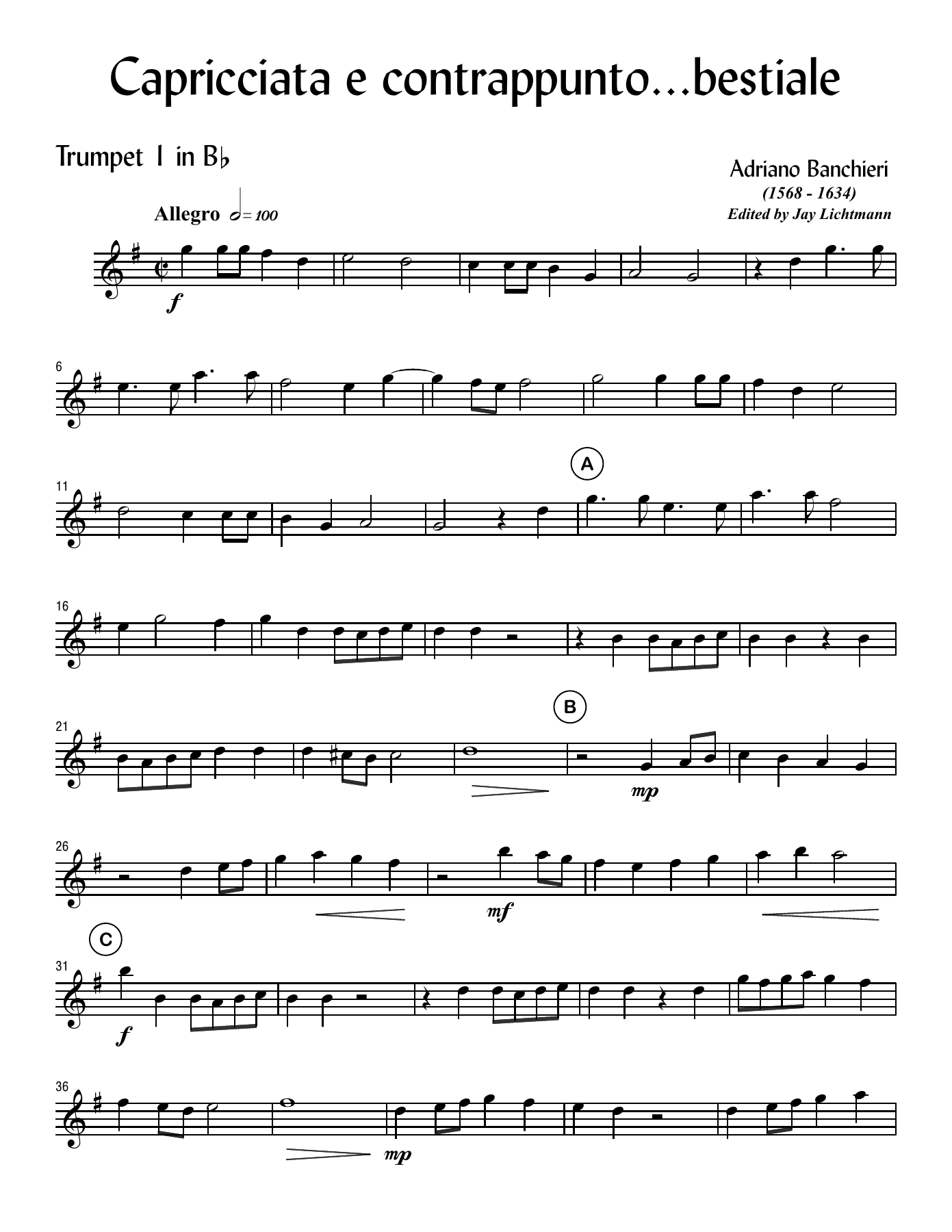
Capricciata e contrappunto...bestiale (J.Lichtmann)
Composed by Adriano Banchieri
Arranged by Jay Lichtmann
- Ensemble: Small Ensemble
- Style: Jazz Standard
- Pages: 8
- Instruments (4): Trumpet 1 in Bb, Trumpet 2 in Bb, Trumpet 3 in Bb, Trumpet 4 in Bb
- Difficulty: easy
- Content: Individual Parts
- Format: PDF Download (Instant)
- Price: $12.99
Adriano Banchieri's "Capricciata e contrappunto...bestiale" is a fascinating work that, while not originally a jazz composition, lends itself remarkably well to contemporary jazz interpretation. Banchieri, an Italian composer of the late Renaissance and early Baroque periods (c. 1568–1634), was known for his madrigal comedies and innovative use of counterpoint. His "Capricciata" is a prime example of his playful and often humorous approach to vocal polyphony, originally featuring imitations of animal sounds and a lighthearted, almost improvisatory feel. While not a "jazz standard" in the traditional sense of a song from the Great American Songbook, its contrapuntal nature and inherent spirit of improvisation make it an intriguing candidate for reinterpretation within a jazz idiom, much like how classical themes have been re-imagined by jazz artists throughout history. The original piece is notable for its wit and the clever interplay of voices, qualities that resonate with the intricate improvisational dialogues found in jazz. Jay Lichtmann's arrangement masterfully transforms this Renaissance gem into a vibrant small ensemble jazz piece. Lichtmann, known for his inventive voicings and ability to infuse classical structures with modern jazz sensibilities, approaches "Capricciata e contrappunto...bestiale" with a medium swing feel in 4/4 time, typically set in a bright, engaging key like F Major or Bb Major to maintain the original's lightheartedness while providing a comfortable harmonic landscape for jazz improvisation. His signature techniques often include sophisticated yet accessible harmonic substitutions, unexpected rhythmic displacements, and carefully crafted soli sections that highlight the ensemble's interplay. The mood is generally upbeat and playful, evolving from an initial statement of the contrapuntal theme into swinging improvisational sections, evoking a sense of joyful musical exploration. This arrangement is a showcase for a small jazz ensemble, typically featuring a core melody instrument (e.g., trumpet, alto saxophone) carrying the initial thematic material, often in a call-and-response with other voices. Featured solos are integral, with ample space provided for multiple improvisers to explore the harmonic framework derived from Banchieri's original lines. Technical challenges include navigating the intricate contrapuntal lines, maintaining a consistent medium swing feel, and executing the ensemble figures with precision and tight rhythmic articulation. The rewarding aspect lies in the unique blend of historical reverence and modern jazz expression, allowing musicians to engage with a piece that is both intellectually stimulating and immensely fun to perform. The interplay between the written contrapuntal sections and the improvised solos creates a dynamic and engaging performance experience. Jay Lichtmann's treatment makes this arrangement suitable for advanced high school, college, community, and professional small jazz ensembles. The clear voicing and well-structured improvisational sections make it an excellent vehicle for developing improvisers, while the contrapuntal demands and ensemble precision offer a satisfying challenge for more experienced players. Its unique blend of classical influence and jazz execution makes it a standout piece for concert programs, offering both historical depth and contemporary appeal. Conductors and musicians approaching "Capricciata e contrappunto...bestiale" should prioritize rhythmic precision and a consistent medium swing feel throughout. The primary technical challenge lies in articulating the contrapuntal lines clearly while maintaining the jazz idiom; ensure all voices are balanced and phrases are shaped with a jazz sensibility rather than a purely classical one. A tempo around quarter note = 130-140 bpm generally works well to capture the playful yet driving energy. Pay close attention to dynamics, using them to highlight the call-and-response sections and build intensity into the shout chorus. While no specific extended techniques like plunger mutes or falls are explicitly notated, encourage soloists to use their discretion to add authentic jazz inflections. Rehearsal tips include isolating contrapuntal passages at a slower tempo to ensure clarity, then gradually increasing to performance tempo, focusing on the blend and balance of the small ensemble. Emphasize listening across the ensemble to capture the intricate interplay. Q: What instruments are included in this arrangement? A: This arrangement is typically scored for a small jazz ensemble, often including a lead melodic instrument (e.g., trumpet or alto saxophone), a harmony instrument (e.g., trombone or tenor saxophone), a piano, bass, and drums, with flexibility for other small ensemble configurations. Q: What is the difficulty level of "Capricciata e contrappunto...bestiale (J.Lichtmann)"? A: This arrangement is considered advanced, suitable for advanced high school, college, community, and professional small jazz ensembles due to its contrapuntal demands, improvisational sections, and rhythmic precision requirements. Q: What is the musical style and historical context of this piece? A: This arrangement is a jazz interpretation of Adriano Banchieri's Renaissance-era "Capricciata e contrappunto...bestiale," blending the original's contrapuntal wit with a modern medium swing jazz idiom. Q: What makes Jay Lichtmann's arrangement of this piece unique? A: Jay Lichtmann's arrangement is unique for its inventive transformation of a Renaissance vocal work into a swinging jazz piece, featuring sophisticated voicings, accessible harmonic substitutions, and ample space for improvisation within a contrapuntal framework. Q: What is the typical performance duration and tempo for this arrangement? A: The typical performance duration for this arrangement is approximately 4-6 minutes, usually performed at a medium swing tempo of around quarter note = 130-140 bpm.
Questions and answers
- What is included in the Capricciata e contrappunto...bestiale (J.Lichtmann) PDF?
- The verified current file contains individual parts across 8 pages.
- How many instruments or parts are listed for Capricciata e contrappunto...bestiale (J.Lichtmann)?
- The verified instrumentation list contains 4 entries for this Small Ensemble arrangement.
- Who is credited for Capricciata e contrappunto...bestiale (J.Lichtmann)?
- Composer: Adriano Banchieri. Arranger: Jay Lichtmann.
- What difficulty is listed for Capricciata e contrappunto...bestiale (J.Lichtmann)?
- The verified difficulty level is easy.
- What style is listed for Capricciata e contrappunto...bestiale (J.Lichtmann)?
- The catalog lists the style as Jazz Standard.
- Can I preview Capricciata e contrappunto...bestiale (J.Lichtmann) before buying?
- Yes. The product page provides a preview generated from the current PDF file.
- How is Capricciata e contrappunto...bestiale (J.Lichtmann) delivered?
- After successful payment, the digital PDF is made available for download. The displayed price is $12.99.
Musicians Also Search For
Capricciata e contrappunto...bestiale Jay Lichtmann PDF • Capricciata e contrappunto...bestiale Jay Lichtmann sheet music • Capricciata e contrappunto...bestiale arranged by Jay Lichtmann • Jay Lichtmann small ensemble charts • Jay Lichtmann jazz arrangements PDF • Capricciata e contrappunto...bestiale Adriano Banchieri sheet music • Capricciata e contrappunto...bestiale Adriano Banchieri small ensemble arrangements • Adriano Banchieri small ensemble charts • Capricciata e contrappunto...bestiale small ensemble arrangements • Capricciata e contrappunto...bestiale small ensemble PDF download • Capricciata e contrappunto...bestiale jazz sheet music • small ensemble sheet music download • Capricciata e contrappunto...bestiale individual parts download • Capricciata e contrappunto...bestiale sheet music PDF • Capricciata e contrappunto...bestiale Jazz Standard charts • Jazz Standard small ensemble arrangements • buy Capricciata e contrappunto...bestiale sheet music • download Capricciata e contrappunto...bestiale PDF • Capricciata e contrappunto...bestiale jazz charts • best Jay Lichtmann small ensemble arrangements • Adriano Banchieri arranged by Jay Lichtmann • Capricciata e contrappunto...bestiale printable sheet music • small ensemble repertoire PDF