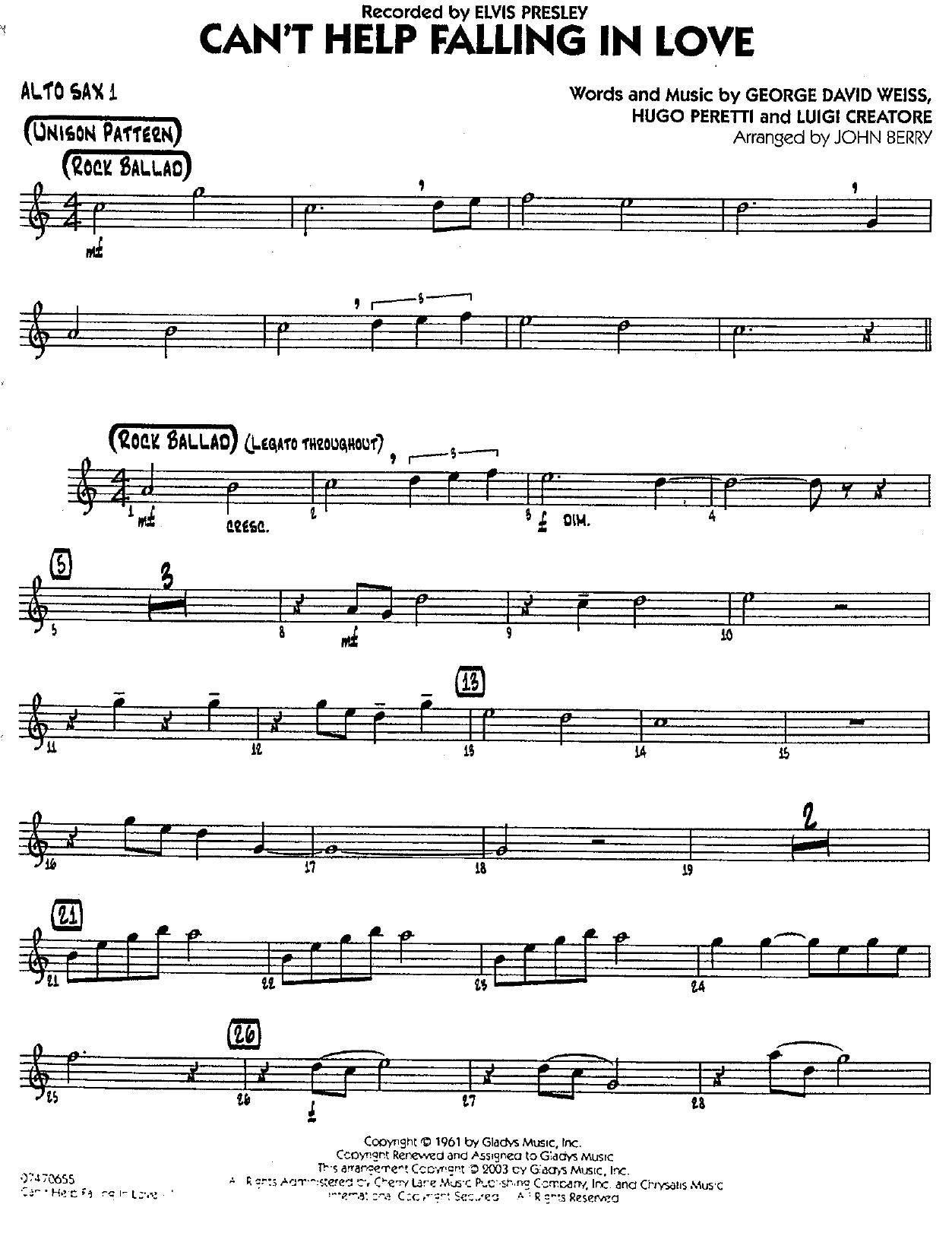
Can't Help Falling In Love (J.Berry) sheet music preview

Can't Help Falling In Love (J.Berry)

Composed by George David Weiss

Arranged by John Berry

  • Ensemble: Big Band
  • Pages: 32
  • Instruments (16): Alto Sax 1, Alto Sax 2, Tenor Sax 1, Tenor Sax 2, Baritone Sax, Trumpet 1, Trumpet 2, Trumpet 3 & 4, Trombone 1, Trombone 2, Trombone 3 & 4, Guitar, Bass, Drums, Piano, Aux. Percussion (Tambourine)
  • Difficulty: medium
  • Content: Individual Parts
  • Format: PDF Download (Instant)
  • Price: $24.99

Originally introduced to the world by Elvis Presley in 1961 for the musical film *Blue Hawaii*—and famously drawn from Jean-Paul-Égide Martini’s 1784 romance "Plaisir d'amour"—George David Weiss’s timeless melody has transcended its pop origins to become a deeply cherished modern standard. While the song is historically rooted in early 1960s balladry and vocal pop, its sweeping harmonic progression and elegant, symmetrical phrasing make it a natural vehicle for jazz interpretation. Over the decades, artists ranging from jazz vocalists to instrumental masters have reharmonized its familiar contours, transforming a simple cinematic love song into a sophisticated vehicle for expressive, extended-ensemble storytelling. John Berry’s masterwork for big band reframes this classic as a lush, tender, yet dynamically expansive ballad. Moving at a relaxed, flowing tempo with a gentle 12/8 or slow triplet feel, the arrangement prioritizes warmth, breath support, and rich harmonic resonance. The emotional landscape shifts seamlessly from intimate, hushed textures in the opening phrases to soaring, cinematic climaxes. Berry treats the ensemble like a vocal choir, utilizing velvety chord clusters in the saxophones and muted brass counterlines that evoke the sophisticated, late-night atmosphere of a classic mid-century supper club while maintaining a modern harmonic richness. Berry’s distinctive arranging approach shines through in the clever distribution of thematic material and subtle modulatory shifts. Rather than relying on a standard, predictable head-and-chorus layout, the chart features a dynamic interplay between sections. The woodwinds frequently carry the initial iterations of the melody with delicate sub-tone playing, gradually handing off the emotional weight to a flugelhorn or tenor saxophone soloist. The arrangement builds toward a tasteful, blooming shout chorus that eschews heavy-handed volume for lush, open-voiced suspensions, before gracefully receding into a tranquil, whispered coda that leaves a lasting impression on the listener. Advanced high school ensembles, collegiate jazz orchestras, and professional community big bands will find this chart an ideal centerpiece for concert programming. While it does not demand blazing technique or extreme high-register endurance from the lead trumpet, it presents a rigorous test of ensemble listening, intonation, and stylistic maturity. Players must possess exceptional breath control, precise balance within chord voicings, and the ability to sustain a long, lyrical line without rushing. For bands looking to showcase their musicality, tone color, and emotional depth rather than sheer velocity, this arrangement offers a deeply rewarding and unforgettable performance experience. Balancing blend and intonation across the full 16-instrument ensemble is the primary technical challenge of this arrangement, particularly during exposed chordal passages where any minor pitch discrepancy will stand out. Conductors should insist on a warm, centered tone from all sections, avoiding excessive vibrato in the saxophones to maintain a modern, blended texture. The tempo should remain flexible yet steady, allowing the rhythm section to push and pull gently behind the beat like a traditional vocal accompaniment. Drummers should employ brushes throughout the ballad sections, utilizing a subtle triplet swing feel or a smooth, whispering ride cymbal pattern that complements the horns without overpowering them. Pay close attention to dynamic markings: the contrast between the hushed, intimate sub-tone statements and the blooming, open-voiced climaxes is what gives the chart its dramatic arc. Muted brass should use harmon or bucket mutes where indicated to achieve a velvety, breathy timbre that blends seamlessly with the woodwind choir. Rehearsal time should be heavily invested in sectional tuning and balancing the inner voices of the saxophone and brass blocks. Q: What instruments and parts are included in this big band arrangement? A: The arrangement is scored for a standard 16-instrument big band instrumentation, featuring Alto Saxophone 1, Alto Saxophone 2, Tenor Saxophone 1, Tenor Saxophone 2, and Baritone Saxophone, alongside a complete brass and rhythm section. The package comprises a comprehensive 32-page conductor and instrumental layout. Q: What is the difficulty level of this John Berry arrangement? A: This piece is best suited for advanced high school, collegiate, and professional community big bands. While it does not require extreme technical velocity or high-register endurance, it demands high-level musicianship, precise intonation, mature tone control, and subtle ensemble blending. Q: What is the musical style and historical context of the piece? A: Originally composed by George David Weiss and popularized by Elvis Presley in 1961, this arrangement reinterprets the familiar pop ballad through a sophisticated jazz lens. It utilizes a slow, expressive ballad feel reminiscent of classic late-night jazz club recordings. Q: What makes this specific arrangement by John Berry unique? A: Berry's chart stands out for its vocal-like writing style, rich harmonic reharmonizations, and dynamic architectural arc. Instead of a standard head arrangement, it features lush woodwind voicings, subtle modulatory shifts, and a blooming, open-voiced climax that prioritizes deep emotional resonance over volume. Q: What is the recommended performance duration and tempo for this arrangement? A: The piece is performed at a slow, relaxed ballad tempo with a flowing triplet or 12/8 feel, typically lasting between 3.5 and 4.5 minutes depending on the conductor's rubato choices and the pacing of any featured solos.

Questions and answers

What is included in the Can't Help Falling In Love (J.Berry) PDF?
The verified current file contains individual parts across 32 pages.
How many instruments or parts are listed for Can't Help Falling In Love (J.Berry)?
The verified instrumentation list contains 16 entries for this Big Band arrangement.
Who is credited for Can't Help Falling In Love (J.Berry)?
Composer: George David Weiss. Arranger: John Berry.
What difficulty is listed for Can't Help Falling In Love (J.Berry)?
The verified difficulty level is medium.
Can I preview Can't Help Falling In Love (J.Berry) before buying?
Yes. The product page provides a preview generated from the current PDF file.
How is Can't Help Falling In Love (J.Berry) delivered?
After successful payment, the digital PDF is made available for download. The displayed price is $24.99.

Musicians Also Search For

Can't Help Falling In Love John Berry PDFCan't Help Falling In Love John Berry sheet musicCan't Help Falling In Love arranged by John BerryJohn Berry big band chartsJohn Berry jazz arrangements PDFCan't Help Falling In Love George David Weiss sheet musicCan't Help Falling In Love George David Weiss big band arrangementsGeorge David Weiss big band chartsCan't Help Falling In Love big band arrangementsCan't Help Falling In Love big band PDF downloadCan't Help Falling In Love jazz sheet musicbig band sheet music downloadCan't Help Falling In Love individual parts downloadCan't Help Falling In Love sheet music PDFbuy Can't Help Falling In Love sheet musicdownload Can't Help Falling In Love PDFCan't Help Falling In Love jazz chartsbest John Berry big band arrangementsGeorge David Weiss arranged by John BerryCan't Help Falling In Love printable sheet musicbig band repertoire PDF

All arrangements by John Berry All George David Weiss sheet music