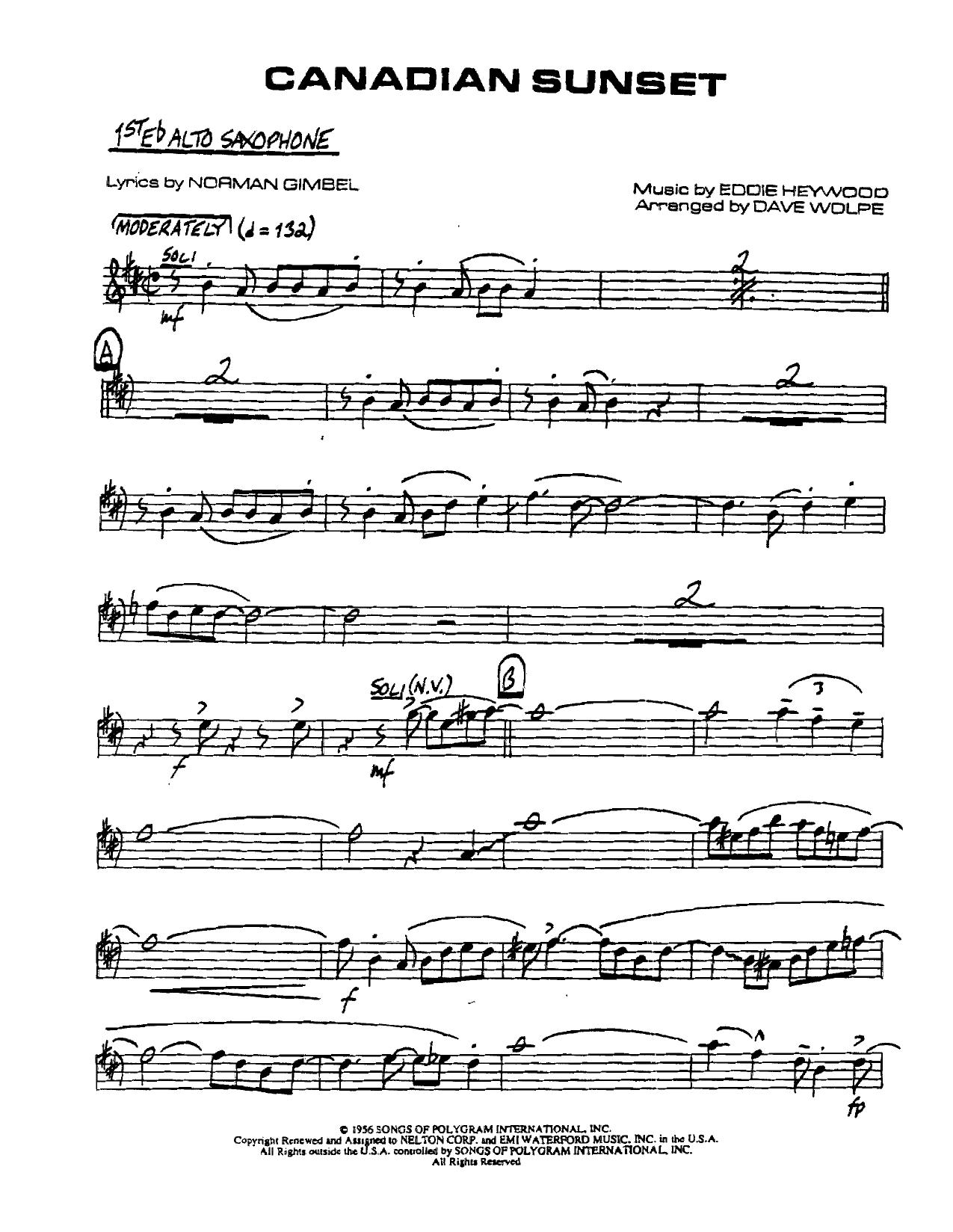
Canadian Sunset (D.Wolpe) sheet music preview

Canadian Sunset (D.Wolpe)

Composed by Eddie Heywood

Arranged by Dave Wolpe

  • Ensemble: Big Band
  • Pages: 54
  • Instruments (17): 1st Eb Alto Saxophone, 2nd Eb Alto Saxophone, 1st Bb Tenor Saxophone, 2nd Bb Tenor Saxophone, Eb Baritone Saxophone, 1st Bb Trumpet, 2nd Bb Trumpet, 3rd Bb Trumpet, 4th Bb Trumpet, 1st Trombone, 2nd Trombone, 3rd Trombone, Bass Trombone, Drums, Bass, Guitar, Piano
  • Difficulty: advanced
  • Content: Individual Parts
  • Format: PDF Download (Instant)
  • Price: $24.99

Eddie Heywood and Norman Gimbel’s timeless classic "Canadian Sunset" occupies a celebrated space at the crossroads of mid-century jazz, pop, and easy-listening instrumental tradition. Originally composed by pianist Eddie Heywood in 1956—with lyrics added later by Gimbel—the tune became an immediate crossover smash, most notably through Heywood's own instrumental recording and Hugo Winterhalter’s lush orchestral adaptation. Its enduring appeal lies in its infectious, relaxed groove and memorable, descending melodic hook that evokes twilight vistas and urban sophistication. Within the jazz idiom, it transitioned seamlessly from a pop-chart phenomenon into a staple of small-group and big band repertoires, appreciated for its inviting harmonic framework and warm, evocative atmosphere. Dave Wolpe’s masterful big band arrangement captures the essence of this mid-century gem while injecting it with the polished, swinging vitality characteristic of his writing style. Set in a comfortable medium swing feel (approximately 120–124 BPM), the chart balances relaxed lyricism with crisp, driving ensemble sections. The harmonic language expands upon the original changes with rich, contemporary extended voicings in the brass and subtle chordal shifts that give the saxophones a lush, velvety backdrop. Wolpe skillfully avoids monotony by varying the texture throughout the chart, alternating between intimate, sparse accompaniment figures and full-throated, harmonically sophisticated ensemble passages that showcase the classic 17-piece big band palette. The melodic narrative unfolds through carefully balanced scoring across the ensemble. The saxes frequently carry the primary thematic material, often framed by soft, punctuating brass flourishes that maintain the forward momentum without crowding the soloist. A standout feature of this arrangement is a well-crafted written or open solo section for alto saxophone (or optional trumpet), designed to let a soloist stretch out over standard changes that mirror the accessible yet sophisticated mood of the piece. The shout chorus builds naturally in dynamic intensity, utilizing classic drop-2 voicing structures and dynamic contrast to deliver an emotional peak before seamlessly winding down to a warm, satisfying final chord. Advanced high school, collegiate, and community jazz ensembles will find this arrangement an ideal vehicle for developing stylistic polish, section blending, and medium-tempo swing phrasing. While the technical demands are moderate—avoiding extreme ranges or breakneck tempos—the chart places a premium on stylistic execution, dynamic control, and internal clock stability. It serves as a fantastic crowd-pleaser for formal concerts and festival performances alike, offering mature musicians plenty of room to refine their ensemble articulation while giving audiences a recognizable and deeply satisfying piece of jazz history. Conductors should approach Dave Wolpe’s setting of "Canadian Sunset" with a focus on relaxed, unhurried swing phrasing. Avoid dragging the tempo; the groove must maintain a steady, forward-moving pulse at around 120 BPM. The primary technical challenge lies in achieving an authentic, lightweight swing feel in the eighth notes, ensuring that the backbeats (beats 2 and 4) driven by the ride cymbal and hi-hat remain crisp and prominent. Brass players must exercise restraint during the background figures, keeping dynamics at a supportive mezzo-piano to allow the lead alto saxophone or featured soloist to project effortlessly. Articulation should be clean and voiced-short on off-beat accents, but never overly aggressive. Rehearsals should initially isolate the sax soli sections to lock in intonation and balance before integrating the brass responses. Pay close attention to the dynamic swells leading into the shout chorus to ensure a natural, controlled crescendo rather than an abrupt blast of sound. Q: What instruments and parts are included in this arrangement? A: This chart is scored for a standard 17-piece big band instrumentation: 5 saxophones (Alto 1, Alto 2, Tenor 1, Tenor 2, Baritone), 4 trumpets, 4 trombones, and a standard 4-piece rhythm section consisting of piano, guitar, bass, and drums. Q: What is the difficulty level of this Dave Wolpe arrangement? A: It is graded as medium (or Grade 3.5 to 4), making it well-suited for proficient high school groups, college bands, and community jazz orchestras looking for accessible yet musically rewarding material. Q: What is the historical style and feel of this piece? A: The arrangement is set in a classic medium swing style, drawing inspiration from the 1950s crossover success of Eddie Heywood’s original composition while incorporating sophisticated big band arranging techniques. Q: What makes this specific arrangement unique? A: Dave Wolpe expertly balances lush, vocal-like harmonic voicings with traditional swing ensemble writing, creating a sophisticated texture that elevates a pop-jazz standard into a mature concert centerpiece with built-in solo opportunities. Q: What is the approximate performance duration and tempo? A: The arrangement plays comfortably at a medium swing tempo of approximately 120–124 BPM, resulting in a total performance duration of roughly 3 to 4 minutes depending on solo extensions.

Questions and answers

What is included in the Canadian Sunset (D.Wolpe) PDF?
The verified current file contains individual parts across 54 pages.
How many instruments or parts are listed for Canadian Sunset (D.Wolpe)?
The verified instrumentation list contains 17 entries for this Big Band arrangement.
Who is credited for Canadian Sunset (D.Wolpe)?
Composer: Eddie Heywood. Arranger: Dave Wolpe.
What difficulty is listed for Canadian Sunset (D.Wolpe)?
The verified difficulty level is advanced.
Can I preview Canadian Sunset (D.Wolpe) before buying?
Yes. The product page provides a preview generated from the current PDF file.
How is Canadian Sunset (D.Wolpe) delivered?
After successful payment, the digital PDF is made available for download. The displayed price is $24.99.

Musicians Also Search For

Canadian Sunset Dave Wolpe PDFCanadian Sunset Dave Wolpe sheet musicCanadian Sunset arranged by Dave WolpeDave Wolpe big band chartsDave Wolpe jazz arrangements PDFCanadian Sunset Eddie Heywood sheet musicCanadian Sunset Eddie Heywood big band arrangementsEddie Heywood big band chartsCanadian Sunset big band arrangementsCanadian Sunset big band PDF downloadCanadian Sunset jazz sheet musicbig band sheet music downloadCanadian Sunset individual parts downloadCanadian Sunset sheet music PDFbuy Canadian Sunset sheet musicdownload Canadian Sunset PDFCanadian Sunset jazz chartsbest Dave Wolpe big band arrangementsEddie Heywood arranged by Dave WolpeCanadian Sunset printable sheet musicbig band repertoire PDF

All arrangements by Dave Wolpe All Eddie Heywood sheet music