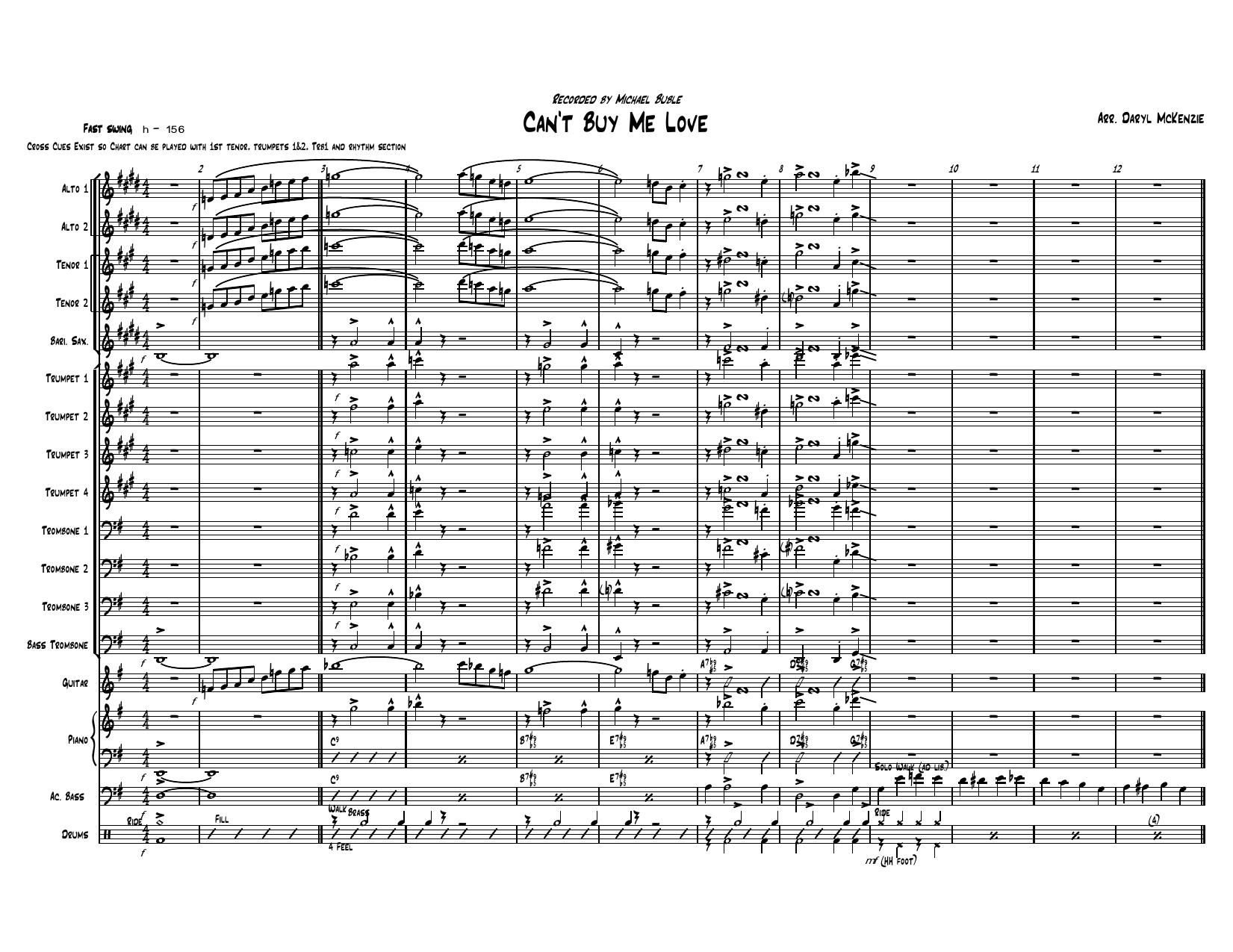
Can't Buy Me Love (D.McKenzie) M.Buble-Vocal
Composed by John Lennon
Arranged by Vocal
- Ensemble: Big Band Vocal
- Style: Pop
- Pages: 75
- Instruments (18): Voice, Alto Saxophone 1, Alto Saxophone 2, Tenor Saxophone 1, Tenor Saxophone 2, Baritone Saxophone, Trumpet 1, Trumpet 2, Trumpet 3, Trumpet 4, Trombone 1, Trombone 2, Trombone 3, Bass Trombone, Guitar, Piano, Acoustic Bass, Drums
- Difficulty: medium
- Content: Individual Parts
- Format: PDF Download (Instant)
- Price: $24.99
Originally penned by John Lennon and released by The Beatles in 1964, "Can't Buy Me Love" stands as an iconic anthem of the British Invasion era, a pivotal moment in popular music history. This infectious tune, famously featured in the film "A Hard Day's Night," quickly soared to international chart-topping success, solidifying its place as one of the most recognizable and enduring pop songs of the 20th century. While rooted in early rock and roll, its melodic strength and driving rhythm have made it a perennial favorite for reinterpretation across various genres, including jazz. This particular arrangement, crafted for big band and vocal soloist, reimagines the classic pop sensibility through a sophisticated, contemporary lens, drawing inspiration from modern vocal jazz interpretations, notably those popularized by artists like Michael Bublé. This arrangement of "Can't Buy Me Love" is presented in a bright, up-tempo swing feel, typically around 190-200 BPM, in the key of F Major. It exudes an undeniable energy and sophisticated swagger, transforming the original's straightforward pop charm into a vibrant, swinging showcase. The mood is exhilarating and celebratory, designed to captivate audiences with its blend of familiar melody and fresh, intricate harmonies. The arrangement retains the song's inherent optimism while infusing it with the rich textures and dynamic contrasts characteristic of a professional big band setting. The overall sound is polished and contemporary, yet respectful of the song's enduring appeal. Vocal's distinctive approach to this arrangement is evident in its clever reharmonizations and dynamic orchestration. The chart opens with an attention-grabbing brass fanfare, immediately setting a sophisticated tone before the vocal enters with the iconic melody. Throughout the piece, the arranger employs lush, extended harmonies in the brass and saxophone sections, providing a rich harmonic carpet for the soloist. There are prominent soli sections for the saxophones that echo and elaborate on the vocal lines, showcasing the ensemble's precision and blend. A powerful, building shout chorus provides a climactic moment, featuring layered brass figures and driving rhythm section work. The arrangement includes a written-out solo section, typically for tenor saxophone, offering an opportunity for improvisation over the familiar chord changes. The vocal line generally carries the primary melody, with the ensemble providing dynamic counterpoint and rhythmic propulsion, culminating in a high-energy, full-band finish. This arrangement is ideally suited for college-level jazz ensembles, advanced community bands, and professional big bands. Its technical demands, including intricate brass rhythms, precise saxophone soli passages, and a vocally challenging lead part, require a strong command of instrumental technique and ensemble cohesion. The rewarding aspect lies in its ability to deliver a familiar, beloved tune with a fresh, sophisticated jazz treatment, guaranteed to engage both performers and audiences. The dynamic shifts, complex voicings, and the sheer joy of its up-tempo swing make it a standout piece in any concert program. Conductors should establish a consistent, driving up-tempo swing feel from the outset, aiming for a metronomic range of 190-200 BPM. Emphasize crisp articulation in the brass fanfares and ensure precise rhythmic alignment in the saxophone soli sections; these require diligent rehearsal to achieve the desired clarity and blend. The vocal soloist needs to maintain strong projection over the full ensemble, particularly during the more powerful ensemble passages, and should be encouraged to bring a charismatic, confident delivery to the iconic melody. Pay close attention to dynamics, building energy gradually towards the shout chorus and maintaining a vibrant, yet controlled, intensity throughout. The written tenor saxophone solo should be approached with a bright, swinging tone, and can be opened up for improvisation if desired. Ensure the rhythm section lays down a solid, energetic groove, driving the ensemble forward without rushing. Q: What instruments and parts are included in this arrangement? A: This big band arrangement includes parts for Vocal Soloist, 5 Saxophones (AATTB), 4 Trumpets, 4 Trombones, Piano, Bass, Drums, and Guitar. Q: What is the difficulty level of this arrangement? A: This arrangement is rated as Advanced-Intermediate to Advanced, suitable for college-level jazz ensembles, advanced community bands, and professional big bands due to its technical demands and sophisticated musicality. Q: What is the musical style and historical context of "Can't Buy Me Love" in this arrangement? A: While the original song is a classic 1964 pop hit by The Beatles, this arrangement reinterprets it as an up-tempo, contemporary big band swing chart, drawing inspiration from modern vocal jazz artists. Q: What makes this specific arrangement unique compared to other versions of "Can't Buy Me Love"? A: This arrangement features sophisticated reharmonizations, dynamic orchestration with prominent saxophone soli sections, a powerful shout chorus, and a contemporary big band swing feel, transforming the pop classic into a vibrant jazz showcase. Q: What is the approximate performance duration and tempo for this arrangement? A: The approximate performance duration is 3-4 minutes, played at a bright, up-tempo swing feel, typically around 190-200 BPM.
Questions and answers
- What is included in the Can't Buy Me Love (D.McKenzie) M.Buble-Vocal PDF?
- The verified current file contains a conductor score and individual parts across 75 pages.
- How many instruments or parts are listed for Can't Buy Me Love (D.McKenzie) M.Buble-Vocal?
- The verified instrumentation list contains 18 entries for this Big Band Vocal arrangement.
- Who is credited for Can't Buy Me Love (D.McKenzie) M.Buble-Vocal?
- Composer: John Lennon. Arranger: Vocal.
- What difficulty is listed for Can't Buy Me Love (D.McKenzie) M.Buble-Vocal?
- The verified difficulty level is medium.
- What style is listed for Can't Buy Me Love (D.McKenzie) M.Buble-Vocal?
- The catalog lists the style as Pop.
- Can I preview Can't Buy Me Love (D.McKenzie) M.Buble-Vocal before buying?
- Yes. The product page provides a preview generated from the current PDF file.
- How is Can't Buy Me Love (D.McKenzie) M.Buble-Vocal delivered?
- After successful payment, the digital PDF is made available for download. The displayed price is $24.99.
Musicians Also Search For
Can't Buy Me Love Vocal PDF • Can't Buy Me Love Vocal sheet music • Can't Buy Me Love arranged by Vocal • Vocal big band vocal charts • Vocal jazz arrangements PDF • Can't Buy Me Love John Lennon sheet music • Can't Buy Me Love John Lennon big band vocal arrangements • John Lennon big band vocal charts • Can't Buy Me Love big band vocal arrangements • Can't Buy Me Love big band vocal PDF download • Can't Buy Me Love jazz sheet music • big band vocal sheet music download • Can't Buy Me Love conductor score PDF • Can't Buy Me Love individual parts download • Can't Buy Me Love sheet music PDF • Can't Buy Me Love Pop charts • Pop big band vocal arrangements • buy Can't Buy Me Love sheet music • download Can't Buy Me Love PDF • Can't Buy Me Love jazz charts • best Vocal big band vocal arrangements • John Lennon arranged by Vocal • Can't Buy Me Love printable sheet music • big band vocal repertoire PDF