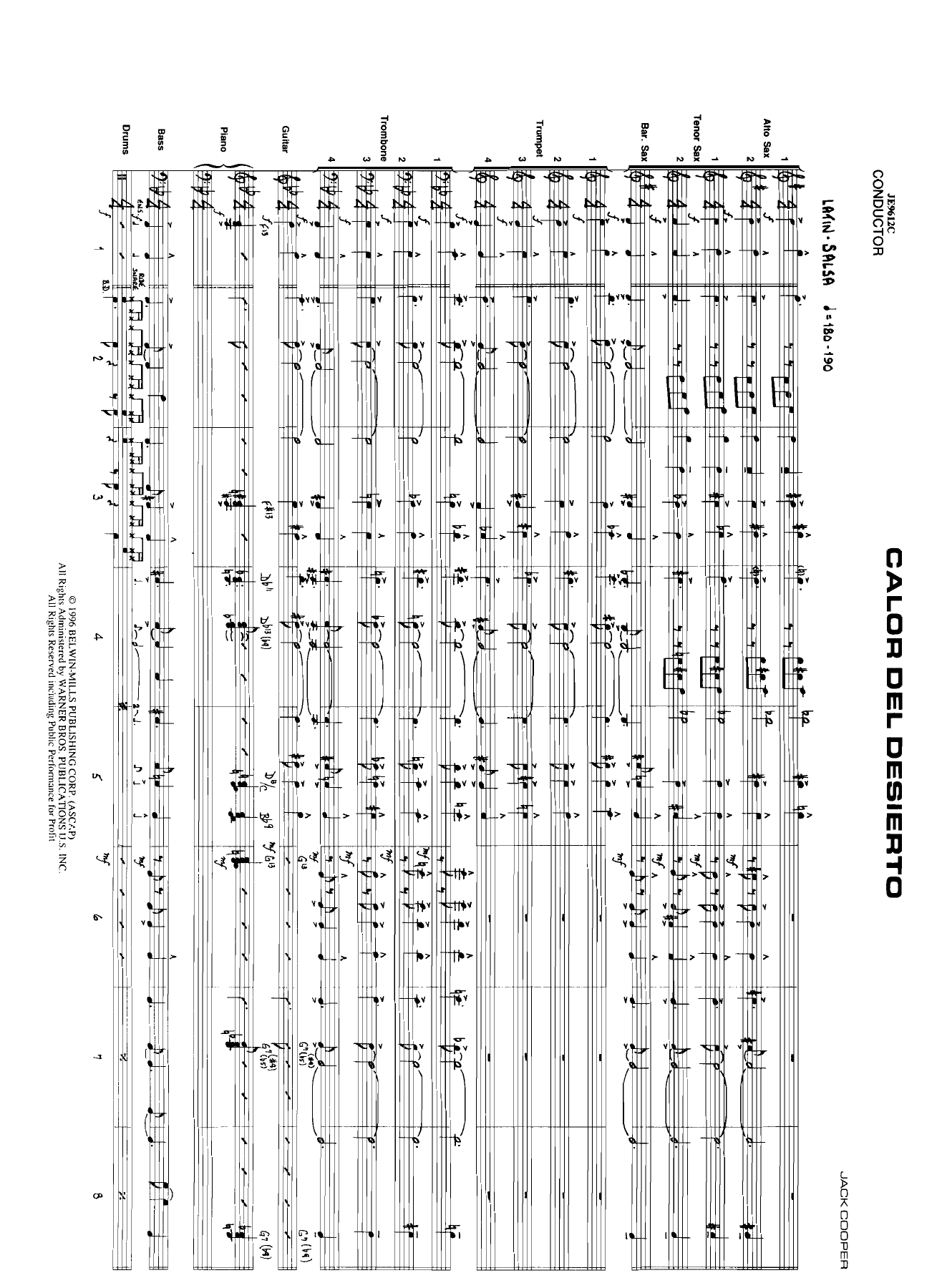
Calor Del Desierto (J.Cooper)
Composed by Jack Cooper
Arranged by J. Cooper
- Ensemble: Big Band
- Style: Salsa
- Pages: 62
- Instruments (17): 1st Eb Alto Saxophone, 2nd Eb Alto Saxophone, 1st Bb Tenor Saxophone, 2nd Bb Tenor Saxophone, Eb Baritone Saxophone, 1st Bb Trumpet, 2nd Bb Trumpet, 3rd Bb Trumpet, 4th Bb Trumpet, 1st Trombone, 2nd Trombone, 3rd Trombone, 4th Trombone, Piano, Guitar, Bass, Drums
- Difficulty: advanced
- Content: Individual Parts
- Format: PDF Download (Instant)
- Price: $24.99
"Calor Del Desierto (J.Cooper)" transports listeners directly into the vibrant, sun-drenched soundscape of Latin jazz, specifically a powerful salsa idiom. While the original composition by Jack Cooper is contemporary, it masterfully evokes the energetic spirit and rhythmic complexity characteristic of classic salsa and Latin big band traditions that gained prominence from the 1960s onward through artists like Tito Puente, Machito, and Eddie Palmieri. This piece is not merely a jazz tune with a Latin rhythm; it is deeply steeped in the harmonic and melodic language of salsa, featuring driving montunos, intricate horn lines, and a relentless, danceable pulse. The title itself, "Heat of the Desert," perfectly encapsulates the fiery intensity and passionate expression inherent in its musical character. The musical character of "Calor Del Desierto" is defined by its exhilarating up-tempo Latin groove, typically performed around 180-200 BPM, driven by a robust rhythm section laying down a solid cascara/timbales pattern, an insistent bass tumbao, and a piano montuno that interlocks with the horns. The primary key is typically minor, often D minor, lending a dramatic and slightly melancholic edge that is beautifully contrasted by the vibrant energy. The mood is one of celebration and high energy, evoking images of a bustling Latin dance hall. J. Cooper's arrangement maximizes this energy, employing bright, brassy voicings and tightly woven saxophone soli sections that cut through the rhythmic density. The piece features a compelling blend of unison lines and rich, often dissonant, harmonies that add a sophisticated edge to its infectious groove. J. Cooper’s distinctive arranging approach for "Calor Del Desierto" is evident in his meticulous attention to rhythmic detail and his masterful orchestration that fully exploits the power and color of the big band. He frequently utilizes layered rhythmic figures across sections, creating a dense, propulsive texture. The melody is initially presented by the trumpets, often in unison or octaves, giving it a piercing, declarative quality, before being picked up by the saxophones in a tightly voiced soli. Solos are strategically placed, typically for trumpet, tenor saxophone, and/or trombone, allowing individual musicians to showcase their improvisational prowess over the driving salsa rhythm section. A hallmark of Cooper's writing in this style is the development of a powerful shout chorus that builds dynamically, often incorporating staggered entrances and complex rhythmic hits that demand precision from the entire ensemble. The arrangement culminates in an electrifying coda, featuring a final, high-energy ensemble statement that leaves a lasting impression. This arrangement is ideally suited for advanced high school, college, community, and professional big bands. Its technical demands, particularly in terms of rhythmic accuracy, ensemble precision, and individual improvisation over a Latin form, require experienced musicians. The brass parts feature extended ranges and dynamic contrasts, while the saxophone soli sections demand tight articulation and blend. The rhythm section must be adept at maintaining a consistent and authentic salsa groove, with the ability to navigate complex tumbao patterns and breaks. Performing "Calor Del Desierto" is incredibly rewarding, offering musicians the chance to immerse themselves in an authentic Latin idiom, develop rhythmic precision, and experience the thrill of a big band operating at peak energy. "Calor Del Desierto" thrives on a relentless, high-energy Latin groove. The tempo should be vibrant, around 180-200 BPM, with a strong emphasis on the rhythmic interplay between the bass, piano, and percussion. The rhythm section must establish a rock-solid foundation, ensuring the piano montuno and bass tumbao are locked in, providing the necessary propulsion. Key technical challenges include precise articulation in the brass and saxophone soli sections, which often feature syncopated figures and tight unison lines. Rehearse these sections slowly, focusing on rhythmic accuracy and consistent note lengths before bringing them up to tempo. Trumpet players will encounter extended upper register demands, particularly in the lead and shout chorus. Encourage strong, confident attacks and releases, particularly on accented figures. There are no special mutes or extended techniques required beyond standard big band articulation. The dynamic contrasts are crucial; ensure the ensemble can move seamlessly from powerful *fortissimo* ensemble hits to more nuanced accompanying figures behind soloists. Q: What instruments and parts are included in the "Calor Del Desierto (J.Cooper)" arrangement? A: This arrangement is scored for a standard 17-piece big band, including Alto Saxophone 1 & 2, Tenor Saxophone 1 & 2, Baritone Saxophone, Trumpet 1-4, Trombone 1-4, Piano, Bass, Drums, and Percussion (e.g., congas, timbales). Q: What is the difficulty level of this arrangement? A: "Calor Del Desierto" is considered advanced, suitable for college, community, and professional big bands. It requires strong rhythmic precision, extended brass ranges, and experienced improvisers. Q: What is the musical style and historical context of "Calor Del Desierto"? A: This piece is a contemporary composition by Jack Cooper, arranged by J. Cooper, presented in an authentic salsa style. It draws heavily on the energetic Latin big band traditions popularized from the mid-20th century onwards by artists like Tito Puente and Machito. Q: What makes J. Cooper's arrangement of "Calor Del Desierto" unique? A: J. Cooper's arrangement is distinguished by its authentic salsa rhythmic complexity, powerful brass voicings, intricately layered saxophone soli sections, and a driving shout chorus that fully exploits the big band's dynamic capabilities, creating an exhilarating and vibrant sound. Q: What is the typical performance duration and recommended tempo for this piece? A: The typical performance duration for "Calor Del Desierto" is approximately 5-7 minutes, depending on the length of improvised solos. The recommended tempo is an up-tempo Latin groove, ideally between 180-200 beats per minute.
Questions and answers
- What is included in the Calor Del Desierto (J.Cooper) PDF?
- The verified current file contains a conductor score and individual parts across 62 pages.
- How many instruments or parts are listed for Calor Del Desierto (J.Cooper)?
- The verified instrumentation list contains 17 entries for this Big Band arrangement.
- Who is credited for Calor Del Desierto (J.Cooper)?
- Composer: Jack Cooper. Arranger: J. Cooper.
- What difficulty is listed for Calor Del Desierto (J.Cooper)?
- The verified difficulty level is advanced.
- What style is listed for Calor Del Desierto (J.Cooper)?
- The catalog lists the style as Salsa.
- Can I preview Calor Del Desierto (J.Cooper) before buying?
- Yes. The product page provides a preview generated from the current PDF file.
- How is Calor Del Desierto (J.Cooper) delivered?
- After successful payment, the digital PDF is made available for download. The displayed price is $24.99.
Musicians Also Search For
Calor Del Desierto J. Cooper PDF • Calor Del Desierto J. Cooper sheet music • Calor Del Desierto arranged by J. Cooper • J. Cooper big band charts • J. Cooper jazz arrangements PDF • Calor Del Desierto Jack Cooper sheet music • Calor Del Desierto Jack Cooper big band arrangements • Jack Cooper big band charts • Calor Del Desierto big band arrangements • Calor Del Desierto big band PDF download • Calor Del Desierto jazz sheet music • big band sheet music download • Calor Del Desierto conductor score PDF • Calor Del Desierto individual parts download • Calor Del Desierto sheet music PDF • Calor Del Desierto Salsa charts • Salsa big band arrangements • buy Calor Del Desierto sheet music • download Calor Del Desierto PDF • Calor Del Desierto jazz charts • best J. Cooper big band arrangements • Jack Cooper arranged by J. Cooper • Calor Del Desierto printable sheet music • big band repertoire PDF