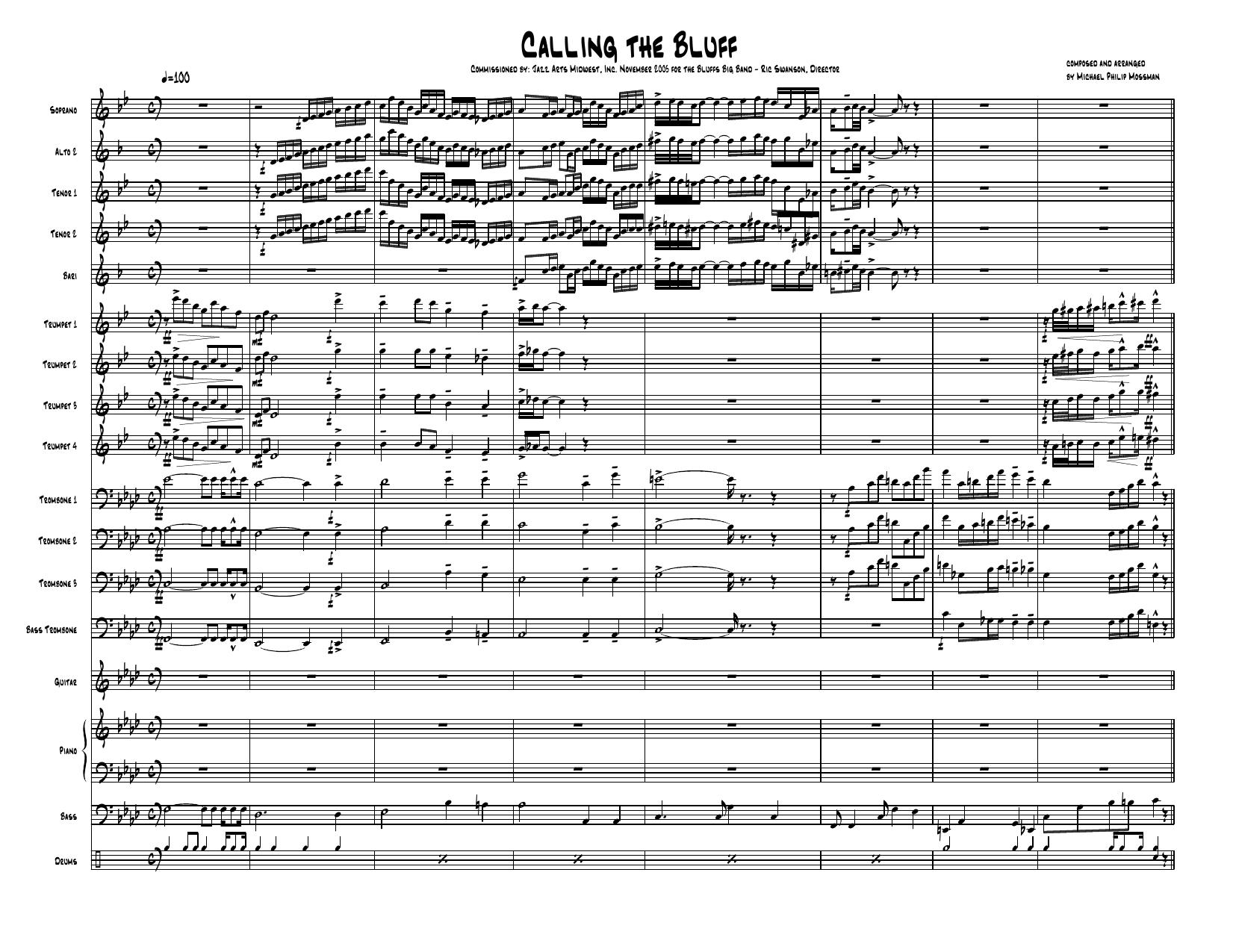
Calling The Bluff (M.P.Mossman) sheet music preview

Calling The Bluff (M.P.Mossman)

Composed by Michael Philip Mossman

Arranged by M.P.Mossman

  • Ensemble: Big Band
  • Pages: 108
  • Instruments (17): Soprano Saxophone, Alto Saxophone 2, Tenor Saxophone 1, Tenor Saxophone 2, Baritone Saxophone, Trumpet 1, Trumpet 2, Trumpet 3, Trumpet 4, Trombone 1, Trombone 2, Trombone 3, Bass Trombone, Guitar, Piano, Bass, Drums
  • Difficulty: advanced
  • Content: Individual Parts
  • Format: PDF Download (Instant)
  • Price: $24.99

Michael Philip Mossman’s dynamic compositional voice has long defined the cutting edge of contemporary big band jazz, bridging the sophisticated harmonic language of post-bop with vibrant Afro-Caribbean rhythmic sensibilities. Originally crafted as a showcase for elite modern large ensembles, "Calling The Bluff" exemplifies Mossman’s signature writing style—characterized by intricate, interlocking horn lines, labyrinthine counterpoint, and an unrelenting forward momentum. As a master trumpeter, composer, and arranger who has worked extensively with the Mingus Big Band, Dizzy Gillespie All-Star Big Band, and Mario Bauzá, Mossman infuses his charts with an authentic insider's understanding of how a modern jazz orchestra breathes, swings, and interacts. Driven by an assertive, high-energy contemporary swing feel at a brisk tempo, "Calling The Bluff" immediately establishes a tense, confident mood. The harmonic landscape is rich with extended alterations, upper-structure triads, and chromatic mediant relationships that demand absolute tonal focus from the entire ensemble. Mossman constructs a tightly wound sonic architecture where the tension-and-release cycle governs every phrase. The arrangement opens with a striking, angular motif that sets an uncompromising tone, quickly giving way to a relentless groove that keeps both the performers and the audience on the edge of their seats. Mossman’s approach to orchestration in this chart showcases a masterclass in texture and color. Rather than relying on standard block-chord writing, he utilizes sophisticated counterpoint and shifting instrumental pairings, frequently pitting the woodwinds against the brass in razor-sharp dialogue. The woodwind doubling—highlighted by a prominent soprano saxophone voice alongside the traditional saxophone section—adds a brilliant, cutting edge to the ensemble’s upper register. A meticulously crafted saxophone soli serves as a structural centerpiece, demanding effortless articulation and flawless intonation across rapid, bebop-infused lines. This leads organically into a thunderous, multi-tiered shout chorus that builds layer upon layer of rhythmic displacement before resolving in a triumphant, high-octane climax. Tailored specifically for advanced collegiate, professional, and elite community big bands, this arrangement requires mature players who possess strong reading skills and command over contemporary jazz idioms. The horn sections carry dense, interlocking thematic material, while designated soloists are provided with ample space to stretch out over sophisticated harmonic progressions. Performing "Calling The Bluff" offers an immense sense of reward for musicians willing to master its complex rhythmic unisons and nuanced dynamic shifts, making it a show-stopping anchor for any ambitious concert or festival program. Conductors tackling "Calling The Bluff" should prioritize rhythmic precision and articulation uniformity across all sections, as Mossman's intricate counterlines leave no room for blurred phrasing. The underlying tempo must remain relentlessly steady; resist the urge to rush during the dense ensemble unisons. The saxophones must approach their soli with a light, forward-moving tongue, ensuring that eighth-note lines bounce rather than sound heavy-handed. Brass players should execute stylistic markings—such as sharp accents, controlled falls, and muted passages—with dry, articulate authority to maintain transparency in the complex harmonic voicings. In rehearsal, isolate the rhythmic figures shared between the lower brass and the rhythm section before integrating the upper horns. Pianists and bassists should lean into the modern modal and altered chord changes, anchoring the ensemble's dynamic peaks while providing an elastic, conversational groove beneath Mossman's intricate melodic web. Q: What instruments and parts are included in this big band arrangement? A: The chart is scored for a 17-piece standard big band instrumentation featuring Soprano Saxophone, Alto Saxophone 2, Tenor Saxophone 1, Tenor Saxophone 2, Baritone Saxophone, four trumpets, four trombones, guitar, piano, bass, and drums, plus a comprehensive conductor score across 108 pages. Q: What is the difficulty level of "Calling The Bluff"? A: This arrangement is graded as advanced/professional, requiring a high level of technical proficiency, strong sight-reading capabilities, and seasoned experience with complex contemporary post-bop harmonic and rhythmic concepts. Q: What is the musical style and historical context of this piece? A: Composed by master jazz trumpeter and arranger Michael Philip Mossman, the piece represents the pinnacle of modern, high-energy contemporary big band jazz, drawing heavily from post-bop traditions and complex rhythmic interplay. Q: What makes this M.P.Mossman arrangement unique? A: It is distinguished by its intricate counterpoint, sophisticated use of soprano saxophone doubling, a blistering saxophone soli, and a multi-layered shout chorus that challenges the ensemble with advanced harmonic alterations and shifting textures. Q: What is the performance duration and tempo feel of the arrangement? A: The piece is built around an assertive, high-energy contemporary swing feel at a brisk, driving tempo designed to test the technical limits and endurance of an elite jazz orchestra.

Questions and answers

What is included in the Calling The Bluff (M.P.Mossman) PDF?
The verified current file contains a conductor score and individual parts across 108 pages.
How many instruments or parts are listed for Calling The Bluff (M.P.Mossman)?
The verified instrumentation list contains 17 entries for this Big Band arrangement.
Who is credited for Calling The Bluff (M.P.Mossman)?
Composer: Michael Philip Mossman. Arranger: M.P.Mossman.
What difficulty is listed for Calling The Bluff (M.P.Mossman)?
The verified difficulty level is advanced.
Can I preview Calling The Bluff (M.P.Mossman) before buying?
Yes. The product page provides a preview generated from the current PDF file.
How is Calling The Bluff (M.P.Mossman) delivered?
After successful payment, the digital PDF is made available for download. The displayed price is $24.99.

Musicians Also Search For

Calling The Bluff M.P.Mossman PDFCalling The Bluff M.P.Mossman sheet musicCalling The Bluff arranged by M.P.MossmanM.P.Mossman big band chartsM.P.Mossman jazz arrangements PDFCalling The Bluff Michael Philip Mossman sheet musicCalling The Bluff Michael Philip Mossman big band arrangementsMichael Philip Mossman big band chartsCalling The Bluff big band arrangementsCalling The Bluff big band PDF downloadCalling The Bluff jazz sheet musicbig band sheet music downloadCalling The Bluff conductor score PDFCalling The Bluff individual parts downloadCalling The Bluff sheet music PDFbuy Calling The Bluff sheet musicdownload Calling The Bluff PDFCalling The Bluff jazz chartsbest M.P.Mossman big band arrangementsMichael Philip Mossman arranged by M.P.MossmanCalling The Bluff printable sheet musicbig band repertoire PDF

All arrangements by M.P.Mossman All Michael Philip Mossman sheet music