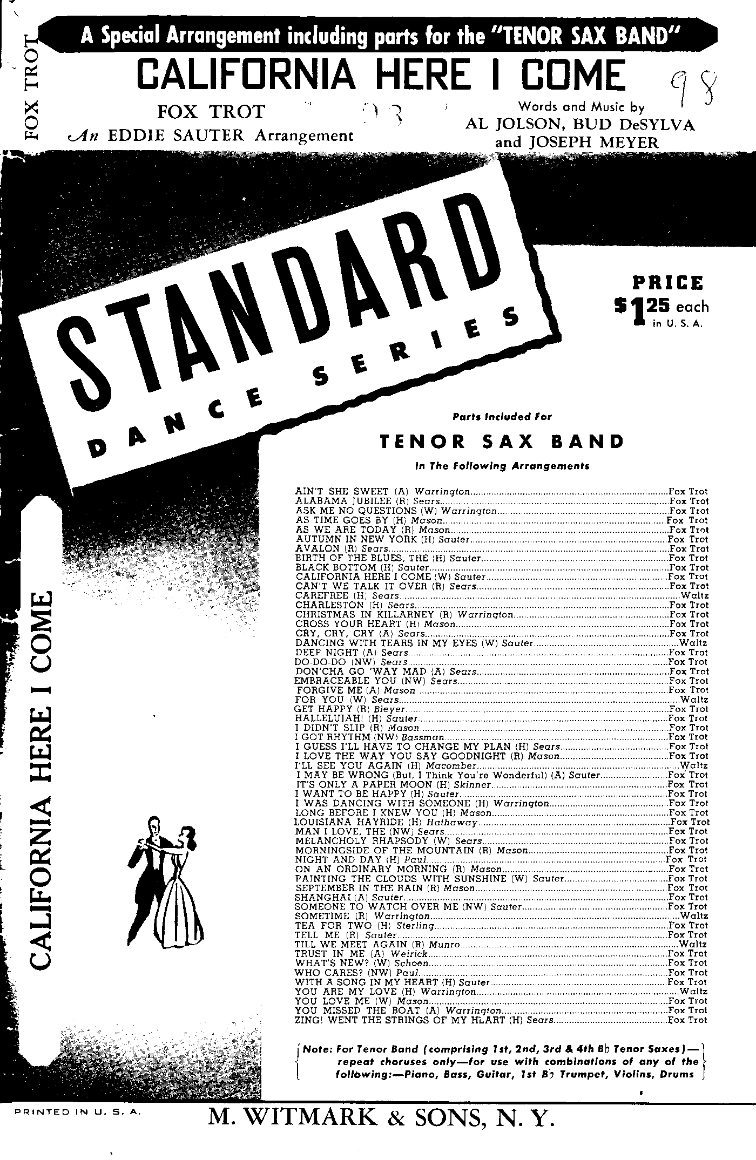
California Here I Come (E.Sauter) sheet music preview

California Here I Come (E.Sauter)

Composed by Joseph Meyer, Al Jolson, Buddy DeSylva

Arranged by E. Sauter

  • Ensemble: Big Band Dance
  • Style: Foxtrot
  • Pages: 35
  • Instruments (17): Alto Saxophone 1, Alto Saxophone 2, Tenor Saxophone 1, Tenor Saxophone 2, Baritone Saxophone, Trumpet 1, Trumpet 2, Trumpet 3, Trumpet 4, Trombone 1, Trombone 2, Trombone 3, Bass Trombone, Piano, Bass, Drums, Guitar
  • Difficulty: medium
  • Content: Individual Parts
  • Format: PDF Download (Instant)
  • Price: $24.99

The iconic tune "California Here I Come," a vibrant anthem penned by Joseph Meyer, Al Jolson, and Buddy DeSylva, burst onto the American consciousness in 1921. Initially popularized by Al Jolson, its infectious melody and optimistic lyrics quickly cemented its status as a Tin Pan Alley standard and an enduring symbol of opportunity and new beginnings, particularly associated with the Golden State. While not strictly a jazz standard in its original form, its widespread popularity and adaptable structure made it a natural fit for interpretation by dance bands and jazz orchestras throughout the 1920s and beyond, embodying the exuberant spirit of the Jazz Age and the burgeoning big band era. This particular arrangement, crafted by the esteemed Eddie Sauter, captures the essence of this period, transforming the familiar melody into a sophisticated Foxtrot perfect for a big band dance ensemble. Sauter's treatment of "California Here I Come" is a masterclass in big band arranging, presenting the piece in a bright, medium-up Foxtrot tempo that encourages a light, buoyant feel. The arrangement is set in a comfortable key, likely C or F major, allowing for a brilliant brass sound without undue strain. Characteristic of Sauter's innovative style, listeners can expect rich, often unexpected harmonic voicings that add depth and color to the familiar melody. His signature use of intricate saxophone soli passages, where the sax section plays complex, interwoven lines in unison or close harmony, will be a highlight. The overall mood is one of joyful anticipation and sophisticated energy, evoking the elegance and excitement of a 1930s ballroom or dance hall. The arrangement opens with a captivating introduction, immediately setting the Foxtrot groove. The melody is primarily carried by the saxophone section, often doubled or punctuated by the brass, showcasing Sauter's skillful orchestration. While specific solo sections are not explicitly detailed in the provided information, it is highly probable that Sauter includes opportunities for improvisation, likely for tenor saxophone or trumpet, typical of the era. The technical challenges lie in executing Sauter's often dense voicings and precise articulations, particularly within the saxophone soli and the dynamic brass interjections. The rewarding aspect of performing this piece comes from achieving the seamless blend and rhythmic precision required to bring Sauter's intricate score to life, culminating in a powerful shout chorus that delivers a thrilling, full-ensemble climax. This arrangement is ideally suited for college-level jazz ensembles, advanced community big bands, or professional dance orchestras seeking a historically authentic and musically rich addition to their repertoire. This Eddie Sauter arrangement of "California Here I Come" thrives on a bright, consistent Foxtrot tempo, around 180-200 BPM, maintaining a light, forward-driving feel without rushing. Conductors should emphasize precise articulation, especially in the saxophone soli sections where Sauter's intricate voicings demand clean attacks and releases for clarity. The brass section requires strong dynamic contrast, moving from supportive background figures to powerful, accented interjections, particularly in the shout chorus. Pay close attention to Sauter's specific dynamic markings and phrasing to achieve the intended emotional arc. Rehearsal should focus on rhythmic accuracy in ensemble passages and ensuring balance within the saxophone section's close harmonies. Muted brass passages, if present, should be executed with appropriate mutes (e.g., cup or straight) to achieve the characteristic period sound. Q: What instruments and parts are included in this arrangement? A: This arrangement is scored for a 17-piece big band dance ensemble, including Alto Saxophone 1, Alto Saxophone 2, Tenor Saxophone 1, Tenor Saxophone 2, Baritone Saxophone, Trumpet 1, Trumpet 2, Trumpet 3, Trumpet 4, Trombone 1, Trombone 2, Trombone 3, Trombone 4, Piano, Bass, Guitar, and Drums. Q: What is the difficulty level of this arrangement? A: This arrangement is considered advanced, suitable for college-level jazz ensembles, advanced community big bands, or professional dance orchestras due to Eddie Sauter's sophisticated voicings, intricate saxophone soli, and precise articulation demands. Q: What musical style and historical context does this arrangement represent? A: This arrangement is a Foxtrot, capturing the vibrant and sophisticated big band dance music style of the 1930s, based on the classic Tin Pan Alley tune "California Here I Come" from 1921. Q: What makes Eddie Sauter's arrangement of "California Here I Come" unique? A: Sauter's distinctive approach features rich, often unexpected harmonic voicings, intricate saxophone soli passages, and a brilliant orchestration that transforms the familiar melody into a sophisticated and energetic big band showpiece. Q: What is the typical performance duration or tempo for this piece? A: As a medium-up Foxtrot, the typical tempo for this arrangement would be in the range of 180-200 BPM, resulting in a performance duration of approximately 3-4 minutes, depending on any improvised solos.

Musicians Also Search For

California Here I Come E. Sauter PDFCalifornia Here I Come E. Sauter sheet musicCalifornia Here I Come arranged by E. SauterE. Sauter big band dance chartsE. Sauter jazz arrangements PDFCalifornia Here I Come Joseph Meyer, Al Jolson, Buddy DeSylva sheet musicCalifornia Here I Come Joseph Meyer, Al Jolson, Buddy DeSylva big band dance arrangementJoseph Meyer, Al Jolson, Buddy DeSylva big band dance chartsCalifornia Here I Come big band dance arrangementCalifornia Here I Come big band dance PDF downloadCalifornia Here I Come jazz ensemble sheet musicbig band dance sheet music instant downloadCalifornia Here I Come individual parts downloadCalifornia Here I Come sheet music with partsCalifornia Here I Come Foxtrot chartFoxtrot big band dance arrangementsbuy California Here I Come sheet music onlinedownload California Here I Come PDFCalifornia Here I Come jazz chartbest E. Sauter big band dance arrangementsJoseph Meyer, Al Jolson, Buddy DeSylva songs arranged by E. SauterCalifornia Here I Come printable sheet musicbig band dance repertoire PDF

All arrangements by E. Sauter All Joseph Meyer, Al Jolson, Buddy DeSylva sheet music