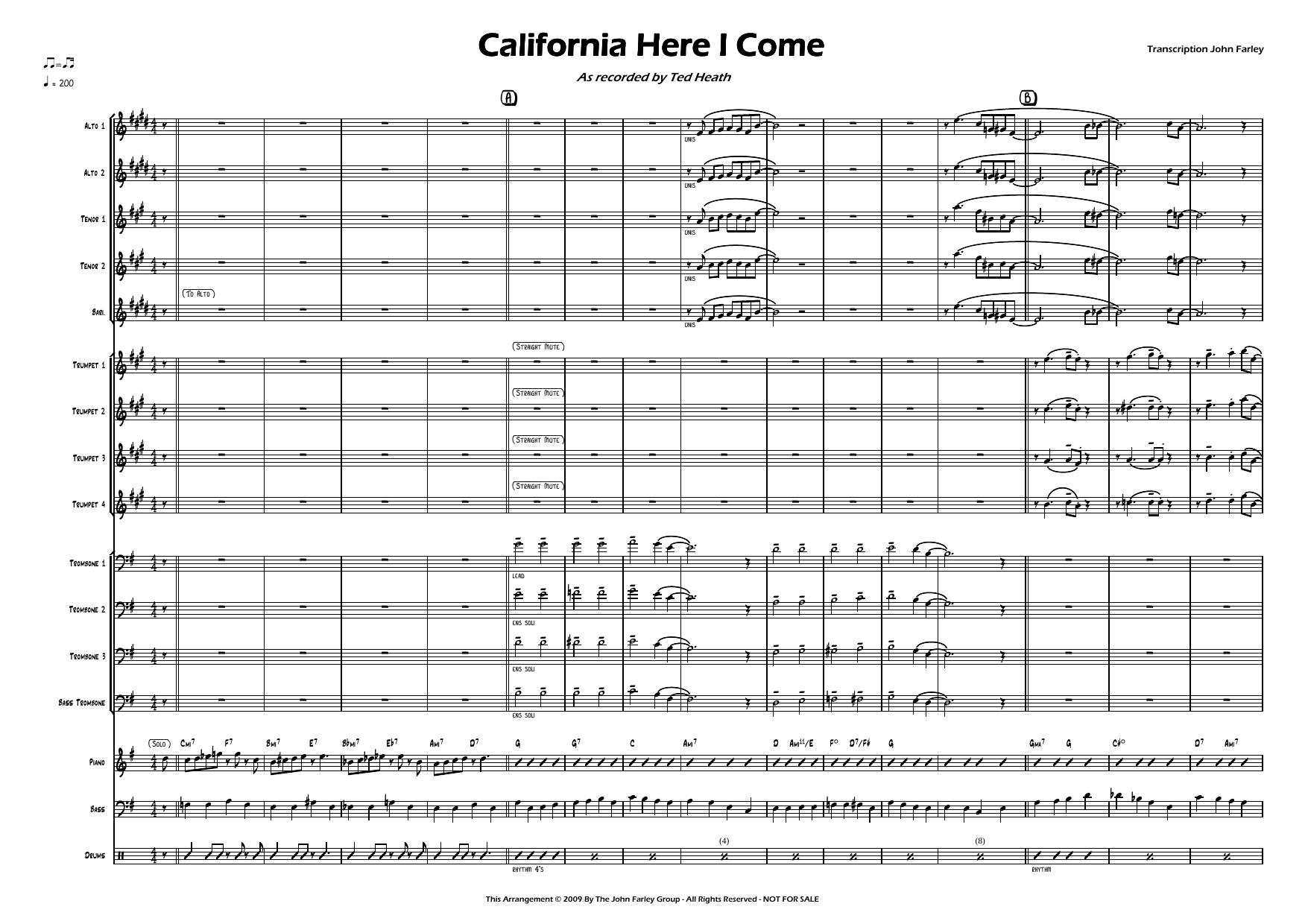
California Here I Come (J.Farley)
Composed by Walter Donaldson
Arranged by John Farley
- Ensemble: Big Band
- Pages: 40
- Instruments (17): Alto 1, Alto 2, Tenor 1, Tenor 2, Bari & Alto, Trumpet 1, Trumpet 2, Trumpet 3, Trumpet 4, Trombone 1, Trombone 2, Trombone 3, Bass Trombone, Guitar, Piano, Bass, Drums
- Difficulty: medium
- Content: Individual Parts
- Format: PDF Download (Instant)
- Price: $24.99
Written by Walter Donaldson and B.G. DeSylva, with a verse contributed by Al Jolson, "California Here I Come" burst onto the Tin Pan Alley scene in 1924, rapidly ascending to become a defining anthem of the roaring twenties. While initially popularized by Jolson—who cemented its status by performing it in the musical *Bombo*—the tune quickly crossed over into the burgeoning jazz idiom. Early jazz icons and traditional dance orchestras embraced its buoyant melody and infectious drive, and it eventually transitioned into a staple jam-session standard. The composition captures the restless, optimistic energy of an America on the move, reflecting the cultural fascination with the golden coast of California and embodying the syncopated vitality of the early jazz age. John Farley’s dynamic big band adaptation channels this historical effervescence through a distinctly modern, high-energy swing lens. Set in a bright, driving 4/4 medium-up swing tempo (around quarter note = 192 BPM), the chart radiates unbridled optimism and exuberant showmanship. Farley frames the iconic, upward- leaping melody with crisp brass stabs and cascading saxophone counterlines that evoke the classic pulse of the mid-century swing era, yet infuses the harmony with clever chromatic passing chords and subtle tritone substitutions. The mood is celebratory and infectious, shifting seamlessly from driving ensemble tutti sections to swinging, laid-back conversational exchanges between the brass and reed families. Farley’s arrangement shines brightest in its architectural pacing, building momentum through a brilliantly constructed saxophone soli that mirrors the melodic agility of the 1930s greats before expanding into a roaring, harmonically rich shout chorus. The tenor saxophone and lead trumpet share primary melodic duties early on, while the baritone saxophone and bass trombone anchor the bottom-end counterpoint with a robust, walking foundation. Featured solo space is thoughtfully provided for tenor saxophone and drums, allowing improvisers to stretch out over standard changes that remain faithful to Donaldson's original harmonic framework. Technical demands center primarily on clean articulation at speed, precise section blending during fast-moving chromatic lines, and maintaining an even, buoyant swing eighth-note subdivision without rushing the tempo. Advanced high school ensembles with strong section players, as well as collegiate and professional community big bands, will find this chart an absolute crowd-pleaser and a rewarding technical workout. The arrangement requires confident lead trumpet playing with range up to high D, agile woodwind doubling or fast fingerwork in the saxes, and a rhythm section capable of driving a relentless, feather-light swing feel. It functions brilliantly as an explosive concert opener, a high-impact festival chart, or a memorable show-closer that leaves audiences energized. Executing this chart successfully hinges on maintaining a relentless, relaxed swing feel at a brisk tempo. The primary technical hurdle lies in the execution of fast, syncopated shout choruses where precision between the brass and reeds is paramount. Conductors should ensure that the brass players utilize short, clipped articulations on accented off-beats, avoiding a heavy, punchy attack that can bog down the forward momentum. The rhythm section must anchor the groove: the drummer should ride the cymbal with a clear triplet feel while keeping the hi-hat crisp on beats two and four, while the bassist avoids over-syncopating, sticking to a driving, quarter-note walking line. Saxophones must balance their dynamic level carefully during the soli section so that internal harmony voices do not obscure the primary melodic line. Standard big band stylistic devices—such as controlled falls on terminal notes and subtle plunger work in the brass—should be applied tastefully to enhance the vintage, theatrical flair of the arrangement without descending into caricature. Q: What instruments and parts are included in this big band package? A: The arrangement is scored for a standard 17-piece big band instrumentation: 5 saxophones (Alto 1, Alto 2, Tenor 1, Tenor 2, Baritone), 4 trumpets, 4 trombones (including bass trombone), piano, guitar, bass, and drums, alongside a comprehensive conductor score and 40 total pages of parts. Q: What is the difficulty level of this arrangement? A: This chart is graded as advanced (approximate Grade 4.5/5), best suited for advanced high school, collegiate, and professional or community big bands with strong section players and confident soloists. Q: What is the stylistic background and historical context of the piece? A: Based on Walter Donaldson’s 1924 Tin Pan Alley classic, this arrangement reimagines a timeless early jazz and vocal standard through a sophisticated, high-energy swing big band treatment. Q: What makes John Farley’s arrangement unique? A: Farley bridges classic 1920s vaudeville optimism with modern big band arranging techniques, featuring inventive harmonic substitutions, a brilliant saxophone soli, and a powerful shout chorus that drives the ensemble to an explosive finish. Q: What is the performance duration and recommended tempo? A: The performance duration is approximately 3 minutes and 30 seconds when played at the recommended tempo of quarter note = 192 BPM in a bright swing feel.
Questions and answers
- What is included in the California Here I Come (J.Farley) PDF?
- The verified current file contains a conductor score and individual parts across 40 pages.
- How many instruments or parts are listed for California Here I Come (J.Farley)?
- The verified instrumentation list contains 17 entries for this Big Band arrangement.
- Who is credited for California Here I Come (J.Farley)?
- Composer: Walter Donaldson. Arranger: John Farley.
- What difficulty is listed for California Here I Come (J.Farley)?
- The verified difficulty level is medium.
- Can I preview California Here I Come (J.Farley) before buying?
- Yes. The product page provides a preview generated from the current PDF file.
- How is California Here I Come (J.Farley) delivered?
- After successful payment, the digital PDF is made available for download. The displayed price is $24.99.
Musicians Also Search For
California Here I Come John Farley PDF • California Here I Come John Farley sheet music • California Here I Come arranged by John Farley • John Farley big band charts • John Farley jazz arrangements PDF • California Here I Come Walter Donaldson sheet music • California Here I Come Walter Donaldson big band arrangements • Walter Donaldson big band charts • California Here I Come big band arrangements • California Here I Come big band PDF download • California Here I Come jazz sheet music • big band sheet music download • California Here I Come conductor score PDF • California Here I Come individual parts download • California Here I Come sheet music PDF • buy California Here I Come sheet music • download California Here I Come PDF • California Here I Come jazz charts • best John Farley big band arrangements • Walter Donaldson arranged by John Farley • California Here I Come printable sheet music • big band repertoire PDF