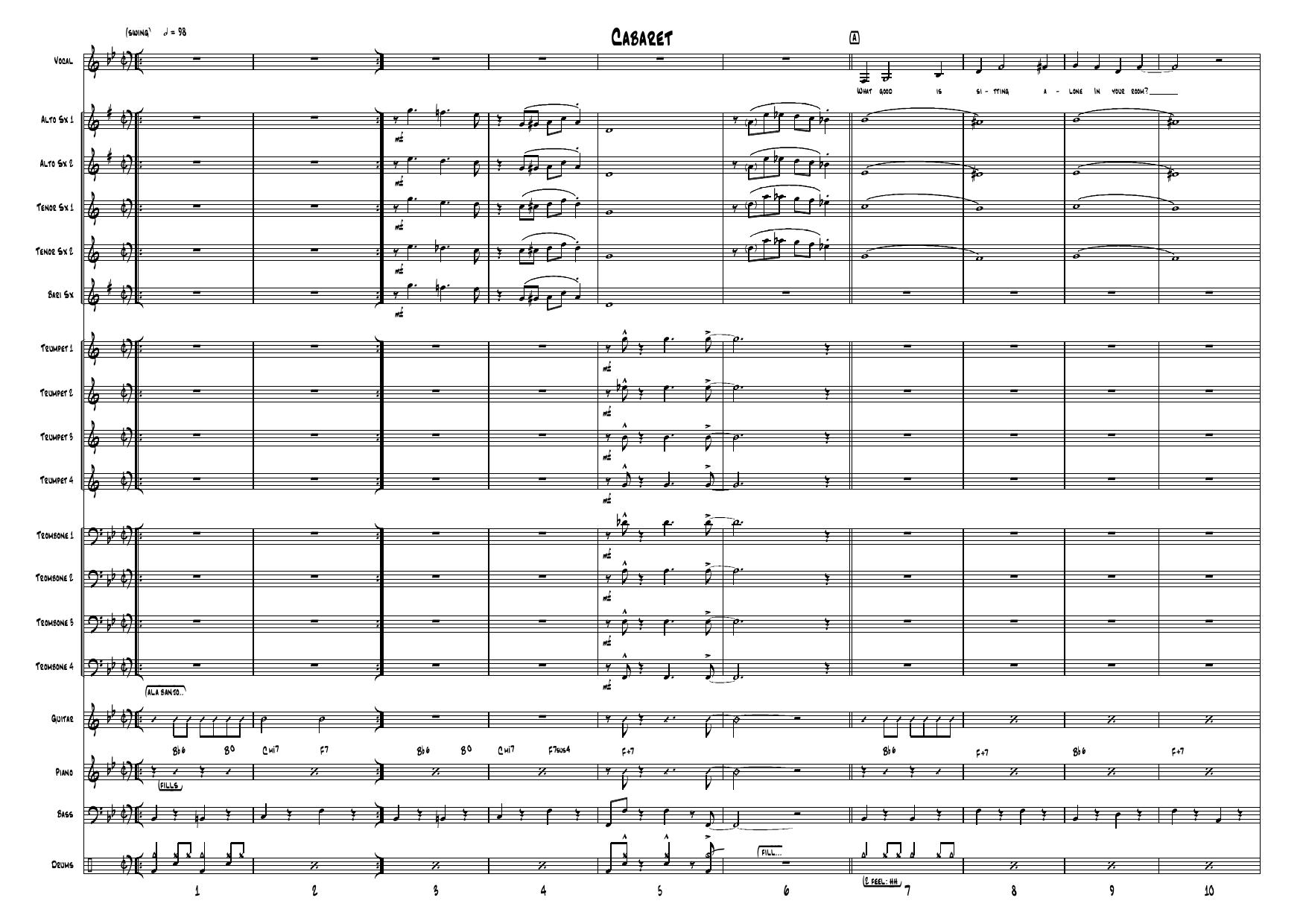
Cabaret (L.Minnelli) Vocal in Bb sheet music preview

Cabaret (L.Minnelli) Vocal in Bb

Composed by John Kander

Arranged by L. Minnelli

  • Ensemble: Big Band Vocal
  • Style: Musical Theatre
  • Pages: 55
  • Instruments (19): Vocal, Alto Saxophone 1, Alto Saxophone 2, Tenor Saxophone 1, Clarinet, Tenor Saxophone 2, Baritone Saxophone, Trumpet 1, Trumpet 2, Trumpet 3, Trumpet 4, Trombone 1, Trombone 2, Trombone 3, Trombone 4, Guitar, Piano, Bass, Drums
  • Difficulty: medium
  • Content: Individual Parts
  • Format: PDF Download (Instant)
  • Price: $24.99

John Kander and Fred Ebb's iconic title song from the musical *Cabaret* first captivated audiences in 1966, quickly becoming synonymous with the defiant spirit and dark allure of Weimar-era Berlin. While originally performed by Jill Haworth on Broadway, it was Liza Minnelli's electrifying portrayal of Sally Bowles in Bob Fosse's 1972 film adaptation that cemented "Cabaret" as a global phenomenon and an enduring musical theatre standard. The song itself is a powerful narrative, urging listeners to embrace life's fleeting pleasures amidst impending doom, a theme that resonates with both historical context and universal human experience. Its dramatic arc, from a deceptively simple opening to a soaring, almost desperate declaration, makes it a compelling vehicle for a powerful vocalist. This arrangement, specifically crafted for big band and vocal soloist by L. Minnelli, captures the theatrical grandeur and emotional depth of the original while re-imagining it within a sophisticated jazz idiom. Set in the key of Bb major, it maintains a deliberate, medium-tempo swing feel, allowing the vocalist ample space to interpret the poignant lyrics without rushing the emotional delivery. The harmonic language is rich and evocative, featuring extended chords and carefully voiced dissonances that underscore the song's bittersweet narrative. Unlike many big band charts that might lean heavily into a pure jazz swing, this arrangement skillfully blends the theatricality of musical theatre with the rhythmic drive and harmonic complexity of a contemporary jazz ensemble. L. Minnelli's distinctive arranging style is evident in the thoughtful orchestration and dynamic shaping throughout the 55-page score. The vocal melody is paramount, often presented with sparse, supportive accompaniment in the initial verses, allowing the singer's storytelling to take center stage. As the piece progresses, the band gradually builds in intensity, employing full ensemble soli sections that echo the vocal line, creating a powerful call-and-response effect. A notable feature is the strategic use of brass fanfares and woodwind flourishes that punctuate key lyrical phrases, enhancing the dramatic impact. The arrangement culminates in a powerful shout chorus that provides a thrilling backdrop for the vocalist's final, climactic statements, demanding both precise ensemble playing and a commanding vocal performance. There are no improvised solos, keeping the focus squarely on the vocal narrative and the ensemble's collective power. This arrangement is ideally suited for college-level jazz ensembles, advanced community big bands, or professional groups seeking a show-stopping vocal feature. The technical demands are moderate to high, requiring strong section playing, excellent dynamic control, and a vocalist with significant range, projection, and interpretive skill. The rewarding aspect lies in the opportunity to perform a truly iconic piece with a fresh, yet respectful, big band treatment, offering both musical challenge and immense audience appeal. The meticulous scoring ensures that every part contributes to the overall dramatic effect, making it a cohesive and impactful performance experience. This arrangement of "Cabaret" in Bb major demands a nuanced approach to tempo and dynamics. Maintain a consistent medium-swing feel (quarter note = 120-128 BPM), ensuring the rhythmic pulse is steady but never rigid, allowing for subtle rubato from the vocalist. The primary technical challenge lies in achieving precise ensemble attacks and releases, particularly in the brass soli sections and the powerful shout chorus. Emphasize dynamic contrasts, from the hushed, supportive accompaniment in the opening verses to the full-throated intensity of the climactic moments. Rehearsal time should be dedicated to balancing the band behind the vocalist, ensuring clarity of the lyrics at all times. Pay close attention to the articulation markings, especially the short, accented figures in the brass, which should be crisp and impactful. No special mutes are required, but a warm, blended brass sound is essential. The dramatic build-up requires careful pacing, with each section contributing to the overall narrative arc. Q: What instruments are included in this arrangement? A: This is a standard big band arrangement, typically including 5 saxophones (2 alto, 2 tenor, 1 baritone), 4 trombones, 4 trumpets, piano, bass, drums, and a dedicated vocal soloist part. Q: What is the difficulty level of this arrangement? A: This arrangement is rated as medium-advanced. It requires solid section playing, strong dynamic control, and a vocalist with significant range, projection, and interpretive abilities, making it suitable for college or advanced community big bands. Q: What musical style does this arrangement represent, and what is its historical context? A: This arrangement is in the musical theatre style, adapted for big band. The original song "Cabaret" was composed by John Kander in 1966 for the musical of the same name, famously performed by Liza Minnelli in the 1972 film, reflecting the vibrant yet tumultuous atmosphere of Weimar-era Berlin. Q: What makes L. Minnelli's arrangement of "Cabaret" unique? A: L. Minnelli's arrangement is unique for its sophisticated blend of musical theatre drama with big band jazz harmonies and a medium-swing feel. It prioritizes the vocal narrative, features powerful full ensemble soli sections, and builds dynamically without relying on improvised solos. Q: What is the typical performance duration and tempo for this piece? A: The typical performance duration for this arrangement is approximately 3:30 to 4:00 minutes. It is designed to be performed at a medium-swing tempo, around quarter note = 120-128 BPM.

Questions and answers

What is included in the Cabaret (L.Minnelli) Vocal in Bb PDF?
The verified current file contains a conductor score and individual parts across 55 pages.
How many instruments or parts are listed for Cabaret (L.Minnelli) Vocal in Bb?
The verified instrumentation list contains 19 entries for this Big Band Vocal arrangement.
Who is credited for Cabaret (L.Minnelli) Vocal in Bb?
Composer: John Kander. Arranger: L. Minnelli.
What difficulty is listed for Cabaret (L.Minnelli) Vocal in Bb?
The verified difficulty level is medium.
What style is listed for Cabaret (L.Minnelli) Vocal in Bb?
The catalog lists the style as Musical Theatre.
Can I preview Cabaret (L.Minnelli) Vocal in Bb before buying?
Yes. The product page provides a preview generated from the current PDF file.
How is Cabaret (L.Minnelli) Vocal in Bb delivered?
After successful payment, the digital PDF is made available for download. The displayed price is $24.99.

Musicians Also Search For

Cabaret L. Minnelli PDFCabaret L. Minnelli sheet musicCabaret arranged by L. MinnelliL. Minnelli big band vocal chartsL. Minnelli jazz arrangements PDFCabaret John Kander sheet musicCabaret John Kander big band vocal arrangementsJohn Kander big band vocal chartsCabaret big band vocal arrangementsCabaret big band vocal PDF downloadCabaret jazz sheet musicbig band vocal sheet music downloadCabaret conductor score PDFCabaret individual parts downloadCabaret sheet music PDFCabaret Musical Theatre chartsMusical Theatre big band vocal arrangementsbuy Cabaret sheet musicdownload Cabaret PDFCabaret jazz chartsbest L. Minnelli big band vocal arrangementsJohn Kander arranged by L. MinnelliCabaret printable sheet musicbig band vocal repertoire PDF

All arrangements by L. Minnelli All John Kander sheet music