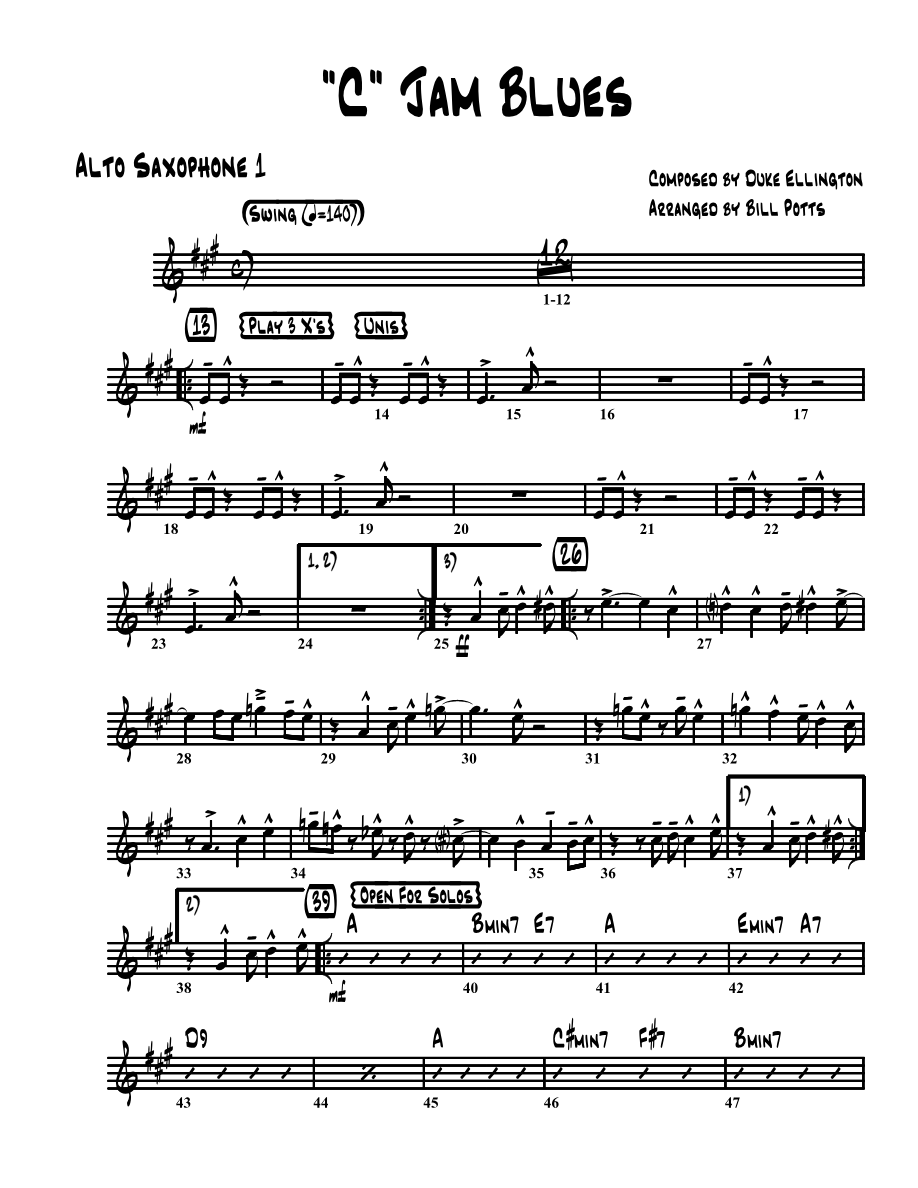
C Jam Blues (B.Potts)
Composed by Duke Ellington
Arranged by Bill Potts
- Ensemble: Big Band
- Style: Jazz Standard
- Pages: 50
- Instruments (17): Alto Saxophone 1, Alto Saxophone 2, Tenor Saxophone 1, Tenor Saxophone 2, Baritone Saxophone, Trumpet 1, Trumpet 2, Trumpet 3, Trumpet 4, Trombone 1, Trombone 2, Trombone 3, Bass Trombone, Guitar, Piano, Bass, Drums
- Difficulty: advanced
- Content: Individual Parts
- Format: PDF Download (Instant)
- Price: $24.99
Duke Ellington's "C Jam Blues," originally conceived in 1941, stands as an enduring emblem of the swing era, a testament to the power of simplicity and rhythmic vitality in jazz. This iconic 12-bar blues in C major, famously built around just two notes for its initial melody, quickly transcended its humble origins to become a jam session staple and a cornerstone of the jazz repertoire. Its immediate accessibility and infectious, medium-swing groove made it a favorite among musicians and audiences alike, solidifying its status as a true jazz standard. The piece embodies the communal spirit of jazz, often serving as a launching pad for extended improvisations and showcasing the individual voices within an ensemble. Bill Potts's masterful arrangement of "C Jam Blues" elevates this classic to a sophisticated big band showpiece, retaining its joyful core while infusing it with his characteristic harmonic richness and orchestral flair. Potts, known for his intricate yet swinging charts, approaches this standard with a keen understanding of big band dynamics. His treatment features lush, tightly voiced saxophone solis that weave intricate countermelodies around the familiar theme, demonstrating his signature ability to make complex harmonies sound effortlessly smooth. The brass sections are deployed with precision, delivering powerful, often punctuated figures that drive the swing forward without ever overwhelming the ensemble. The arrangement maintains a medium-swing tempo, allowing for both rhythmic precision and expressive fluidity, evoking a mood of sophisticated exuberance. This arrangement is a rewarding challenge for any big band seeking to explore a classic through a fresh, yet authentically swinging lens. The melody is initially carried by the saxophones, often in unison or tight harmonies, before being passed to the brass for powerful statements. Solo opportunities are plentiful and strategically placed, typically over the blues form, allowing multiple instrumentalists to shine. Technical challenges include precise articulation in the fast-moving soli passages, maintaining blend and balance in the full ensemble shout choruses, and executing dynamic contrasts that are crucial to Potts's dramatic arc. The chart culminates in a thrilling, full-ensemble shout chorus that builds to an exhilarating climax, requiring strong breath support and cohesive attack from all sections. With its 17-instrument scoring, this arrangement is ideally suited for advanced high school, collegiate, community, and professional big bands. The depth of Potts's writing offers substantial educational value, providing an excellent vehicle for developing ensemble precision, harmonic awareness, and stylistic authenticity. The detailed voicings and dynamic markings demand careful attention, fostering a higher level of musicality and ensemble cohesion. Performing this chart is a deeply satisfying experience, offering both the comfort of a familiar classic and the excitement of discovering its renewed vitality through Potts's ingenious orchestration. Conductors should emphasize a consistent, medium-swing feel throughout, ensuring the rhythm section lays down a solid, unhurried foundation. Pay close attention to Bill Potts's detailed dynamic markings; they are integral to shaping the dramatic contour of the piece, particularly in the build-up to and release from the shout choruses. Technical challenges include the precise articulation and blend required for the saxophone solis, which feature intricate lines and close voicings. Brass players should focus on clean attacks and releases, especially in the punctuated figures, and be prepared for potential plunger mute work in specified sections, adding classic big band color. Rehearsal time should be dedicated to balancing the layered textures, ensuring that inner voices are heard without obscuring the main melodic lines. Encourage soloists to embrace the blues form with both melodic invention and rhythmic drive, allowing their individual voices to contribute to the overall narrative. Q: What instruments and parts are included in this arrangement? A: This arrangement is scored for a standard 17-instrument big band lineup, including Alto Saxophone 1, Alto Saxophone 2, Tenor Saxophone 1, Tenor Saxophone 2, Baritone Saxophone, Trumpet 1, Trumpet 2, Trumpet 3, Trumpet 4, Trombone 1, Trombone 2, Trombone 3, Trombone 4, Piano, Bass, Guitar, and Drums. Q: What is the difficulty level of "C Jam Blues (B.Potts)"? A: This arrangement is considered advanced, suitable for collegiate, community, or professional big bands. It presents challenges in terms of intricate voicings, dynamic control, and ensemble precision, making it a rewarding piece for experienced musicians. Q: What is the musical style and historical context of this arrangement? A: This is a big band jazz arrangement of Duke Ellington's classic "C Jam Blues," a quintessential swing era jazz standard composed in 1941. Bill Potts's arrangement maintains the original's medium-swing feel while adding sophisticated harmonic and orchestral elements. Q: What makes Bill Potts's arrangement of "C Jam Blues" unique? A: Bill Potts's treatment is distinctive for its rich, intricate voicings, particularly in the saxophone solis, and his sophisticated harmonic approach that elevates the simple blues form. It features powerful brass statements and a dynamic, building shout chorus, showcasing his signature big band writing. Q: What is the typical performance duration and tempo for this piece? A: The typical performance duration for this arrangement is approximately 4-6 minutes, depending on the number and length of improvised solos. It is designed to be performed at a medium-swing tempo, around 120-144 beats per minute.
Questions and answers
- What is included in the C Jam Blues (B.Potts) PDF?
- The verified current file contains individual parts across 50 pages.
- How many instruments or parts are listed for C Jam Blues (B.Potts)?
- The verified instrumentation list contains 17 entries for this Big Band arrangement.
- Who is credited for C Jam Blues (B.Potts)?
- Composer: Duke Ellington. Arranger: Bill Potts.
- What difficulty is listed for C Jam Blues (B.Potts)?
- The verified difficulty level is advanced.
- What style is listed for C Jam Blues (B.Potts)?
- The catalog lists the style as Jazz Standard.
- Can I preview C Jam Blues (B.Potts) before buying?
- Yes. The product page provides a preview generated from the current PDF file.
- How is C Jam Blues (B.Potts) delivered?
- After successful payment, the digital PDF is made available for download. The displayed price is $24.99.
Musicians Also Search For
C Jam Blues Bill Potts PDF • C Jam Blues Bill Potts sheet music • C Jam Blues arranged by Bill Potts • Bill Potts big band charts • Bill Potts jazz arrangements PDF • C Jam Blues Duke Ellington sheet music • C Jam Blues Duke Ellington big band arrangements • Duke Ellington big band charts • C Jam Blues big band arrangements • C Jam Blues big band PDF download • C Jam Blues jazz sheet music • big band sheet music download • C Jam Blues individual parts download • C Jam Blues sheet music PDF • C Jam Blues Jazz Standard charts • Jazz Standard big band arrangements • buy C Jam Blues sheet music • download C Jam Blues PDF • C Jam Blues jazz charts • best Bill Potts big band arrangements • Duke Ellington arranged by Bill Potts • C Jam Blues printable sheet music • big band repertoire PDF