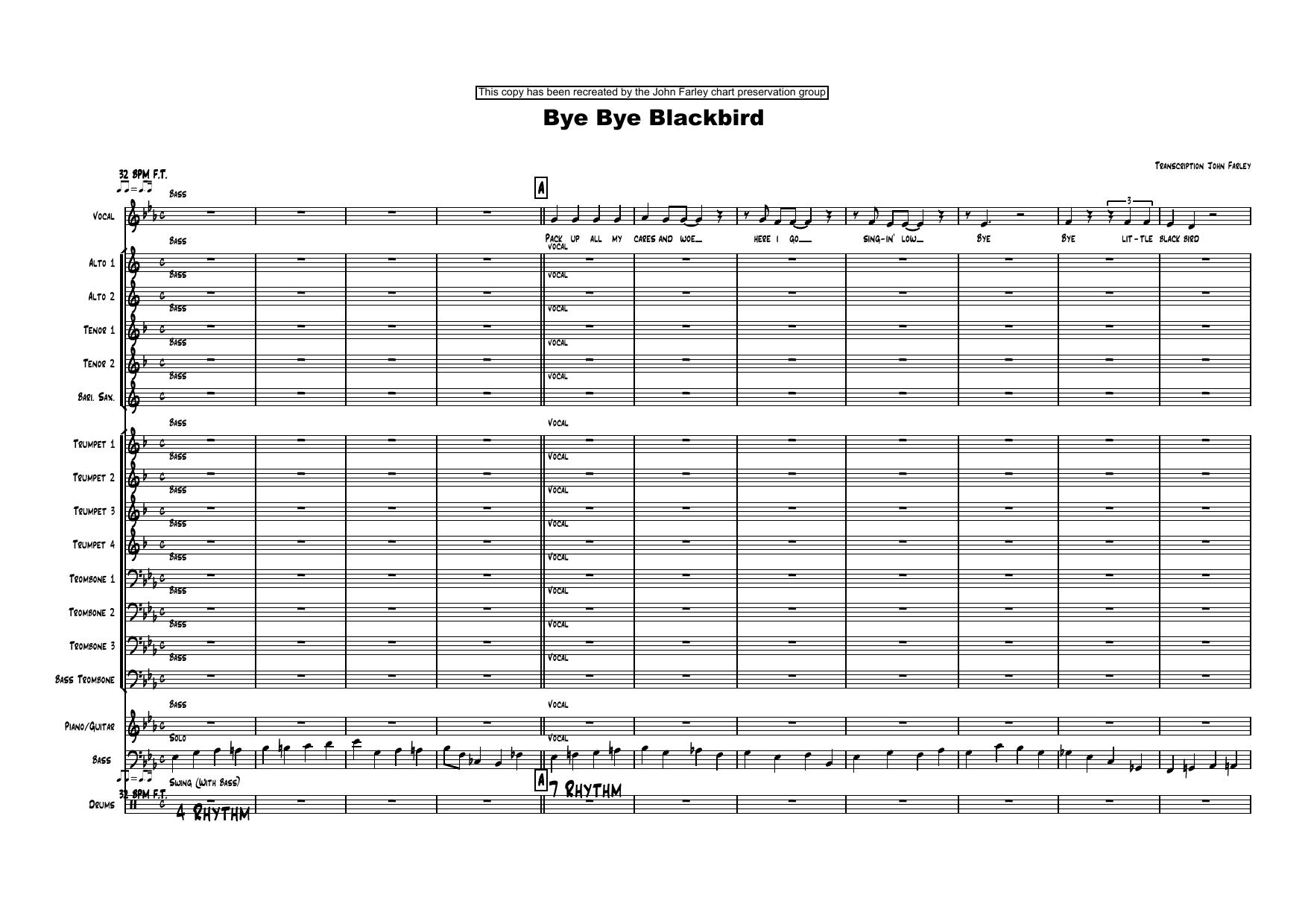
Bye Bye Blackbird (M.Collins)
Composed by Ray Henderson
Arranged by Myles Collins
- Ensemble: Big Band Vocal
- Style: Jazz Standard
- Pages: 29
- Instruments (18): Vocal, Alto Saxophone 1, Alto Saxophone 2, Tenor Saxophone 1, Tenor Saxophone 2, Baritone Saxophone, Trumpet 1, Trumpet 2, Trumpet 3, Trumpet 4, Trombone 1, Trombone 2, Trombone 3, Bass Trombone, Piano, Guitar, Bass, Drums
- Difficulty: medium
- Content: Individual Parts
- Format: PDF Download (Instant)
- Price: $24.99
First published in 1926, Ray Henderson's "Bye Bye Blackbird" quickly became a cornerstone of the Great American Songbook, a poignant melody that captured the spirit of an era. Its enduring appeal lies in its deceptively simple, yet deeply expressive, harmonic and melodic structure, making it a favorite for countless interpretations across jazz, pop, and blues. Initially popularized by performers like Gene Austin and later embraced by jazz luminaries such as Louis Armstrong, Miles Davis, and Frank Sinatra, the tune’s narrative of leaving troubles behind for a new beginning resonates universally. This particular arrangement by Myles Collins reimagines the classic as a sophisticated, medium-swing big band vocal feature, honoring its historical roots while infusing it with contemporary jazz sensibilities. Myles Collins’ treatment of "Bye Bye Blackbird" establishes a comfortable, medium-swing groove in 4/4 time, likely in a singer-friendly key such as F or G major, designed to highlight the vocal soloist’s lyrical delivery. The arrangement opens with a warm, inviting introduction, perhaps a harmonically rich brass choir or a subtle saxophone soli, setting a mood of gentle anticipation. Throughout the piece, Collins masterfully weaves intricate voicings for the saxophone and brass sections, creating a lush sonic tapestry that supports the vocalist without overwhelming them. Expect sophisticated extended harmonies and occasional reharmonizations that add a fresh, modern sheen to the familiar melody, maintaining the tune's inherent optimism while deepening its emotional resonance. The arrangement features the vocalist prominently, carrying the iconic melody through the initial choruses. Collins’ signature approach often includes dynamic contrasts, building from understated accompaniment to powerful, full-ensemble sections. A standout feature will likely be a meticulously crafted saxophone soli, showcasing the section's precision and blend, followed by a brass soli that adds punch and brilliance. There will undoubtedly be a dedicated section for an improvised solo, typically for tenor saxophone or trumpet, providing an opportunity for a band member to shine over the swinging rhythm section. The arrangement culminates in a powerful shout chorus, where the full big band erupts in a joyous, harmonically dense statement, before resolving into a polished, definitive ending. This arrangement is ideally suited for college-level jazz ensembles, advanced community big bands, or professional groups looking for a polished and engaging vocal chart. While the technical demands are significant, particularly in the soli sections and for the lead trumpet, the clarity of Collins' writing makes these challenges rewarding to conquer. The piece demands strong ensemble blend, precise articulation, and a rhythm section capable of maintaining a consistent, driving swing feel. Performers will find immense satisfaction in bringing this vibrant interpretation of a beloved standard to life, offering audiences a fresh yet respectful take on "Bye Bye Blackbird." Conductors should emphasize a relaxed, yet propulsive, medium-swing feel from the outset, ensuring the rhythm section lays down a solid foundation without rushing. Key technical challenges include the intricate saxophone and brass soli passages, which require meticulous attention to articulation, balance, and intonation for maximum impact. Encourage brass players to maintain a bright, focused sound, particularly in the shout chorus, while saxophones should strive for a warm, unified blend. Pay close attention to dynamic contrasts, building tension and release effectively, especially leading into and out of the vocal sections. The improvised solo section should allow for creative freedom over the changes, with the rhythm section providing sensitive accompaniment. Ensure the vocalist has ample space and support, allowing their interpretation of the classic melody to shine through. Q: What instruments and parts are included in this arrangement? A: This big band vocal arrangement typically includes parts for a vocalist, 5 saxophones (2 altos, 2 tenors, 1 baritone), 4 trumpets, 4 trombones, and a full rhythm section (piano, bass, drums, guitar). Q: What is the difficulty level of "Bye Bye Blackbird (M.Collins)"? A: This arrangement is rated as advanced intermediate to advanced (Grade 4-5), making it suitable for college, advanced community, or professional jazz ensembles due to its intricate voicings, soli sections, and demands on ensemble precision. Q: What musical style and historical context does this arrangement represent? A: This is a sophisticated big band vocal arrangement of "Bye Bye Blackbird," a classic jazz standard from 1926. It blends the timeless melody and harmonic structure of the Great American Songbook with modern jazz arranging techniques and a medium-swing feel. Q: What makes Myles Collins' arrangement of "Bye Bye Blackbird" unique? A: Myles Collins' treatment stands out for its elegant reharmonizations, meticulously crafted saxophone and brass soli sections, dynamic contrasts, and a powerful shout chorus, all while maintaining a singer-friendly, medium-swing groove that highlights the vocalist. Q: What is the typical performance duration or tempo for this piece? A: Performed at a medium-swing tempo (e.g., quarter note = 120-132 bpm), this arrangement typically has a performance duration of approximately 3 to 4 minutes, depending on the length of the improvised solo.
Questions and answers
- What is included in the Bye Bye Blackbird (M.Collins) PDF?
- The verified current file contains a conductor score and individual parts across 29 pages.
- How many instruments or parts are listed for Bye Bye Blackbird (M.Collins)?
- The verified instrumentation list contains 18 entries for this Big Band Vocal arrangement.
- Who is credited for Bye Bye Blackbird (M.Collins)?
- Composer: Ray Henderson. Arranger: Myles Collins.
- What difficulty is listed for Bye Bye Blackbird (M.Collins)?
- The verified difficulty level is medium.
- What style is listed for Bye Bye Blackbird (M.Collins)?
- The catalog lists the style as Jazz Standard.
- Can I preview Bye Bye Blackbird (M.Collins) before buying?
- Yes. The product page provides a preview generated from the current PDF file.
- How is Bye Bye Blackbird (M.Collins) delivered?
- After successful payment, the digital PDF is made available for download. The displayed price is $24.99.
Musicians Also Search For
Bye Bye Blackbird Myles Collins PDF • Bye Bye Blackbird Myles Collins sheet music • Bye Bye Blackbird arranged by Myles Collins • Myles Collins big band vocal charts • Myles Collins jazz arrangements PDF • Bye Bye Blackbird Ray Henderson sheet music • Bye Bye Blackbird Ray Henderson big band vocal arrangements • Ray Henderson big band vocal charts • Bye Bye Blackbird big band vocal arrangements • Bye Bye Blackbird big band vocal PDF download • Bye Bye Blackbird jazz sheet music • big band vocal sheet music download • Bye Bye Blackbird conductor score PDF • Bye Bye Blackbird individual parts download • Bye Bye Blackbird sheet music PDF • Bye Bye Blackbird Jazz Standard charts • Jazz Standard big band vocal arrangements • buy Bye Bye Blackbird sheet music • download Bye Bye Blackbird PDF • Bye Bye Blackbird jazz charts • best Myles Collins big band vocal arrangements • Ray Henderson arranged by Myles Collins • Bye Bye Blackbird printable sheet music • big band vocal repertoire PDF