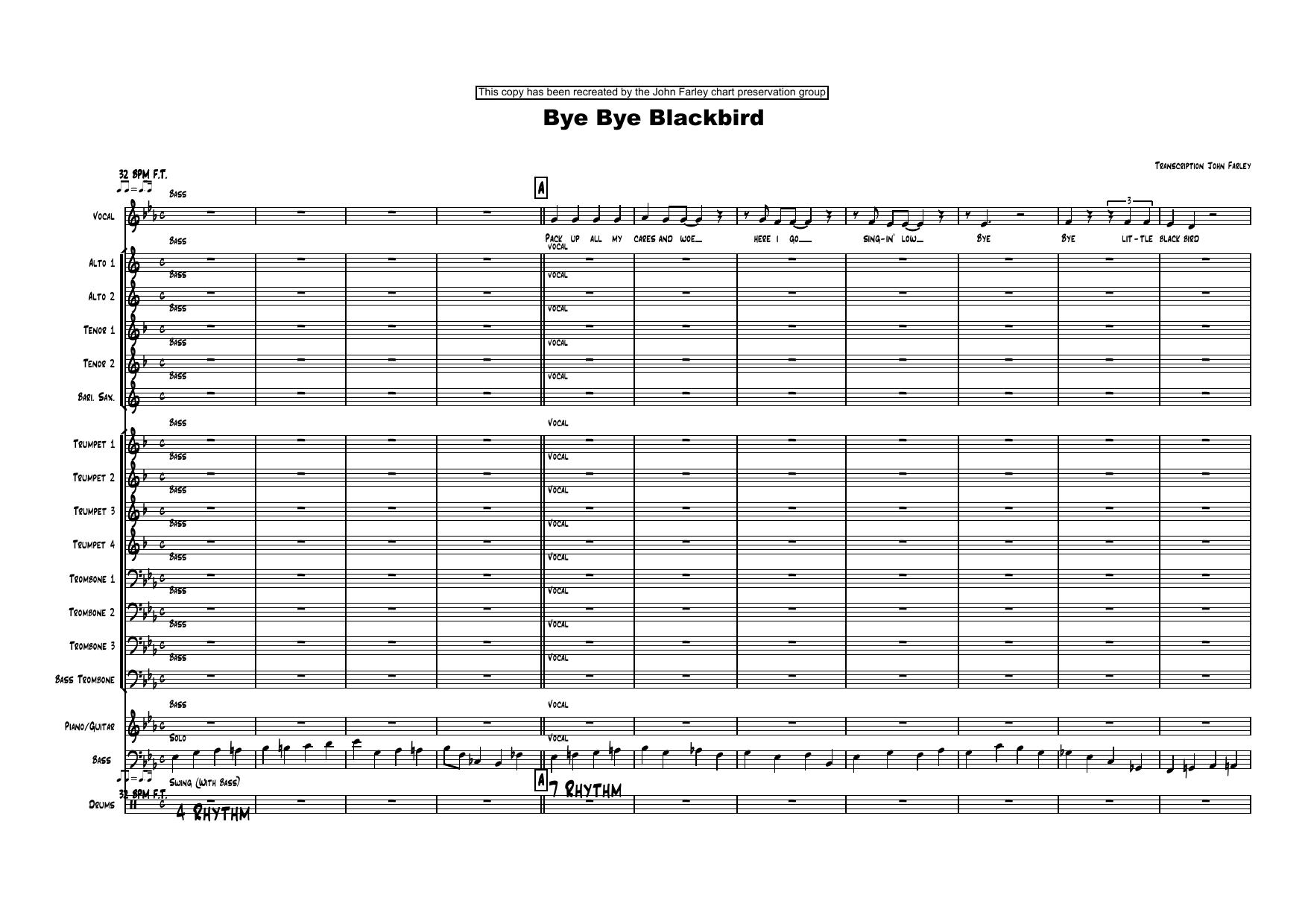
Bye Bye Blackbird (J.Farley) sheet music preview

Bye Bye Blackbird (J.Farley)

Composed by Ray Henderson

Arranged by Frank Sinatra & Nelson Riddle

  • Ensemble: Big Band
  • Pages: 29
  • Instruments (17): Vocal, Alto Saxophone 1, Alto Saxophone 2, Tenor Saxophone 1, Tenor Saxophone 2, Baritone Saxophone, Trumpet 1, Trumpet 2, Trumpet 3, Trumpet 4, Trombone 1, Trombone 2, Trombone 3, Bass Trombone, Piano/Guitar, Bass, Drums
  • Difficulty: medium
  • Content: Individual Parts
  • Format: PDF Download (Instant)
  • Price: $24.99

Ray Henderson’s timeless 1926 composition "Bye Bye Blackbird"—with lyrics by Mort Dixon—cemented its status as an immutable American songbook standard long before it entered the pantheon of jazz adaptation. However, the definitive vocal blueprint for the mid-century swinging iteration arrived when Frank Sinatra recorded it with master arranger Nelson Riddle for his 1957 Capitol Records release, *A Swingin' Affair!*. Riddle’s chart captures the apex of the Capitol era, balancing exuberant optimism with sophisticated, brass-driven swagger. This arrangement encapsulates the quintessential high-energy swing aesthetic of the 1950s, marrying the vocal phrasing of the Chairman of the Board with Riddle's lush, harmonically inventive orchestrations. Propelled by a driving, medium-up swing feel in 4/4 time, the arrangement radiates a confident, celebratory mood. Riddle avoids a static backing track, instead constructing a dynamic journey that opens with an iconic, teasing brass introduction before settling into a crisp, infectious groove. The harmonic language relies on extended jazz chords, clever chromatic line-writing, and brilliant modulation strategies that elevate the tension leading into the vocal entrances. The mood shifts effortlessly from playful intimacy during the verse to a triumphant, full-ensemble roar during the climactic sections. Nelson Riddle’s signature scoring techniques shine brilliantly across the 17-instrument big band canvas. The arrangement features characteristically rich woodwind doublings, snappy sax solis that weave counter-melodies around the vocal line, and punchy brass interjections that respond directly to Sinatra's phrasing. The rhythm section functions as an elastic, pulsing engine, demanding a precise, light-footed swing eighth-note interpretation rather than a heavy, modern stomp. The vocal lead takes center stage, supported by meticulously crafted background figures that never crowd the singer, yet provide a thick, sophisticated harmonic cushion using augmented and altered dominants. Advanced high school, collegiate, and professional big bands will find this arrangement an absolute joy to perform, though it demands disciplined section playing and a mature sense of swing phrasing. The primary technical challenge lies in achieving a seamless, conversational interaction between the 17-piece ensemble and the featured vocalist, requiring acute dynamic control and immaculate articulation uniformity across the saxophone and brass sections. Instrumentalists will relish the authentic vintage voicings, while conductors will appreciate the comprehensive 29-page conductor score, which provides a crystal-clear roadmap through Riddle's brilliant textural shifts and celebratory shout chorus. Executing this Nelson Riddle masterpiece requires a deep understanding of 1950s swinging style, where precision and lightness are paramount. The tempo should sit comfortably in a driving medium-up swing (around 144–152 BPM), avoiding any tendency to rush during dynamic crescendos. The rhythm section must establish an unyielding, feather-light pulse; the drummer should emphasize a crisp ride cymbal pattern with ghosted snare notes, while the bass player walks quarters with an understated, forward-leaning acoustic tone. Horn players must pay close attention to short, clipped articulations on background punches, ensuring that all staccato and accent markings match uniformly across sections. Brass players should utilize subtle cup or harmon mutes where indicated, avoiding aggressive modern edge in favor of a warm, round Capitol-era tone. Rehearsals should initially isolate the ensemble figures away from the vocal line to lock in intonation on Riddle's dense, upper-extension chord voicings, followed by careful dynamic balancing so the horns never overpower the stylistic nuances of the vocal delivery. Q: What instruments and parts are included in this arrangement? A: This 17-instrument big band chart includes a vocal lead sheet, two alto saxophones, two tenor saxophones, a baritone saxophone, four trumpets, four trombones, piano, guitar, bass, and drums, along with a complete conductor score spanning 29 pages. Q: What is the difficulty level of this chart? A: This arrangement is calibrated for advanced high school, collegiate, and professional big bands, requiring strong section cohesion, mature swing feel, and precise dynamic control to balance the sophisticated orchestrations. Q: What is the historical style and context of this piece? A: It reflects the quintessential 1950s Capitol Records swing era, immortalized by Frank Sinatra and arranger Nelson Riddle on the 1957 album *A Swingin' Affair!*, transforming Ray Henderson's 1926 Tin Pan Alley tune into a masterclass of vocal jazz. Q: What makes this particular Nelson Riddle arrangement unique? A: It stands out due to Riddle’s signature lush harmonic voicings, intricate woodwind counter-lines, punchy brass responses, and a brilliant structural build that supports the vocalist without ever sounding stagnant or overly heavy. Q: What is the performance duration and tempo feel? A: The arrangement runs approximately 3 minutes and features a driving, medium-up swing feel in 4/4 time, typically anchored around 144 to 152 beats per minute.

Questions and answers

What is included in the Bye Bye Blackbird (J.Farley) PDF?
The verified current file contains a conductor score and individual parts across 29 pages.
How many instruments or parts are listed for Bye Bye Blackbird (J.Farley)?
The verified instrumentation list contains 17 entries for this Big Band arrangement.
Who is credited for Bye Bye Blackbird (J.Farley)?
Composer: Ray Henderson. Arranger: Frank Sinatra & Nelson Riddle.
What difficulty is listed for Bye Bye Blackbird (J.Farley)?
The verified difficulty level is medium.
Can I preview Bye Bye Blackbird (J.Farley) before buying?
Yes. The product page provides a preview generated from the current PDF file.
How is Bye Bye Blackbird (J.Farley) delivered?
After successful payment, the digital PDF is made available for download. The displayed price is $24.99.

Musicians Also Search For

Bye Bye Blackbird Frank Sinatra & Nelson Riddle PDFBye Bye Blackbird Frank Sinatra & Nelson Riddle sheet musicBye Bye Blackbird arranged by Frank Sinatra & Nelson RiddleFrank Sinatra & Nelson Riddle big band chartsFrank Sinatra & Nelson Riddle jazz arrangements PDFBye Bye Blackbird Ray Henderson sheet musicBye Bye Blackbird Ray Henderson big band arrangementsRay Henderson big band chartsBye Bye Blackbird big band arrangementsBye Bye Blackbird big band PDF downloadBye Bye Blackbird jazz sheet musicbig band sheet music downloadBye Bye Blackbird conductor score PDFBye Bye Blackbird individual parts downloadBye Bye Blackbird sheet music PDFbuy Bye Bye Blackbird sheet musicdownload Bye Bye Blackbird PDFBye Bye Blackbird jazz chartsbest Frank Sinatra & Nelson Riddle big band arrangementsRay Henderson arranged by Frank Sinatra & Nelson RiddleBye Bye Blackbird printable sheet musicbig band repertoire PDF

All arrangements by Frank Sinatra & Nelson Riddle All Ray Henderson sheet music