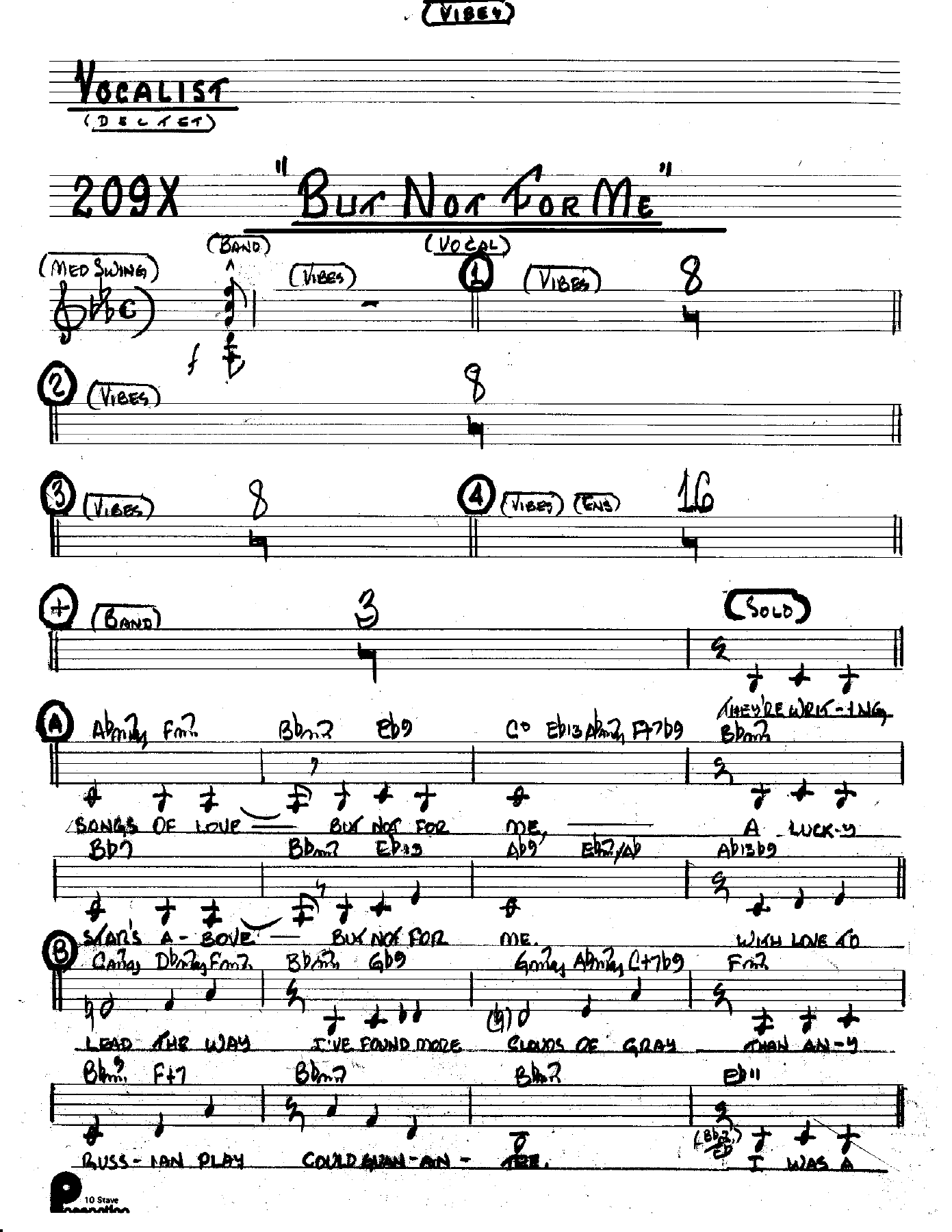
But Not For Me (Kenton Dectet #209X)
Composed by George Gershwin
Arranged by Stan Kenton Dected 176
- Ensemble: Small Ensemble
- Style: Jazz Standard
- Pages: 32
- Instruments (11): Vocalist, Vibes, Alto Sax, Tenor Sax, Baritone Sax, Trumpet 1, Trumpet 2, Trombone, Drums, Bass, Piano
- Difficulty: easy
- Content: Individual Parts
- Format: PDF Download (Instant)
- Price: $12.99
George Gershwin's timeless ballad "But Not For Me," originally composed for the 1930 musical *Girl Crazy*, quickly transcended its Broadway origins to become a cornerstone of the Great American Songbook. Its lyrical poignancy and sophisticated harmonic structure made it an immediate favorite among jazz musicians, with countless interpretations solidifying its status as a quintessential jazz standard. Chet Baker's melancholic vocal and trumpet renditions, in particular, helped define its introspective character, while Ella Fitzgerald's definitive recordings showcased its versatility across various tempos and moods. The piece embodies the emotional depth and melodic elegance characteristic of the Tin Pan Alley era, offering a rich canvas for improvisation and nuanced expression. This arrangement, "But Not For Me (Kenton Dectet #209X)," reimagines Gershwin's classic as a medium-slow swing, set in the key of F major. The mood is one of sophisticated melancholy, imbued with a subtle, understated energy that allows the melody's inherent beauty to shine. The tempo encourages a relaxed, yet propulsive, swing feel, eschewing overt sentimentality for a more refined, cool jazz aesthetic. The harmonic palette is rich with extended chords and tasteful substitutions, providing a lush backdrop without obscuring the original melody's clarity. The arrangement maintains a consistent 4/4 time signature, focusing on rhythmic precision within its relaxed groove. Stan Kenton Dected 176's approach to "But Not For Me" is characterized by his signature blend of intricate voicings and dynamic contrasts, adapted here for a smaller, more intimate ensemble. Expect meticulously crafted soli sections that feature the Dectet's unique instrumentation, showcasing the interplay between brass and reeds. The arrangement opens with a lyrical statement of the melody, often voiced in a warm, blended texture, before transitioning into a series of carefully constructed solo features. While specific soloists are indicated, there is ample room for improvisation, allowing individual musicians to contribute their unique voice. The technical demands lie in achieving a seamless blend, executing precise articulations, and navigating the nuanced harmonic progressions with sensitivity. The arrangement culminates in a refined, understated coda, leaving a lasting impression of elegant introspection. This arrangement is ideally suited for advanced high school, college, community, and professional small jazz ensembles. Its sophisticated voicings and opportunities for both ensemble precision and individual improvisation make it an excellent vehicle for developing musicality and stylistic understanding. The challenges, while present, are rewarding, fostering a deep appreciation for harmonic subtlety, dynamic control, and the art of collective interpretation within a small group setting. Ensembles will find great satisfaction in bringing out the emotional depth and refined swing feel inherent in this masterful arrangement. Conductors should emphasize a relaxed, yet precise, medium-slow swing feel, ensuring the rhythm section provides a steady, unhurried foundation. The key technical challenge lies in achieving a seamless blend and balance within the Dectet's instrumentation, particularly during the intricate soli passages. Encourage musicians to listen across sections to match intonation and articulation. Pay close attention to dynamic markings, as subtle shifts are crucial for conveying the arrangement's sophisticated mood. There are no specific extended techniques like plungers or doits, but expressive phrasing and careful control of vibrato are paramount. Rehearsal time should be dedicated to finessing the harmonic voicings, ensuring each note within a chord contributes to the overall richness without becoming overbearing. Soloists should be encouraged to craft melodic, lyrical improvisations that complement the arrangement's introspective character. Q: What instruments are included in the "But Not For Me (Kenton Dectet #209X)" arrangement? A: This arrangement is scored for a small ensemble, typically consisting of trumpet, trombone, alto saxophone, tenor saxophone, baritone saxophone, piano, bass, and drums, reflecting the standard Kenton Dectet instrumentation. Q: What is the difficulty level of this arrangement? A: This arrangement is considered advanced, suitable for experienced high school, college, community, and professional small jazz ensembles due to its intricate voicings, nuanced harmonic progressions, and demands for precise ensemble playing. Q: What musical style and historical context does this arrangement represent? A: It is a jazz standard, originally a George Gershwin composition from 1930, arranged in a sophisticated medium-slow swing style characteristic of the Stan Kenton Dectet's cool jazz aesthetic. Q: What makes this specific arrangement unique compared to other versions of "But Not For Me"? A: This arrangement by Stan Kenton Dected 176 features his distinctive harmonic language, intricate soli sections tailored for a small ensemble, and a refined, introspective medium-slow swing interpretation of the classic standard. Q: What is the approximate performance duration and tempo for this piece? A: The approximate performance duration is typically between 4 to 5 minutes, played at a medium-slow swing tempo, allowing for expressive phrasing and improvised solos.
Questions and answers
- What is included in the But Not For Me (Kenton Dectet #209X) PDF?
- The verified current file contains individual parts across 32 pages.
- How many instruments or parts are listed for But Not For Me (Kenton Dectet #209X)?
- The verified instrumentation list contains 11 entries for this Small Ensemble arrangement.
- Who is credited for But Not For Me (Kenton Dectet #209X)?
- Composer: George Gershwin. Arranger: Stan Kenton Dected 176.
- What difficulty is listed for But Not For Me (Kenton Dectet #209X)?
- The verified difficulty level is easy.
- What style is listed for But Not For Me (Kenton Dectet #209X)?
- The catalog lists the style as Jazz Standard.
- Can I preview But Not For Me (Kenton Dectet #209X) before buying?
- Yes. The product page provides a preview generated from the current PDF file.
- How is But Not For Me (Kenton Dectet #209X) delivered?
- After successful payment, the digital PDF is made available for download. The displayed price is $12.99.
Musicians Also Search For
But Not For Me Stan Kenton Dected 176 PDF • But Not For Me Stan Kenton Dected 176 sheet music • But Not For Me arranged by Stan Kenton Dected 176 • Stan Kenton Dected 176 small ensemble charts • Stan Kenton Dected 176 jazz arrangements PDF • But Not For Me George Gershwin sheet music • But Not For Me George Gershwin small ensemble arrangements • George Gershwin small ensemble charts • But Not For Me small ensemble arrangements • But Not For Me small ensemble PDF download • But Not For Me jazz sheet music • small ensemble sheet music download • But Not For Me individual parts download • But Not For Me sheet music PDF • But Not For Me Jazz Standard charts • Jazz Standard small ensemble arrangements • buy But Not For Me sheet music • download But Not For Me PDF • But Not For Me jazz charts • best Stan Kenton Dected 176 small ensemble arrangements • George Gershwin arranged by Stan Kenton Dected 176 • But Not For Me printable sheet music • small ensemble repertoire PDF