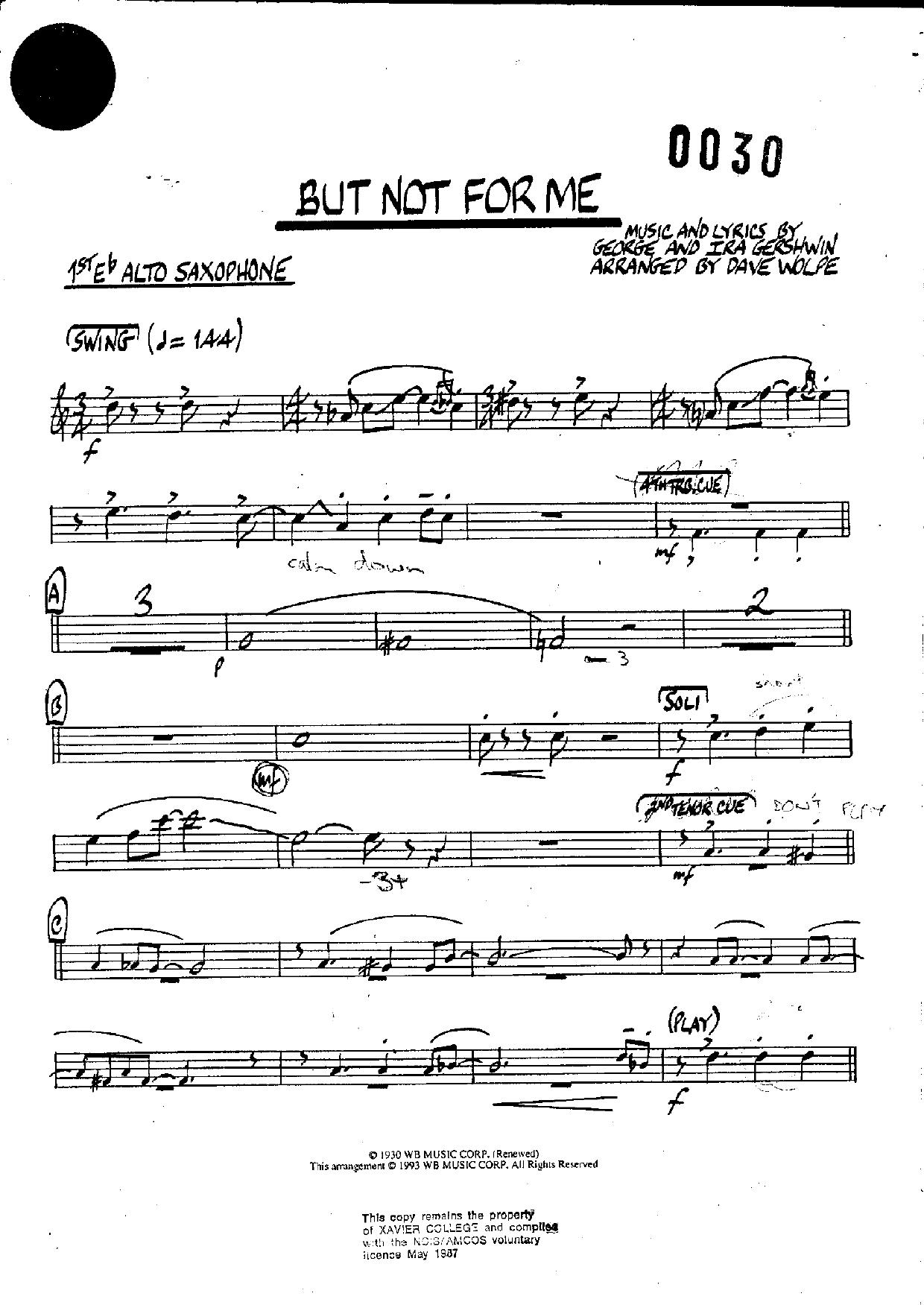
But Not For Me (D.Wolpe) sheet music preview

But Not For Me (D.Wolpe)

Composed by George Gershwin

Arranged by Dave Wolpe

  • Ensemble: Big Band
  • Pages: 63
  • Instruments (17): 1st Eb Alto Saxophone, 2nd Eb Alto Saxophone, 1st Bb Tenor Saxophone, 2nd Bb Tenor Saxophone, Eb Baritone Saxophone, 1st Bb Trumpet, 2nd Bb Trumpet, 3rd Bb Trumpet, 4th Bb Trumpet, 1st Trombone, 2nd Trombone, 3rd Trombone, Bass Trombone, Piano, Guitar, Bass, Drums
  • Difficulty: advanced
  • Content: Individual Parts
  • Format: PDF Download (Instant)
  • Price: $24.99

George Gershwin and Ira Gershwin’s timeless 1930 composition "But Not For Me," originally introduced in the Broadway musical *Girl Crazy*, stands as one of the most enduring pillars of the Great American Songbook. Over the decades, this poignant yet ultimately upbeat melody has been interpreted by virtually every major jazz icon, from Chet Baker and Ella Fitzgerald to Miles Davis and John Coltrane. It bridges the gap between classic Tin Pan Alley songwriting and sophisticated harmonic jazz improvisation, making it an essential vehicle for exploring melancholy lyricism paired with an underlying, resilient swing momentum. In this masterwork big band adaptation, arranger Dave Wolpe infuses the standard with a vibrant, mid-tempo swing feel that honors the bittersweet duality of the original lyric. Driven by a crisp, conversational rhythm section groove in 4/4 time, the chart balances lush, sweeping ensemble harmonies with driving, straight-ahead momentum. Wolpe expertly utilizes rich, contemporary extended voicings in the brass that evoke the golden era of studio big bands, while keeping the underlying harmonic movement accessible enough to highlight the gorgeous contours of Gershwin’s original melody. The mood shifts fluidly from introspective, velvety ballad-esque textures to jubilant, full-ensemble swing bursts that capture the quintessential spirit of mid-century jazz orchestration. Wolpe structures the arrangement to showcase the entire ensemble, giving distinct voice to individual sections while maintaining a cohesive, driving narrative. The chart opens with a moody, atmospheric introduction before handing the primary melody over to the saxophones, bolstered by subtle, harmon-muted brass counterlines. A standout feature of this chart is the expertly crafted sax soli section, which demands tight intonation and stylistic unity, leading organically into an open solo section for your lead horn players. The climax builds toward a classic, hard-swinging shout chorus that reinterprets the main theme with dense, dynamic block-chord voicings, forcing the brass and reeds to lock tightly together before a decisive, high-energy punch ending. Advanced high school ensembles, collegiate jazz orchestras, and professional community big bands will find this chart to be an exceptionally rewarding addition to their repertoire. While the technical demands are approachable enough for developing players who have a solid grasp of medium-swing articulation, the arrangement offers enough sophisticated harmonic color and stylistic nuance to satisfy seasoned performers. It serves as an ideal festival chart, offering a perfect blend of crowd-pleasing historical recognition and substantive pedagogical challenges in ensemble balance, phrasing, and dynamic control. Achieving an authentic medium-swing feel is the primary challenge of this arrangement; conductors must ensure the rhythm section lays down a relaxed yet driving quarter-note pulse, avoiding any tendency to rush the tempo. The underlying eighth-note subdivision must remain impeccably even, swinging naturally without descending into a choppy triplet feel. Pay close attention to dynamic markings during the muted brass passages to prevent the accompaniment from overpowering the lead melodic voices in the saxophones. Horn players should carefully execute standard big band articulations, including precise roof accents (`>`) on downbeats and clean, controlled drop-offs or falls where indicated in the shout chorus. Rehearsals should initially isolate the saxophone soli at a slower tempo to lock in articulation and blend before integrating the rhythm section. Finally, encourage the featured soloists to reference classic vocal and instrumental recordings of the standard to capture the essential lyrical phrasing required to make Gershwin's melody sing over the band. Q: What instruments and parts are included in this big band arrangement? A: This 63-page publication features a complete 17-instrument big band instrumentation, including standard parts for two alto saxophones, two tenor saxophones, baritone saxophone, four trumpets, four trombones, piano, guitar, bass, and drums, alongside a comprehensive conductor score. Q: What is the difficulty level of Dave Wolpe's "But Not For Me"? A: This arrangement is graded as medium-advanced, making it exceptionally well-suited for capable high school jazz ensembles, university bands, and professional community big bands looking for a polished, traditional chart. Q: What is the musical style and historical context of this piece? A: Written in a classic medium-swing style, this chart reimagines George and Ira Gershwin's iconic 1930 Broadway tune through the lens of traditional big band jazz, honoring a standard immortalized by decades of vocal and instrumental jazz legends. Q: What makes this specific arrangement by Dave Wolpe unique? A: Wolpe’s chart stands out due to its clever balance of lush, sophisticated harmonic voicings, a tightly written saxophone soli, and a powerful, high-energy shout chorus that injects fresh momentum into a well-worn standard. Q: What is the performance duration and recommended tempo for this arrangement? A: While performance time can vary depending on the length of improvised solos, the chart is designed to sit comfortably at a medium-swing tempo of approximately 120 to 126 beats per minute, running roughly 3 to 4 minutes in total duration.

Questions and answers

What is included in the But Not For Me (D.Wolpe) PDF?
The verified current file contains a conductor score and individual parts across 63 pages.
How many instruments or parts are listed for But Not For Me (D.Wolpe)?
The verified instrumentation list contains 17 entries for this Big Band arrangement.
Who is credited for But Not For Me (D.Wolpe)?
Composer: George Gershwin. Arranger: Dave Wolpe.
What difficulty is listed for But Not For Me (D.Wolpe)?
The verified difficulty level is advanced.
Can I preview But Not For Me (D.Wolpe) before buying?
Yes. The product page provides a preview generated from the current PDF file.
How is But Not For Me (D.Wolpe) delivered?
After successful payment, the digital PDF is made available for download. The displayed price is $24.99.

Musicians Also Search For

But Not For Me Dave Wolpe PDFBut Not For Me Dave Wolpe sheet musicBut Not For Me arranged by Dave WolpeDave Wolpe big band chartsDave Wolpe jazz arrangements PDFBut Not For Me George Gershwin sheet musicBut Not For Me George Gershwin big band arrangementsGeorge Gershwin big band chartsBut Not For Me big band arrangementsBut Not For Me big band PDF downloadBut Not For Me jazz sheet musicbig band sheet music downloadBut Not For Me conductor score PDFBut Not For Me individual parts downloadBut Not For Me sheet music PDFbuy But Not For Me sheet musicdownload But Not For Me PDFBut Not For Me jazz chartsbest Dave Wolpe big band arrangementsGeorge Gershwin arranged by Dave WolpeBut Not For Me printable sheet musicbig band repertoire PDF

All arrangements by Dave Wolpe All George Gershwin sheet music