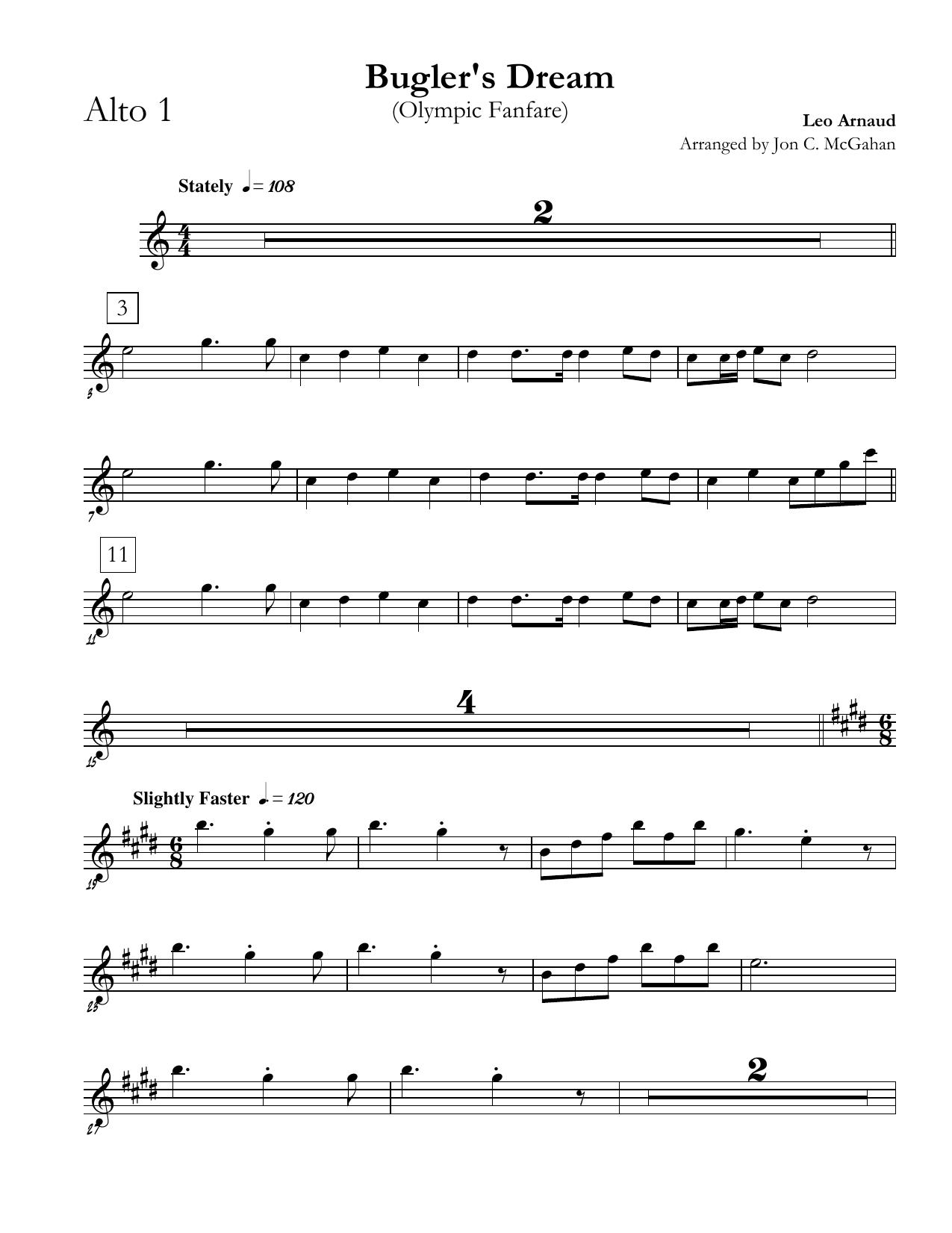
Bugler's Dream (Olympic Fanfare) sheet music preview

Bugler's Dream (Olympic Fanfare)

Composed by Leo Arnaud

Arranged by Jon McCahan

  • Ensemble: Big Band
  • Style: Jazz Standard
  • Pages: 36
  • Instruments (17): Alto 1, Alto 2, Tenor 1, Tenor 2, Baritone, Trumpet 1, Trumpet 2, Trumpet 3, Trumpet 4, Trombone 1, Trombone 2, Trombone 3, Trombone 4, Guitar, Piano, Bass, Drums
  • Difficulty: medium
  • Content: Individual Parts
  • Format: PDF Download (Instant)
  • Price: $24.99

Leo Arnaud’s iconic 1958 composition "Bugler’s Dream," immortalized globally as the definitive broadcast theme of the Olympic Games, undergoes a striking metamorphosis in this sophisticated big band adaptation by Jon McCahan. Originally written as the second movement of Arnaud's *The Charge Suite* and later popularized by ABC Sports and various orchestral brass ensembles, the motif’s triumphant military-fanfare cadence is seamlessly recontextualized within a vibrant, swinging jazz idiom. This arrangement honors the majestic, heraldic DNA of the original source material while injecting the harmonic sophistication, syncopated drive, and textural variety characteristic of modern contemporary big band writing. Built upon a robust, driving medium-up swing groove in 4/4 time, the chart captures an intoxicating blend of stately grandeur and swinging exhilaration. The arrangement opens with a respectful nod to the famous triplet-based brass figure before quickly pivoting into a shimmering, harmonically expanded landscape. McCahan utilizes lush, extended voicings across the saxophone and brass sections, creating a rich sonic palette that shifts effortlessly from hushed, suspenseful chordal pads to roaring, high-energy counterpoint. The mood is relentlessly optimistic, charged with competitive electricity and theatrical flair, offering a fresh perspective on a universally recognized melody. McCahan’s structural approach brilliantly balances ensemble power with nuanced, small-group textures. The melody is initially introduced through fragmented horn calls before being handed off to a tight, interlocking sax soli that showcases intricate line-writing. Mid-chart developments feature dynamic dialogue between the brass and reed sections, building relentless momentum toward a towering shout chorus. Solos are strategically carved out for lead trumpet and tenor saxophone, providing ample space for improvisers to stretch out over crisp, modal-leaning chord changes that still respect the tonal center of the chart. Technical demands center primarily on clean articulation, precise rhythmic unison during fast triplet figures, and stamina in the upper brass registers. Advanced high school, collegiate, and professional big bands will find this arrangement an exceptional centerpiece for festival programs, formal concerts, or celebratory events. The chart demands a mature rhythm section capable of maintaining an unyielding, buoyant swing feel beneath complex ensemble figures, as well as lead players comfortable with high-register interventions. Delivering an irresistible blend of nostalgia and fresh jazz innovation, this chart guarantees an unforgettable audience reaction and a deeply satisfying rehearsal experience for every section in the band. Executing this arrangement successfully requires careful attention to the juxtaposition between rigid, fanfare-style articulation and fluid, relaxed swing phrasing. The conductor should establish a steady, driving medium-up tempo, ensuring the rhythm section locks into an aggressive yet laid-back groove that prevents the triplet fanfares from sounding stiff. Trumpets and trombones must approach the opening statements with authoritative projection, utilizing clean tongue-strokes and controlled releases without overblowing. Pay close attention to dynamic contrast: the transition points from delicate, muted background figures to full-ensemble shout choruses rely heavily on dynamic discipline to achieve maximum impact. Saxophones should focus on a unified, warm timbre during the soli sections, ensuring that internal voice-leading is audible even at faster tempos. Drumset players should drive the ensemble with crisp ride-cymbal definition and well-placed accented kicks that reinforce the brass punches, avoiding excessive clutter during transitional ensemble passages. Q: What instruments and parts are included in this big band arrangement? A: The arrangement is scored for a standard 17-piece big band instrumentation, featuring 2 alto saxophones, 2 tenor saxophones, 1 baritone saxophone, 4 trumpets, 4 trombones, piano, guitar, bass, and drums, along with a comprehensive conductor score. Q: What is the difficulty level of Jon McCahan’s "Bugler’s Dream" big band chart? A: This arrangement is graded as advanced (Level 4-5), making it best suited for accomplished high school ensembles, university jazz bands, and professional community big bands due to its technical demands and range requirements. Q: How does this arrangement relate to the original Leo Arnaud composition? A: While preserving the unmistakable heroic melody and tripartite structure of Arnaud's 1958 Olympic fanfare, this arrangement reimagines the piece through a vibrant jazz lens, incorporating swing feels, extended chord harmonies, and improvised solo sections. Q: What makes this particular big band version unique? A: Jon McCahan expertly bridges the gap between classical heraldry and modern jazz writing by utilizing intricate horn dialogues, a brilliant sax soli, and a powerful shout chorus that transforms a marching brass motif into a sophisticated swing chart. Q: What is the recommended performance tempo and approximate duration? A: The chart is designed to be performed at a brisk, energetic medium-up swing tempo (approximately 138-144 BPM) and runs for roughly 3.5 to 4 minutes, making it an ideal concert opener or festival closer.

Questions and answers

What is included in the Bugler's Dream (Olympic Fanfare) PDF?
The verified current file contains a conductor score and individual parts across 36 pages.
How many instruments or parts are listed for Bugler's Dream (Olympic Fanfare)?
The verified instrumentation list contains 17 entries for this Big Band arrangement.
Who is credited for Bugler's Dream (Olympic Fanfare)?
Composer: Leo Arnaud. Arranger: Jon McCahan.
What difficulty is listed for Bugler's Dream (Olympic Fanfare)?
The verified difficulty level is medium.
What style is listed for Bugler's Dream (Olympic Fanfare)?
The catalog lists the style as Jazz Standard.
Can I preview Bugler's Dream (Olympic Fanfare) before buying?
Yes. The product page provides a preview generated from the current PDF file.
How is Bugler's Dream (Olympic Fanfare) delivered?
After successful payment, the digital PDF is made available for download. The displayed price is $24.99.

Musicians Also Search For

Bugler's Dream Jon McCahan PDFBugler's Dream Jon McCahan sheet musicBugler's Dream arranged by Jon McCahanJon McCahan big band chartsJon McCahan jazz arrangements PDFBugler's Dream Leo Arnaud sheet musicBugler's Dream Leo Arnaud big band arrangementsLeo Arnaud big band chartsBugler's Dream big band arrangementsBugler's Dream big band PDF downloadBugler's Dream jazz sheet musicbig band sheet music downloadBugler's Dream conductor score PDFBugler's Dream individual parts downloadBugler's Dream sheet music PDFBugler's Dream Jazz Standard chartsJazz Standard big band arrangementsbuy Bugler's Dream sheet musicdownload Bugler's Dream PDFBugler's Dream jazz chartsbest Jon McCahan big band arrangementsLeo Arnaud arranged by Jon McCahanBugler's Dream printable sheet musicbig band repertoire PDF

All arrangements by Jon McCahan All Leo Arnaud sheet music