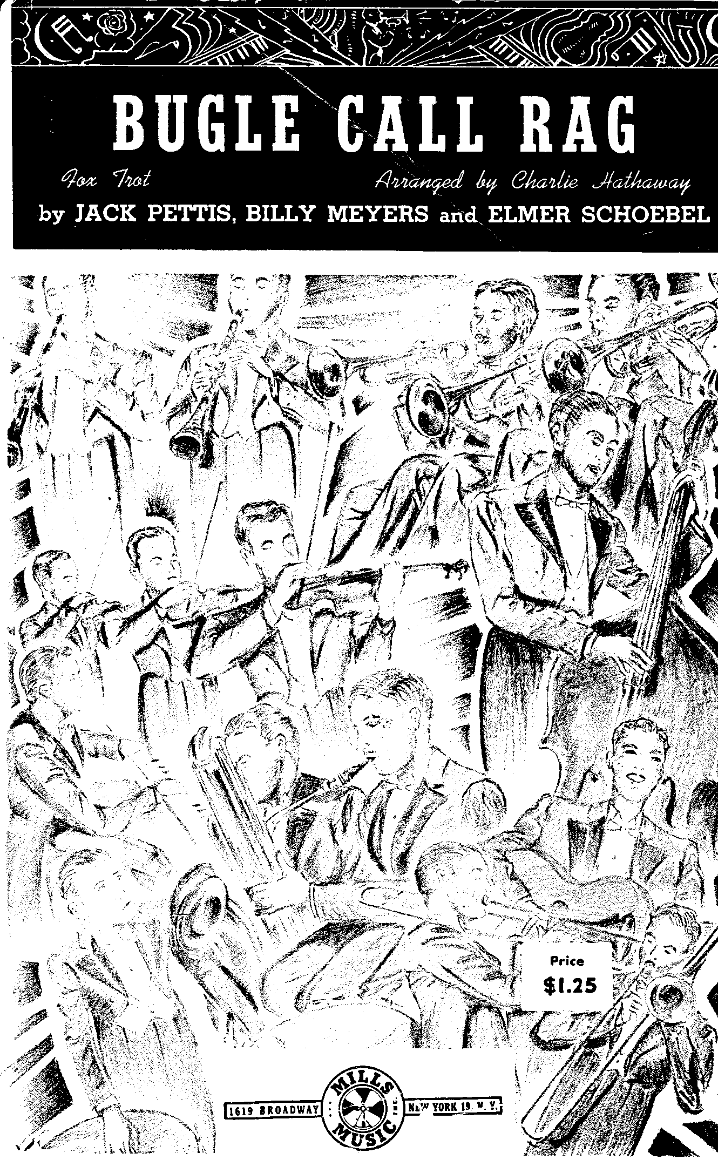
Bugle Call Rag (C.Hathaway)
Composed by Jack Pettis, Billy Meyers, Elmer Schoebel
Arranged by C. Hathaway
- Ensemble: Big Band Dance
- Style: Foxtrot
- Pages: 34
- Instruments (15): 1st Saxophone Eb Alto, 2nd Saxophone Bb Tenor, 3rd Saxophone Eb Alto, 5th Saxophone Eb Baritone, 1st Trumpet in Bb, 2nd Trumpet in Bb, 3rd Trumpet in Bb, 1st Trombone, 3rd Trombone, 2nd Trombone, Guitar, 1st Violins, 1st Violins 2, Piano, Bass
- Difficulty: medium
- Content: Individual Parts
- Format: PDF Download (Instant)
- Price: $24.99
"Bugle Call Rag," originally composed by Jack Pettis, Billy Meyers, and Elmer Schoebel, stands as a foundational piece in the jazz canon, first gaining widespread recognition in the early 1920s. This vibrant Foxtrot exemplifies the exuberant spirit of the Jazz Age, a period characterized by rapid social change and the emergence of new musical forms. Its catchy, syncopated melodies and driving rhythm quickly made it a favorite among dance bands and early jazz ensembles, establishing it as a perennial standard. The piece's enduring appeal lies in its infectious energy and its clever integration of a military bugle call motif into a swinging, improvisational framework, making it instantly recognizable and a staple for bands looking to capture the authentic sound of early big band jazz. C. Hathaway's arrangement of "Bugle Call Rag" masterfully captures the ebullient, up-tempo Foxtrot feel of the original while infusing it with sophisticated big band voicings suitable for a modern ensemble. Set in a bright, driving tempo, this arrangement maintains the piece's characteristic energy, propelled by a solid 4/4 swing rhythm. Hathaway's distinctive approach is evident in the dynamic interplay between sections, featuring tightly voiced brass and saxophone soli passages that evoke the classic big band sound. The arrangement frequently utilizes call-and-response figures, particularly between the brass and saxophones, enhancing the conversational quality inherent in early jazz. While remaining true to the piece's historical context, Hathaway introduces subtle harmonic extensions that add depth without sacrificing the authentic Foxtrot character, making it both historically informed and musically engaging. The arrangement features the iconic bugle call melody prominently, initially presented by the trumpet section, then developed through various sections. There are ample opportunities for featured solos, typically allocated to trumpet and tenor saxophone, allowing improvisers to showcase their skills over the piece's straightforward yet compelling chord changes. A standout moment is the meticulously crafted shout chorus, where the full ensemble delivers a powerful, unified statement, building to an exhilarating climax. Technical challenges include precise articulation for the brisk tempo, maintaining rhythmic clarity in the syncopated figures, and achieving balanced ensemble blend, particularly in the dense soli sections. Performing this arrangement is immensely rewarding, offering musicians the chance to connect with a pivotal piece of jazz history while delivering a performance that is both historically authentic and thrillingly vibrant. This arrangement is ideally suited for advanced high school, collegiate, community, and professional big bands. Its demanding ensemble work, requiring strong section playing and individual solo contributions, makes it an excellent vehicle for developing rhythmic precision, articulation, and stylistic authenticity. The clear structure, combined with Hathaway's thoughtful scoring, provides a solid framework for bands aiming to explore the origins of big band jazz. Its energetic nature makes it a fantastic concert opener or a lively addition to any set list, guaranteed to engage both performers and audiences with its timeless appeal and infectious swing. Conductors should emphasize a bright, driving Foxtrot feel, maintaining a consistent, energetic 4/4 swing at a brisk tempo (e.g., quarter note = 200-220 bpm). Articulation is paramount; encourage sharp, precise attacks and releases, particularly in the brass, to convey the piece's characteristic punch. The saxophone soli sections require meticulous attention to balance and blend, ensuring all voices are heard clearly within the tight voicings. Trumpet and trombone sections should practice their unison and octave passages for maximum impact. Mutes (straight or cup) may be indicated for specific brass sections; ensure these are executed cleanly and promptly. Rehearsal time should focus on rhythmic accuracy in the syncopated figures and dynamic contrast to highlight the call-and-response elements and build the shout chorus effectively. Q: What instruments are included in this arrangement? A: This arrangement is scored for a standard 17-piece big band: Alto Saxophone 1, Alto Saxophone 2, Tenor Saxophone 1, Tenor Saxophone 2, Baritone Saxophone, Trumpet 1, Trumpet 2, Trumpet 3, Trumpet 4, Trombone 1, Trombone 2, Trombone 3, Trombone 4, Piano, Bass, Drums, and Guitar. Q: What is the difficulty level of "Bugle Call Rag (C.Hathaway)"? A: This arrangement is considered advanced, suitable for college-level, advanced high school, community, and professional big bands due to its demanding ensemble playing, precise articulation requirements, and solo opportunities. Q: What musical style and historical context does this arrangement represent? A: This arrangement is a Foxtrot, capturing the energetic and syncopated style of early big band jazz from the 1920s, a period when the original "Bugle Call Rag" gained prominence as a jazz standard. Q: What makes C. Hathaway's arrangement of "Bugle Call Rag" unique? A: Hathaway's arrangement uniquely blends the authentic, driving Foxtrot feel of the original with sophisticated big band voicings, dynamic section interplay, and a powerful shout chorus, while introducing subtle harmonic extensions for a fresh yet historically informed sound. Q: What is the typical performance duration and tempo for this piece? A: The typical performance duration for "Bugle Call Rag (C.Hathaway)" is approximately 3-4 minutes, performed at a brisk, up-tempo Foxtrot (swing) feel, generally around 200-220 beats per minute.
Musicians Also Search For
Bugle Call Rag C. Hathaway PDF • Bugle Call Rag C. Hathaway sheet music • Bugle Call Rag arranged by C. Hathaway • C. Hathaway big band dance charts • C. Hathaway jazz arrangements PDF • Bugle Call Rag Jack Pettis, Billy Meyers, Elmer Schoebel sheet music • Bugle Call Rag Jack Pettis, Billy Meyers, Elmer Schoebel big band dance arrangement • Jack Pettis, Billy Meyers, Elmer Schoebel big band dance charts • Bugle Call Rag big band dance arrangement • Bugle Call Rag big band dance PDF download • Bugle Call Rag jazz ensemble sheet music • big band dance sheet music instant download • Bugle Call Rag individual parts download • Bugle Call Rag sheet music with parts • Bugle Call Rag Foxtrot chart • Foxtrot big band dance arrangements • buy Bugle Call Rag sheet music online • download Bugle Call Rag PDF • Bugle Call Rag jazz chart • best C. Hathaway big band dance arrangements • Jack Pettis, Billy Meyers, Elmer Schoebel songs arranged by C. Hathaway • Bugle Call Rag printable sheet music • big band dance repertoire PDF