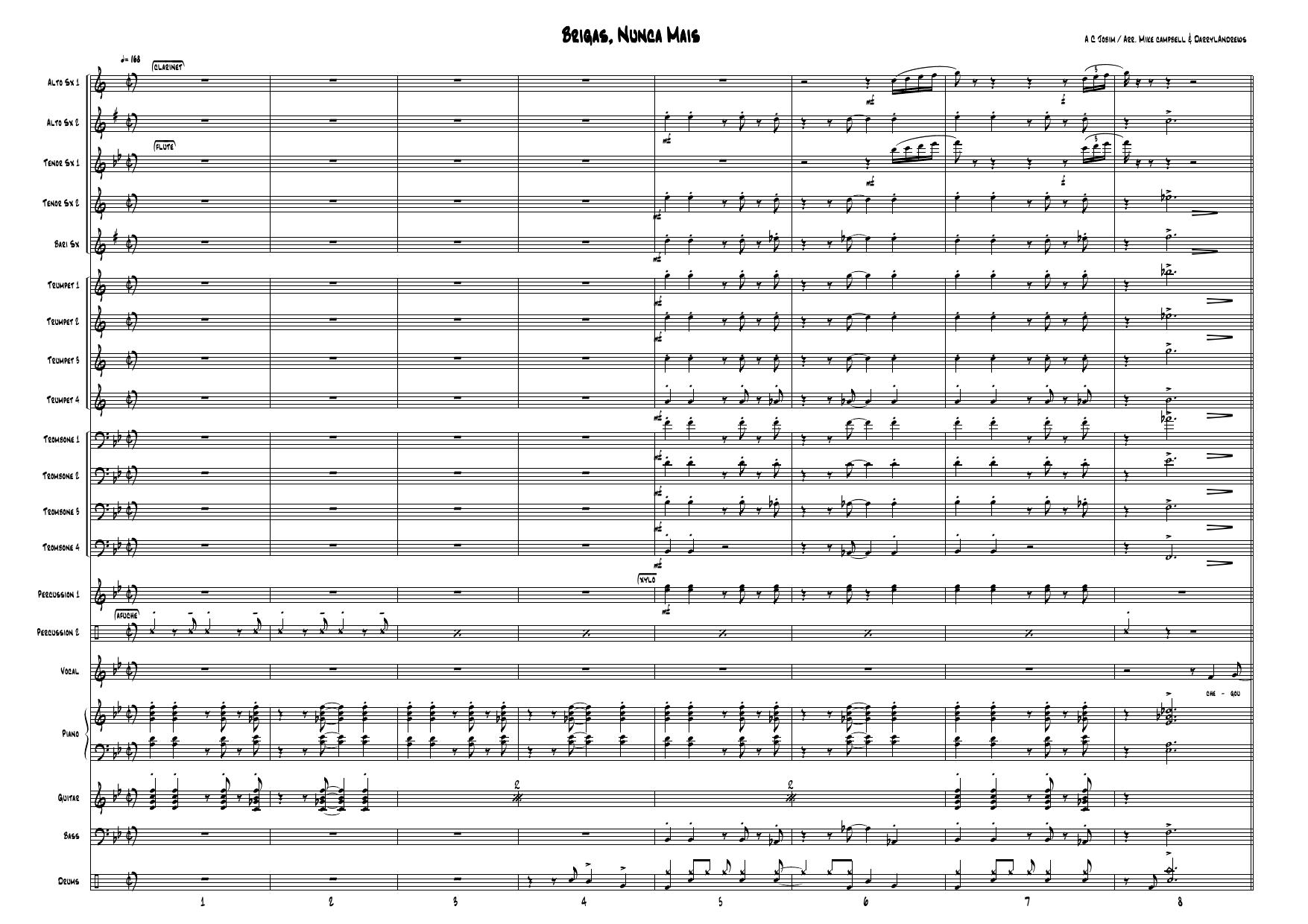
Brigas, Nunca Mais (M.Cambell)
Composed by Antonio Carlos Jobim
Arranged by M.Cambell
- Ensemble: Big Band
- Pages: 39
- Instruments (22): Alto Saxophone 1, Clarinet, Alto Saxophone 2, Tenor Saxophone 1, Flute, Tenor Saxophone 2, Baritone Saxophone, Trumpet 1, Trumpet 2, Trumpet 3, Trumpet 4, Trombone 1, Trombone 2, Trombone 3, Trombone 4, Percussion 1, Percussion 2, Vocal, Piano, Guitar, Bass, Drums
- Difficulty: medium
- Content: Individual Parts
- Format: PDF Download (Instant)
- Price: $24.99
Capturing the effortless grace and rhythmic sophistication of the mid-century Brazilian bossa nova movement, "Brigas, Nunca Mais" stands as one of the most enduring melodic gems born from the historic collaboration between Antonio Carlos Jobim and lyricist Vinícius de Moraes. Originally immortalized on seminal 1950s and 1960s recordings by João Gilberto, the composition bridges traditional samba syncopation with modern jazz harmony, evoking themes of reconciliation, warmth, and tranquil romance. Within the jazz canon, the piece is celebrated for its deceptively complex harmonic shifts and its lilting, conversational melody that invites subtle, nuanced interpretation. M.Cambell’s distinctive big band arrangement breathes fresh vitality into the source material, reframing an intimate acoustic style into a lush, dynamic canvas for an eight-piece instrumental ensemble. The chart maintains a quintessential medium-up bossa groove in 4/4 time, anchored by crisp percussion writing and sophisticated chord voicings that highlight the characteristic major-seventh and altered tensions inherent to Jobim's writing. M.Cambell utilizes rich horn-soli passages to distribute the iconic melody smoothly across the saxophone section—featuring alto, tenor, and baritone voices—while utilizing the trumpet and trombone to provide warm counter-melodies and punchy harmonic punctuation. The arrangement carefully balances transparent ensemble textures with moments of dense, soaring counterpoint, avoiding heavy-handed scoring to preserve the airy, optimistic mood of the original classic. Throughout the 39 pages of score and parts, the arrangement offers engaging challenges and rewarding moments for every section. The melody is primarily carried by the upper woodwinds before opening into dedicated solo sections that allow improvisers to stretch out over changes evocative of both modal jazz and traditional Brazilian idioms. Technical considerations focus heavily on rhythmic precision, particularly in executing clean, unforced syncopations that land precisely on the off-beats without rushing the tempo. The low-register anchoring provided by the baritone saxophone and trombone gives the chart a rich, resonant foundation, while upper-register trumpet lines add a brilliant sheen to key transitional phrases. Advanced high school, collegiate, and professional community jazz ensembles will find this arrangement an exceptional vehicle for developing Latin-jazz literacy and stylistic versatility. Because success relies heavily on light articulation, inner-voice balance, and a relaxed time-feel rather than sheer velocity, performers are pushed to refine their ensemble listening skills. It serves as a sophisticated concert opener or a refreshing stylistic change-of-pace within any contemporary big band or expanded jazz combo setlist. Achieving an authentic reading of this chart requires meticulous attention to the underlying bossa nova groove. The rhythm section must maintain an even, unhurried pulse, avoiding a heavy heavy-handed backbeat; the drummer should favor light ride-cymbal patterns and subtle cross-stick rimshots over driving rock or swing subdivisions. Technically, horn players must master precise articulation of syncopated figures that begin on the "and" of the beat. Avoid harsh accents; instead, use a warm, breath-supported tongue style to let notes speak naturally. The lead trumpet and alto saxophonist should coordinate closely on dynamic contours, ensuring that counterlines do not overpower the primary thematic statements traded across the ensemble. Rehearsals should begin slowly with a metronome clicking on beats two and four to lock in the stylistic feel before ramping up to the marked performance tempo. Directors should isolate the inner-voice harmony lines in the saxophones and trombone to balance complex chord extensions cleanly. Q: What instruments and parts are included in this arrangement? A: The chart is scored for an 8-instrument expanded jazz ensemble consisting of Alto Saxophone, Tenor Saxophone, Baritone Saxophone, Trumpet, Trombone, and a rhythm section (spanning 39 total pages of comprehensive score and individual parts). Q: What is the difficulty level of this arrangement? A: It is classified as intermediate-to-advanced, primarily due to the demands of maintaining a relaxed Latin-jazz time-feel, clean syncopated phrasing, and precise inner-voice balance rather than extreme technical speed. Q: What is the musical style and historical background of the piece? A: The piece is a classic bossa nova standard originally composed by Antonio Carlos Jobim and Vinícius de Moraes, celebrated for blending traditional Brazilian samba rhythms with sophisticated jazz harmonies. Q: What makes M.Cambell's treatment unique? A: M.Cambell skillfully reimagines an intimate acoustic bossa nova tune into a rich, full-ensemble format, utilizing subtle horn solis and dynamic counter-melodies that give every section an active, expressive role. Q: What is the recommended performance tempo and duration? A: The arrangement is set at a comfortable, swinging medium-bossa tempo (approximately 132–144 BPM) and typically runs around 4 to 5 minutes depending on the length of improvised solo choruses.
Questions and answers
- What is included in the Brigas, Nunca Mais (M.Cambell) PDF?
- The verified current file contains a conductor score and individual parts across 39 pages.
- How many instruments or parts are listed for Brigas, Nunca Mais (M.Cambell)?
- The verified instrumentation list contains 22 entries for this Big Band arrangement.
- Who is credited for Brigas, Nunca Mais (M.Cambell)?
- Composer: Antonio Carlos Jobim. Arranger: M.Cambell.
- What difficulty is listed for Brigas, Nunca Mais (M.Cambell)?
- The verified difficulty level is medium.
- Can I preview Brigas, Nunca Mais (M.Cambell) before buying?
- Yes. The product page provides a preview generated from the current PDF file.
- How is Brigas, Nunca Mais (M.Cambell) delivered?
- After successful payment, the digital PDF is made available for download. The displayed price is $24.99.
Musicians Also Search For
Brigas, Nunca Mais M.Cambell PDF • Brigas, Nunca Mais M.Cambell sheet music • Brigas, Nunca Mais arranged by M.Cambell • M.Cambell big band charts • M.Cambell jazz arrangements PDF • Brigas, Nunca Mais Antonio Carlos Jobim sheet music • Brigas, Nunca Mais Antonio Carlos Jobim big band arrangements • Antonio Carlos Jobim big band charts • Brigas, Nunca Mais big band arrangements • Brigas, Nunca Mais big band PDF download • Brigas, Nunca Mais jazz sheet music • big band sheet music download • Brigas, Nunca Mais conductor score PDF • Brigas, Nunca Mais individual parts download • Brigas, Nunca Mais sheet music PDF • buy Brigas, Nunca Mais sheet music • download Brigas, Nunca Mais PDF • Brigas, Nunca Mais jazz charts • best M.Cambell big band arrangements • Antonio Carlos Jobim arranged by M.Cambell • Brigas, Nunca Mais printable sheet music • big band repertoire PDF