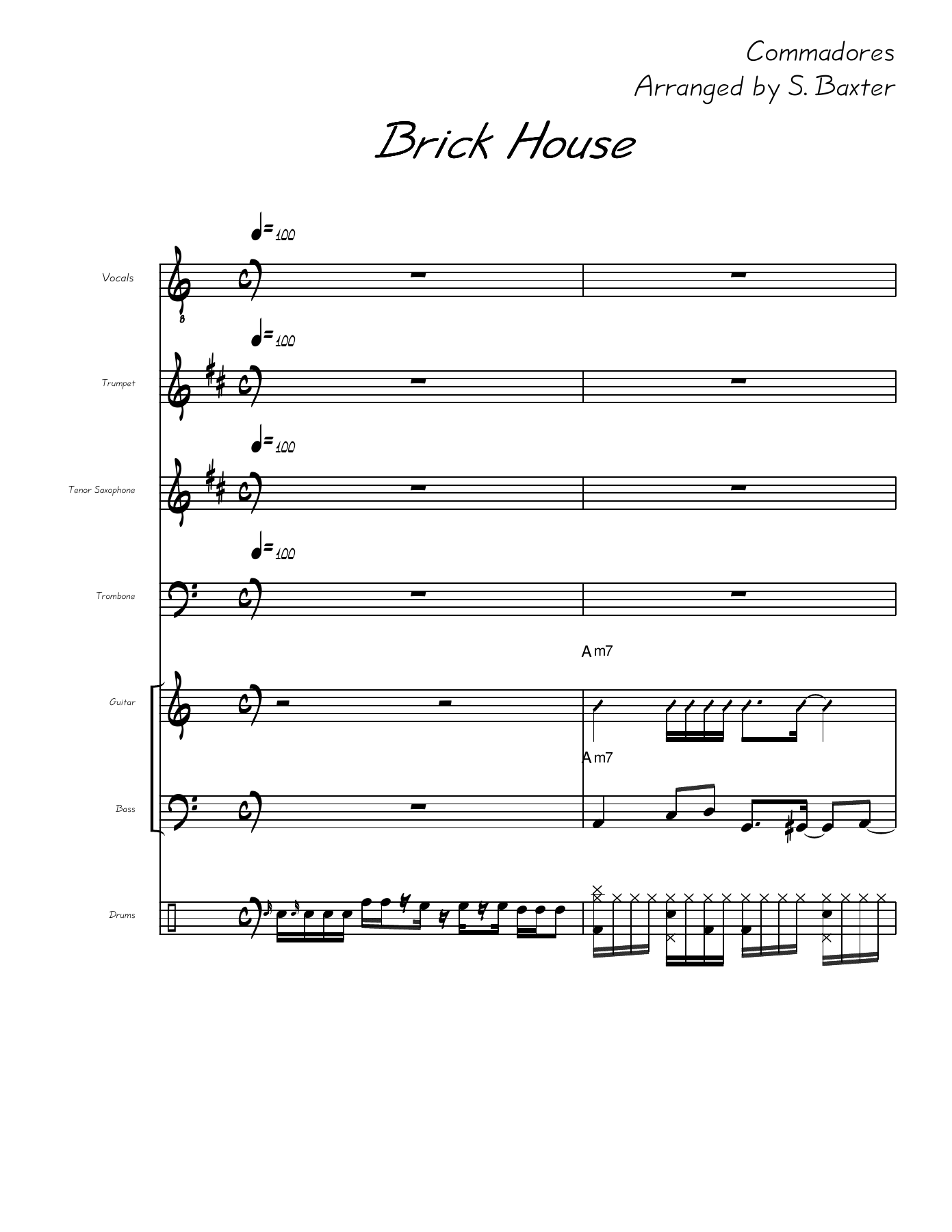
Brick House-3 horns (S.Baxter)
Composed by Commodores
Arranged by S. Baxter
- Ensemble: Small Ensemble
- Style: Jazz Standard
- Pages: 26
- Instruments (7): Vocals, Trumpet, Tenor Saxophone, Trombone, Guitar, Bass, Drums
- Difficulty: easy
- Content: Individual Parts
- Format: PDF Download (Instant)
- Price: $12.99
"Brick House," originally composed by the Commodores, emerged as an iconic funk anthem in 1977, a vibrant testament to the disco and R&B era. While deeply rooted in funk, its infectious groove, memorable melody, and enduring popularity have solidified its place in the broader lexicon of American popular music, frequently revisited and reinterpreted across genres, including jazz. The original recording, featuring Lionel Richie and William King, captured the essence of late 70s dance music with its driving bassline, punchy horns, and soulful vocals, making it a staple on dance floors and radio waves for decades. This enduring appeal and rhythmic sophistication make it a compelling candidate for jazz interpretation, allowing for exploration of its harmonic and melodic potential within a different improvisational framework. S. Baxter's arrangement of "Brick House" for a 3-horn small ensemble masterfully re-imagines this funk classic as a medium-up swing jazz standard. The piece is set in a bright, driving 4/4 meter, maintaining the original's energetic spirit but translating its rhythmic propulsion into a sophisticated swing feel. Baxter's characteristic approach to arranging shines through in his inventive reharmonization, which subtly enriches the original chord progression with extended harmonies and jazz-inflected voicings without sacrificing the tune's inherent catchiness. The arrangement opens with a captivating horn soli that immediately establishes the swing groove, showcasing Baxter's knack for crafting intricate yet accessible lines that highlight the ensemble's blend and precision. The overall mood is exhilarating and celebratory, evoking the joy of a classic jazz jam session. The arranger's distinctive voice is particularly evident in the interplay between the horns and the rhythm section. Baxter employs clever call-and-response figures and tightly voiced soli sections that give the small ensemble a much larger sound. The melody is initially presented by the lead alto saxophone, then traded and developed through the trumpet and trombone, ensuring each voice has moments in the spotlight. A dedicated improvisation section is provided over the form, offering ample space for featured solos from one or more of the horn players, allowing for individual expression within the established swing context. Technical challenges include precise articulation to achieve the authentic swing feel, navigating Baxter's harmonically rich voicings, and maintaining rhythmic tightness in the soli passages. However, the rewarding payoff lies in the ensemble's ability to transform a familiar funk tune into a vibrant, swinging jazz vehicle, delighting both performers and audiences with its fresh perspective and undeniable groove. This arrangement is ideally suited for college-level jazz combos, advanced high school ensembles, or community jazz groups seeking a fresh, engaging piece that bridges the gap between popular music and jazz improvisation. Its manageable 3-horn instrumentation makes it accessible for groups without a full big band complement, while its sophisticated harmonic and rhythmic demands provide excellent educational opportunities for developing jazz musicians. The arrangement's ability to fuse a well-known melody with authentic jazz styling makes it a crowd-pleaser, perfect for concerts, festivals, or casual gigs where a high-energy, swinging number is desired. Conductors should emphasize a consistent, driving medium-up swing feel from the rhythm section, ensuring the bass line walks with authority and the drums articulate the ride cymbal pattern clearly. The horn players must pay close attention to Baxter's specific articulation markings, particularly the short, crisp staccatos and the smooth, connected legato phrases, to achieve the intended jazz inflection. The opening horn soli requires meticulous balance and intonation, as the tight voicings are crucial to its impact. Encourage horn players to listen across the section, blending their individual sounds into a cohesive whole. During the solo section, guide soloists to build their improvisations dynamically, referencing the original melody or rhythmic motifs. Rehearsal time should be dedicated to locking in the rhythmic interplay between the horns and the rhythm section, especially in the shout chorus, to maximize the arrangement's energetic punch. Q: What instruments are included in this "Brick House" arrangement? A: This small ensemble arrangement is scored for 3 horns (typically Alto Saxophone, Trumpet, and Trombone) plus a standard rhythm section (Piano, Bass, Drums). Q: What is the difficulty level of this arrangement? A: This arrangement is rated as intermediate to advanced, suitable for college-level jazz combos, advanced high school ensembles, or skilled community jazz groups. Q: What is the musical style and historical context of this arrangement? A: This is a jazz standard arrangement of "Brick House," originally a funk hit by the Commodores from 1977. S. Baxter reinterprets it with a medium-up swing jazz feel. Q: What makes S. Baxter's arrangement of "Brick House" unique? A: S. Baxter's arrangement is unique for its sophisticated reharmonization, inventive horn soli sections, and its successful transformation of a funk classic into an authentic, swinging jazz vehicle for a small ensemble. Q: What is the typical performance duration and tempo for this piece? A: The typical performance duration is approximately 3-4 minutes, depending on the length of improvised solos, and it should be played at a medium-up swing tempo.
Questions and answers
- What is included in the Brick House-3 horns (S.Baxter) PDF?
- The verified current file contains a conductor score across 26 pages.
- How many instruments or parts are listed for Brick House-3 horns (S.Baxter)?
- The verified instrumentation list contains 7 entries for this Small Ensemble arrangement.
- Who is credited for Brick House-3 horns (S.Baxter)?
- Composer: Commodores. Arranger: S. Baxter.
- What difficulty is listed for Brick House-3 horns (S.Baxter)?
- The verified difficulty level is easy.
- What style is listed for Brick House-3 horns (S.Baxter)?
- The catalog lists the style as Jazz Standard.
- Can I preview Brick House-3 horns (S.Baxter) before buying?
- Yes. The product page provides a preview generated from the current PDF file.
- How is Brick House-3 horns (S.Baxter) delivered?
- After successful payment, the digital PDF is made available for download. The displayed price is $12.99.
Musicians Also Search For
Brick House-3 horns S. Baxter PDF • Brick House-3 horns S. Baxter sheet music • Brick House-3 horns arranged by S. Baxter • S. Baxter small ensemble charts • S. Baxter jazz arrangements PDF • Brick House-3 horns Commodores sheet music • Brick House-3 horns Commodores small ensemble arrangements • Commodores small ensemble charts • Brick House-3 horns small ensemble arrangements • Brick House-3 horns small ensemble PDF download • Brick House-3 horns jazz sheet music • small ensemble sheet music download • Brick House-3 horns conductor score PDF • Brick House-3 horns sheet music PDF • Brick House-3 horns Jazz Standard charts • Jazz Standard small ensemble arrangements • buy Brick House-3 horns sheet music • download Brick House-3 horns PDF • Brick House-3 horns jazz charts • best S. Baxter small ensemble arrangements • Commodores arranged by S. Baxter • Brick House-3 horns printable sheet music • small ensemble repertoire PDF