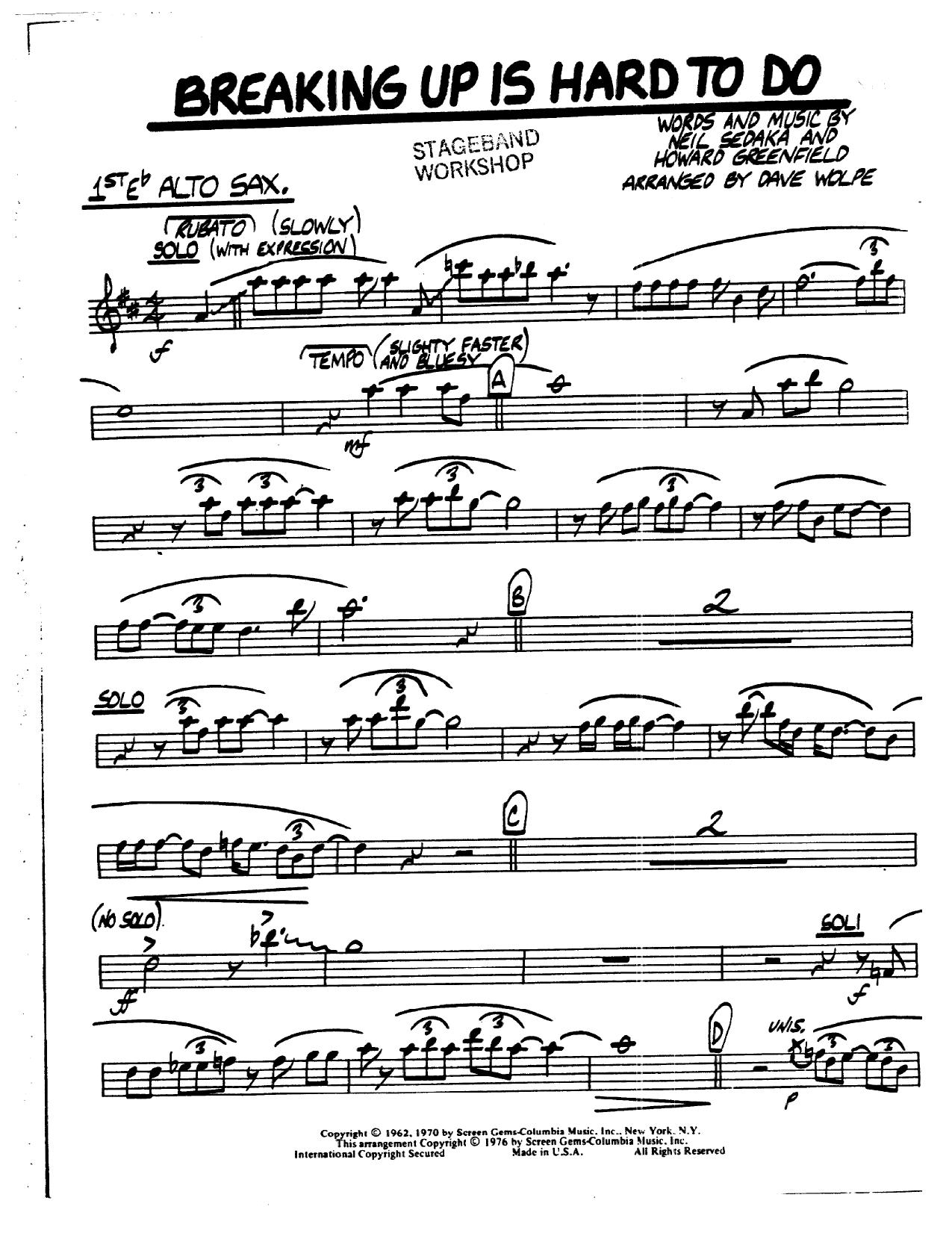
Breaking Up Is Hard To Do (D.Wolpe) sheet music preview

Breaking Up Is Hard To Do (D.Wolpe)

Composed by Neil Sedaka

Arranged by Dave Wolpe

  • Ensemble: Big Band
  • Pages: 47
  • Instruments (17): 1st Eb Alto Sax., 2nd Eb Alto Sax., 1st Bb Tenor Sax., 2nd Bb Tenor Sax., Eb Baritone Sax., 1st Bb Trumpet, 2nd Bb Trumpet, 3rd Bb Trumpet, 4th Bb Trumpet, 1st Trombone, 2nd Trombone, 3rd Trombone, Bass Trombone, Guitar, Drums, Bass, Piano
  • Difficulty: medium
  • Content: Individual Parts
  • Format: PDF Download (Instant)
  • Price: $24.99

Originally crafted by Neil Sedaka and Howard Greenfield in 1962, "Breaking Up Is Hard to Do" stands as one of the defining pop-rock anthems of the early 1960s, famously propelling Sedaka to the top of the Billboard Hot 100. While its origins are firmly rooted in the Brill Building pop tradition, the song’s inherent melodic strength and infectious harmonic structure make it a brilliant vehicle for big band jazz adaptation. Transcending its nostalgic pop roots, the composition possesses a durable chord progression and a buoyant, uplifting framework that invites a clever stylistic reinvention. In this masterful treatment, arranger Dave Wolpe transforms the upbeat pop classic into a swinging, high-energy chart that radiates classic big band sophistication. Driven by a buoyant, driving medium-swing feel in 4/4 time, the arrangement captures an effervescent mood that bridges mid-century dance band charm with modern jazz articulation. Wolpe avoids a simplistic novelty approach, instead treating the familiar melody with genuine harmonic respect while injecting fresh syncopation, vibrant brass counterlines, and dynamic contrast that keeps both the ensemble and the audience thoroughly engaged from the opening count-off to the final sustained chord. Wolpe's signature arranging style shines through the clever distribution of thematic material across the 17-piece ensemble. The saxophones introduce the primary hooks with tight, polished voicings before handing off the line to a swaggering brass section. A standout feature of the chart is a tightly knit, harmonically rich ensemble soli that showcases the saxophone section's interplay against crisp, punctuating brass stabs. The rhythm section is given ample room to drive the groove, featuring an interactive piano comping framework and an assertive bass line that anchors the swinging momentum. Solo opportunities are strategically placed to highlight featured performers—typically within the trumpet or tenor saxophone chairs—allowing individual improvisers to stretch out over accessible yet sophisticated changes. Advanced high school ensembles, collegiate jazz orchestras, and professional community big bands will find this chart to be an exceptionally rewarding addition to their repertoire. While the technical demands are approachable enough for developing bands to master with proper sectional work, the arrangement offers enough subtle articulation nuances, dynamic shading, and stylistic maturity to satisfy advanced groups. It functions remarkably well as an upbeat concert opener, a crowd-pleasing second-set highlight, or a showcase piece for audiences looking to connect with a brilliantly reframed mid-century standard. Executing this chart successfully hinges on maintaining a relaxed yet authoritative medium-swing feel; conductors should guard against rushing the tempo, ensuring the quarter-note pulse remains steady and foundational. The primary technical challenge lies in the uniform execution of short, crisp articulations—particularly the accented and staccato notes in the brass section that punctuate the off-beats. Saxophone players must focus on blend and intonation during the harmonically dense soli sections, ensuring that internal voices do not overpower the lead alto. Trumpets should approach high register passages with a bright, focused tone rather than forced volume, utilizing subtle falls and doits where indicated to authentic stylistic effect. Rehearsals should initially isolate the rhythm section to lock in the groove before layering in the horns section by section, paying meticulous attention to dynamic contrasts between the lush background pads and the explosive, driving shout chorus. Q: What instruments and parts are included in this big band arrangement? A: The arrangement is scored for a standard 17-instrument big band line-up, which includes 2 alto saxophones, 2 tenor saxophones, baritone saxophone, 4 trumpets, 4 trombones, piano, guitar, bass, and drums, along with a comprehensive conductor score. Q: What is the difficulty level of Dave Wolpe's "Breaking Up Is Hard To Do"? A: This chart is graded as medium difficulty, making it ideal for accomplished high school groups, collegiate jazz ensembles, and professional community big bands looking for a polished, crowd-pleasing swing chart. Q: What is the musical style and historical context of this piece? A: It reinterprets Neil Sedaka's 1962 pop-rock chart through a vibrant, straight-ahead medium-swing big band lens, blending classic 1960s vocal pop melodies with traditional jazz arranging techniques. Q: What makes this specific arrangement by Dave Wolpe unique? A: Wolpe expertly balances nostalgic recognition with sophisticated jazz harmony, featuring clever horn counterlines, a tightly knit saxophone soli, and a dynamic shout chorus that elevate the familiar pop tune into a legitimate jazz showcase. Q: What is the performance duration and recommended tempo for this arrangement? A: While performance time can vary slightly based on improvised solo lengths, it typically runs around 3 to 4 minutes when performed at the recommended medium-swing tempo.

Questions and answers

What is included in the Breaking Up Is Hard To Do (D.Wolpe) PDF?
The verified current file contains individual parts across 47 pages.
How many instruments or parts are listed for Breaking Up Is Hard To Do (D.Wolpe)?
The verified instrumentation list contains 17 entries for this Big Band arrangement.
Who is credited for Breaking Up Is Hard To Do (D.Wolpe)?
Composer: Neil Sedaka. Arranger: Dave Wolpe.
What difficulty is listed for Breaking Up Is Hard To Do (D.Wolpe)?
The verified difficulty level is medium.
Can I preview Breaking Up Is Hard To Do (D.Wolpe) before buying?
Yes. The product page provides a preview generated from the current PDF file.
How is Breaking Up Is Hard To Do (D.Wolpe) delivered?
After successful payment, the digital PDF is made available for download. The displayed price is $24.99.

Musicians Also Search For

Breaking Up Is Hard To Do Dave Wolpe PDFBreaking Up Is Hard To Do Dave Wolpe sheet musicBreaking Up Is Hard To Do arranged by Dave WolpeDave Wolpe big band chartsDave Wolpe jazz arrangements PDFBreaking Up Is Hard To Do Neil Sedaka sheet musicBreaking Up Is Hard To Do Neil Sedaka big band arrangementsNeil Sedaka big band chartsBreaking Up Is Hard To Do big band arrangementsBreaking Up Is Hard To Do big band PDF downloadBreaking Up Is Hard To Do jazz sheet musicbig band sheet music downloadBreaking Up Is Hard To Do individual parts downloadBreaking Up Is Hard To Do sheet music PDFbuy Breaking Up Is Hard To Do sheet musicdownload Breaking Up Is Hard To Do PDFBreaking Up Is Hard To Do jazz chartsbest Dave Wolpe big band arrangementsNeil Sedaka arranged by Dave WolpeBreaking Up Is Hard To Do printable sheet musicbig band repertoire PDF

All arrangements by Dave Wolpe All Neil Sedaka sheet music