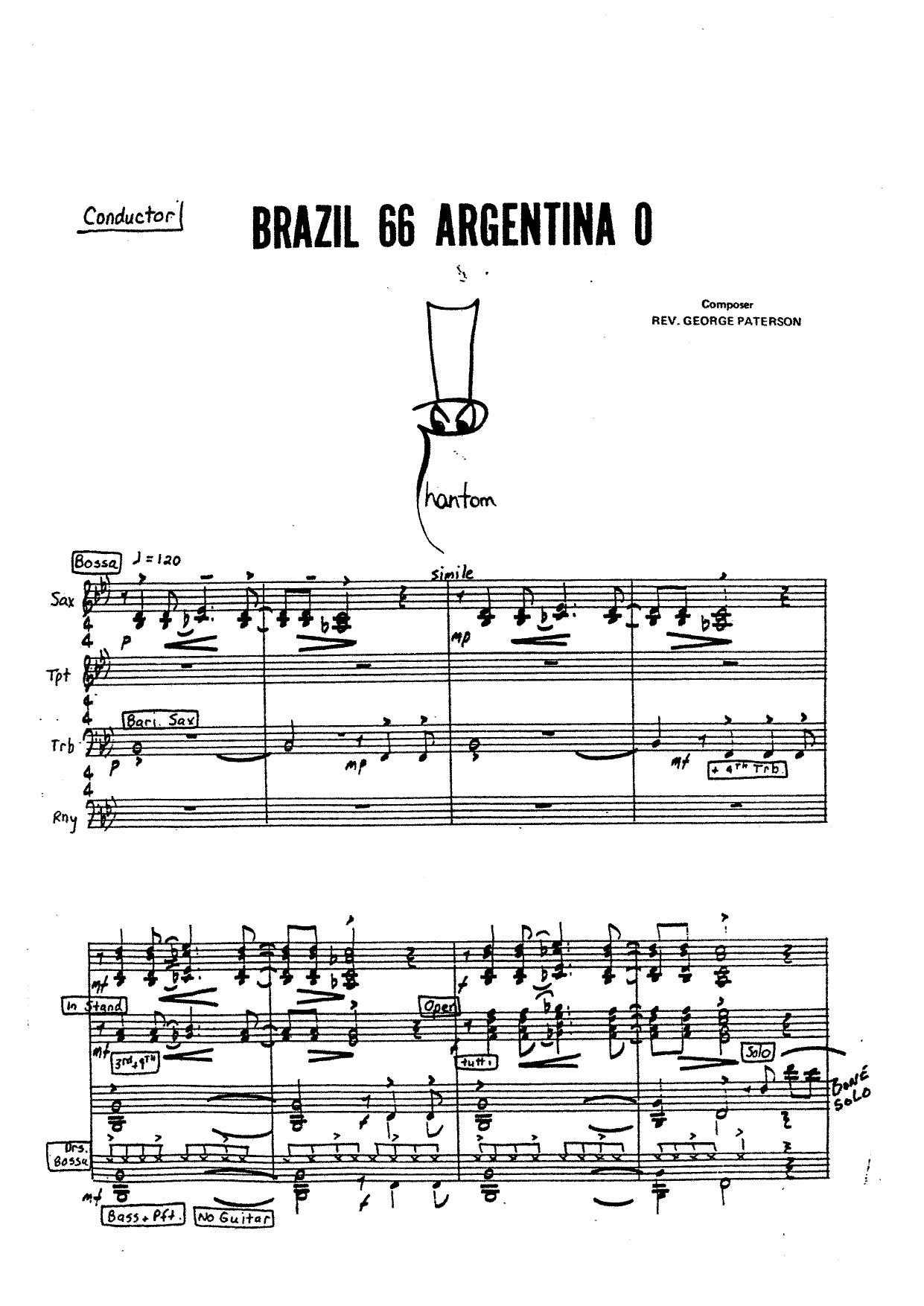
Brazil 66 Argentina 0 (G.Paterson)
Composed by G. Paterson
Arranged by G.Paterson
- Ensemble: Big Band
- Pages: 38
- Instruments (17): Conductor Score, Piano, Guitar, Bass, Alto Saxophone I, Alto Saxophone II, Tenor Saxophone I, Tenor Saxophone II, Baritone Saxophone, Trumpet I, Trumpet II, Trumpet III, Trumpet IV, Trombone I, Trombone II, Trombone III, Trombone IV
- Difficulty: medium
- Content: Individual Parts
- Format: PDF Download (Instant)
- Price: $24.99
Blending the infectious rhythms of South America with sophisticated harmonic structures, "Brazil 66 Argentina 0" reimagines traditional folkloric motifs through the lens of modern big band jazz. While drawing upon the rich rhythmic vernacular of the Southern Cone and tropical modernism, this composition bridges the gap between traditional Latin-infused dance forms and contemporary jazz composition. The title itself playfully evokes legendary South American football rivalries, setting a stage of high energy, rhythmic drive, and spirited interplay between sections. Driven by a pulsating, intricate Latin-jazz groove in 4/4 time, the musical character shifts dynamically between cascading woodwind flourishes and heavy, brass-led stabs. The mood is celebratory yet intellectually engaging, moving from an open, atmospheric intro into a high-octane vamp that evokes the sultry heat of a Buenos Aires night and the sun-drenched coastal energy of Brazil. G.Paterson’s arrangement utilizes lush, extended modal harmonies and tight chordal voicings reminiscent of the West Coast cool school meets Latin fusion. Rather than relying on simple rhythm section ostinatos, Paterson weaves the harmonic tension across the entire 17-piece ensemble, employing clever counterpoint and shifting metric accents that keep both the performers and listeners on edge. The melodic weight is shared dynamically across the saxophone and trumpet sections, featuring a soaring alto saxophone soli that demands immaculate blend and articulation. Brass sections are treated to punchy, brass-heavy interludes that require agile tongue technique and precise breath support, culminating in an exhilarating shout chorus that builds steadily in volume and complexity before resolving into a driving climax. Solo opportunities are provided over accessible modal vamps, allowing competent improvisers to stretch out without losing the momentum of the underlying groove. The rhythm section—anchored by piano, guitar, bass, and an auxiliary percussion setup—serves as the engine room, demanding a tight, interlocking feel between the drum kit and hand percussion to authentically capture the stylistic intent. Advanced high school ensembles with strong section leaders, as well as collegiate and professional big bands, will find this chart an immensely rewarding addition to their repertoire. The 38-page publication includes a comprehensive conductor score and all 17 standard instrumental parts, meticulously formatted for readability. While the technical demands require disciplined section playing and a strong collective sense of time, the payoff is a crowd-pleasing, intellectually stimulating centerpiece for any contemporary jazz concert program. Executing "Brazil 66 Argentina 0" successfully hinges on the rhythm section’s ability to establish an unyielding, buoyant Latin-jazz groove right from the downbeat. The tempo should remain brisk and danceable, avoiding any tendency to drag during complex ensemble passages. Conductors should pay close attention to the dynamic contrast between the understated, harmonically rich background figures and the explosive ensemble shout choruses. Brass players should approach their articulations with clarity—utilizing crisp staccatos and controlled falls where indicated—without overblowing the upper register, ensuring the intricate inner voicings remain transparent. Woodwinds must practice their unison and harmonized soli sections slowly with a metronome to lock in intonation, particularly during chromatic shifts. The percussionist and drummer must lock tightly together: the drummer should maintain a crisp cross-stick or ride pattern while the auxiliary percussion drives the syncopated cross-rhythms. Rehearsals should initially isolate the rhythm section before layering in the horn sections section-by-section to master the tricky syncopated hits that define Paterson's unique arrangement style. Q: What instruments and parts are included in this publication? A: The 38-page publication includes a full conductor score and individual parts for a standard 17-instrument big band: Alto Saxophone 1 & 2, Tenor Saxophone 1 & 2, Baritone Saxophone, 4 Trumpets, 4 Trombones, Piano, Guitar, Bass, Drums, and Auxiliary Percussion. Q: What is the difficulty level of this arrangement? A: This arrangement is graded as advanced (suitable for advanced high school, collegiate, and professional big bands), primarily due to its intricate syncopated Latin rhythms, fast tempo, and the technical precision required for the sax soli and brass interludes. Q: What is the musical style and historical context of the piece? A: The piece is a contemporary jazz arrangement by G.Paterson that fuses traditional South American folkloric themes and Latin grooves with modern big band jazz harmonies and sophisticated counterpoint. Q: What makes G.Paterson's arrangement unique? A: It stands out through its clever integration of extended modal harmonies, shared melodic responsibilities across sections rather than just lead brass, and a driving rhythmic concept that treats the entire 17-piece ensemble as a unified percussion unit. Q: What is the performance duration and suggested tempo feel? A: While performance time can vary based on solo lengths, the chart is designed as a high-energy feature lasting approximately 4 to 5 minutes, driven by a brisk, infectious Latin-jazz groove in 4/4 time.
Questions and answers
- What is included in the Brazil 66 Argentina 0 (G.Paterson) PDF?
- The verified current file contains a conductor score and individual parts across 38 pages.
- How many instruments or parts are listed for Brazil 66 Argentina 0 (G.Paterson)?
- The verified instrumentation list contains 17 entries for this Big Band arrangement.
- Who is credited for Brazil 66 Argentina 0 (G.Paterson)?
- Composer: G. Paterson. Arranger: G.Paterson.
- What difficulty is listed for Brazil 66 Argentina 0 (G.Paterson)?
- The verified difficulty level is medium.
- Can I preview Brazil 66 Argentina 0 (G.Paterson) before buying?
- Yes. The product page provides a preview generated from the current PDF file.
- How is Brazil 66 Argentina 0 (G.Paterson) delivered?
- After successful payment, the digital PDF is made available for download. The displayed price is $24.99.
Musicians Also Search For
Brazil 66 Argentina 0 G.Paterson PDF • Brazil 66 Argentina 0 G.Paterson sheet music • Brazil 66 Argentina 0 arranged by G.Paterson • G.Paterson big band charts • G.Paterson jazz arrangements PDF • Brazil 66 Argentina 0 G. Paterson sheet music • Brazil 66 Argentina 0 G. Paterson big band arrangements • G. Paterson big band charts • Brazil 66 Argentina 0 big band arrangements • Brazil 66 Argentina 0 big band PDF download • Brazil 66 Argentina 0 jazz sheet music • big band sheet music download • Brazil 66 Argentina 0 conductor score PDF • Brazil 66 Argentina 0 individual parts download • Brazil 66 Argentina 0 sheet music PDF • buy Brazil 66 Argentina 0 sheet music • download Brazil 66 Argentina 0 PDF • Brazil 66 Argentina 0 jazz charts • best G.Paterson big band arrangements • G. Paterson arranged by G.Paterson • Brazil 66 Argentina 0 printable sheet music • big band repertoire PDF