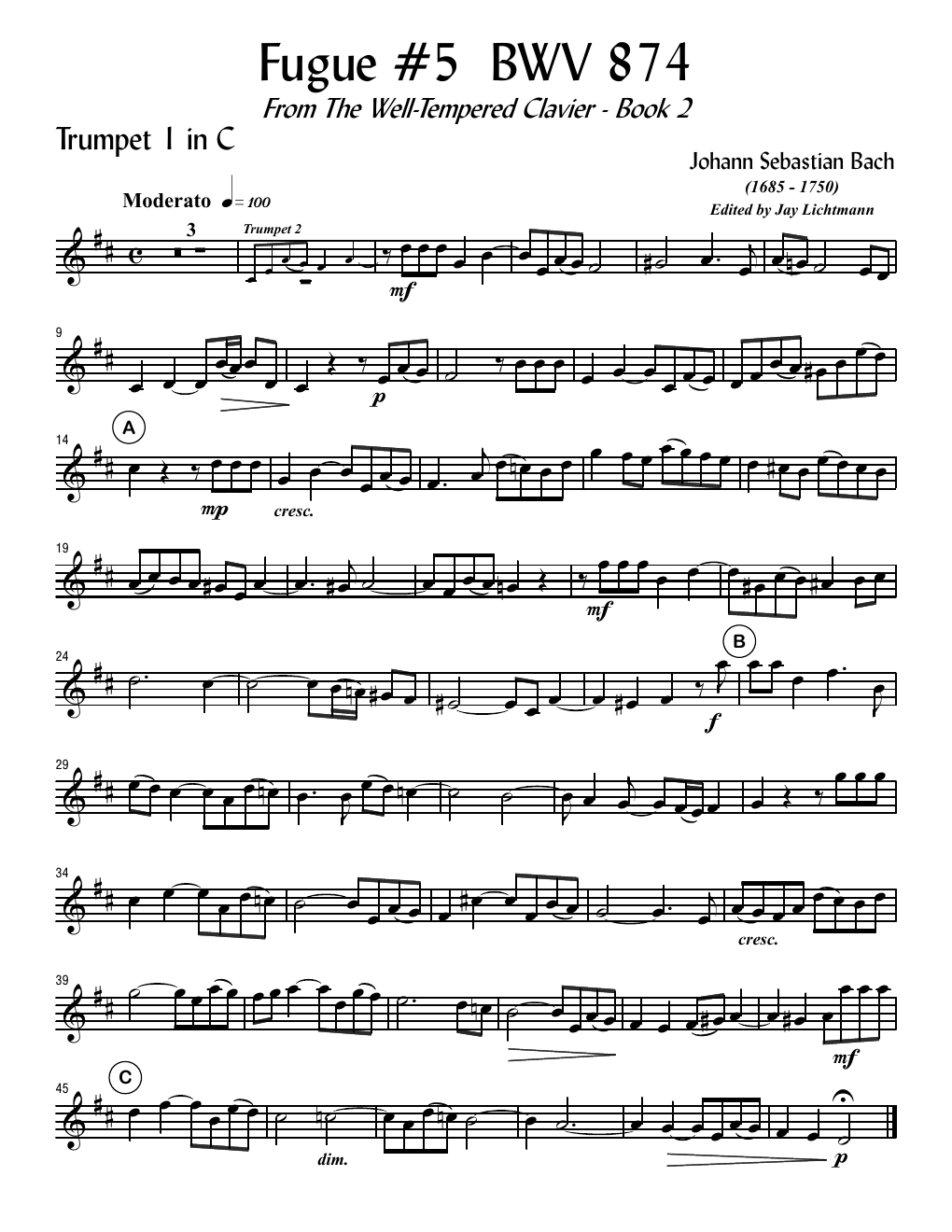
Brass Quintet (A.Holborne)
Composed by Anthony Holborne
Arranged by A Holborne
- Ensemble: Small Ensemble
- Style: Traditional
- Pages: 5
- Instruments (5): Trumpet 1 in C, Trumpet 2 in C, Trombone 1, Trombone 2, Horn in F (Substitute for Trombone 1)
- Difficulty: easy
- Content: Individual Parts
- Format: PDF Download (Instant)
- Price: $12.99
Anthony Holborne's original compositions, primarily from the late 16th and early 17th centuries, represent a pinnacle of English Renaissance music, often categorized under the "Golden Age" of Elizabethan and Jacobean eras. His works, particularly those for consort, were celebrated for their intricate counterpoint, elegant melodic lines, and sophisticated harmonic language, making him a contemporary of William Byrd and John Dowland. While not a jazz standard in the traditional sense, Holborne's enduring appeal lies in his masterful blend of melancholy and sprightliness, often found in his pavans, galliards, and almains. This particular arrangement, "Brass Quintet (A.Holborne)," reimagines a selection of these timeless pieces, translating their inherent grace and structural clarity into a compelling setting for modern brass. The original works were not "made famous" by a single artist but rather by their widespread popularity and publication during Holborne's lifetime, contributing significantly to the instrumental repertoire of the period. The musical character of this arrangement carefully preserves the original's dignified and often introspective mood, juxtaposed with moments of vibrant rhythmic energy. While the original pieces were not conceived with a "swing feel" or "Latin groove," A. Holborne's arrangement subtly infuses a sense of rhythmic vitality and articulation appropriate for a contemporary brass quintet, without sacrificing historical authenticity. The primary key centers remain largely as per the original, often in modal or minor keys, contributing to the evocative and sometimes melancholic atmosphere. Tempos vary from stately and processional for the pavans to brisk and dance-like for the galliards and almains. The overall energy is one of refined elegance and expressive depth, evoking the grandeur and emotional nuance of the Renaissance court. A. Holborne's distinctive approach to arranging this material for brass quintet is marked by an exceptional understanding of both the original idiom and the capabilities of modern brass instruments. Rather than simply transcribing, the arranger has re-voiced the original consort textures to exploit the unique timbral blend and dynamic range of two trumpets, horn, trombone, and tuba. Expect rich, sustained harmonies, often featuring close voicings that enhance the inherent warmth of the brass. The arranger skillfully distributes melodic lines across the ensemble, allowing each instrument to carry the primary theme at various points, fostering a true ensemble interplay rather than a lead-and-accompaniment structure. There are no traditional jazz "soli sections" or "shout choruses" here; instead, the focus is on polyphonic clarity and the seamless passing of melodic fragments, echoing the contrapuntal nature of the original. The arrangement avoids extended harmonies or overt jazz inflections, prioritizing the integrity of Holborne's original harmonic language. Performance of "Brass Quintet (A.Holborne)" demands precision, blend, and a nuanced understanding of phrasing. Melodies are distributed fluidly, requiring all five players to be equally adept at leading and supporting. There are no featured improvised solos; the challenge and reward lie in the collective interpretation of Holborne's intricate lines. Technical challenges include maintaining consistent tone and intonation across the quintet, navigating intricate contrapuntal passages, and achieving a unified articulation that balances historical sensitivity with brass quintet idiom. The arrangement is particularly rewarding for its ability to transport both performers and audience to a different era, showcasing the timeless beauty of Holborne's compositions through the powerful and expressive voice of brass. This arrangement is ideally suited for college-level ensembles, community brass quintets, and professional groups seeking to expand their repertoire with historically informed yet freshly presented classical works. Its educational value for high school ensembles focusing on ensemble blend and classical phrasing is also significant. This arrangement of Anthony Holborne's works for brass quintet requires a meticulous approach to ensemble balance and articulation. The primary technical challenge lies in achieving a unified sound that respects the original Renaissance counterpoint while leveraging the dynamic range of modern brass. Conductors should emphasize a legato, sustained tone, particularly in the longer melodic lines, ensuring that inner voices are clearly audible but never overpower the primary melodic contour. A moderate, flowing tempo (e.g., quarter note = 72-84 bpm for pavans, quarter note = 100-120 bpm for galliards) is generally appropriate, allowing for clarity of articulation without rushing the inherent dignity of the music. Special techniques such as plunger mutes or falls are not applicable; instead, focus on precise attacks and releases, and a consistent vibrato (or lack thereof) across the ensemble. Rehearsal tips include isolating contrapuntal entrances to ensure rhythmic accuracy and independence, and practicing dynamic shaping within phrases to highlight melodic peaks and valleys. Attention to tuning sustained chords is paramount for achieving the rich harmonic blend. Q: What instruments are included in this arrangement? A: This arrangement is scored for a standard brass quintet, which typically includes two B-flat trumpets, one F horn, one trombone, and one tuba. All five individual parts are provided. Q: What is the difficulty level of "Brass Quintet (A.Holborne)"? A: This arrangement is considered intermediate to advanced. It requires strong technical proficiency, excellent ensemble blend, and a nuanced understanding of classical phrasing, making it suitable for college, community, and professional brass quintets. Q: What musical style and historical context does this arrangement represent? A: This arrangement reimagines compositions by Anthony Holborne from the late English Renaissance (late 16th/early 17th century). While presented for modern brass, it maintains the traditional classical style, focusing on intricate counterpoint and elegant melodic lines. Q: What makes A. Holborne's arrangement of his own work unique? A: This arrangement by A. Holborne (the original composer) is unique in its faithful yet interpretive translation of Renaissance consort music for the modern brass quintet. It highlights the original's polyphonic clarity and harmonic richness, expertly re-voicing it to exploit the unique timbres and blend of brass instruments without adding anachronistic elements. Q: What is the typical performance duration or tempo for this piece? A: As this arrangement likely comprises multiple short pieces (e.g., pavans, galliards), the overall performance duration would depend on how many are selected. Individual piece tempos range from stately and slow (e.g., quarter note = 72 bpm) to brisk and dance-like (e.g., quarter note = 120 bpm), reflecting the original Renaissance forms.
Questions and answers
- What is included in the Brass Quintet (A.Holborne) PDF?
- The verified current file contains individual parts across 5 pages.
- How many instruments or parts are listed for Brass Quintet (A.Holborne)?
- The verified instrumentation list contains 5 entries for this Small Ensemble arrangement.
- Who is credited for Brass Quintet (A.Holborne)?
- Composer: Anthony Holborne. Arranger: A Holborne.
- What difficulty is listed for Brass Quintet (A.Holborne)?
- The verified difficulty level is easy.
- What style is listed for Brass Quintet (A.Holborne)?
- The catalog lists the style as Traditional.
- Can I preview Brass Quintet (A.Holborne) before buying?
- Yes. The product page provides a preview generated from the current PDF file.
- How is Brass Quintet (A.Holborne) delivered?
- After successful payment, the digital PDF is made available for download. The displayed price is $12.99.
Musicians Also Search For
Brass Quintet A Holborne PDF • Brass Quintet A Holborne sheet music • Brass Quintet arranged by A Holborne • A Holborne small ensemble charts • A Holborne jazz arrangements PDF • Brass Quintet Anthony Holborne sheet music • Brass Quintet Anthony Holborne small ensemble arrangements • Anthony Holborne small ensemble charts • Brass Quintet small ensemble arrangements • Brass Quintet small ensemble PDF download • Brass Quintet jazz sheet music • small ensemble sheet music download • Brass Quintet individual parts download • Brass Quintet sheet music PDF • Brass Quintet Traditional charts • Traditional small ensemble arrangements • buy Brass Quintet sheet music • download Brass Quintet PDF • Brass Quintet jazz charts • best A Holborne small ensemble arrangements • Anthony Holborne arranged by A Holborne • Brass Quintet printable sheet music • small ensemble repertoire PDF