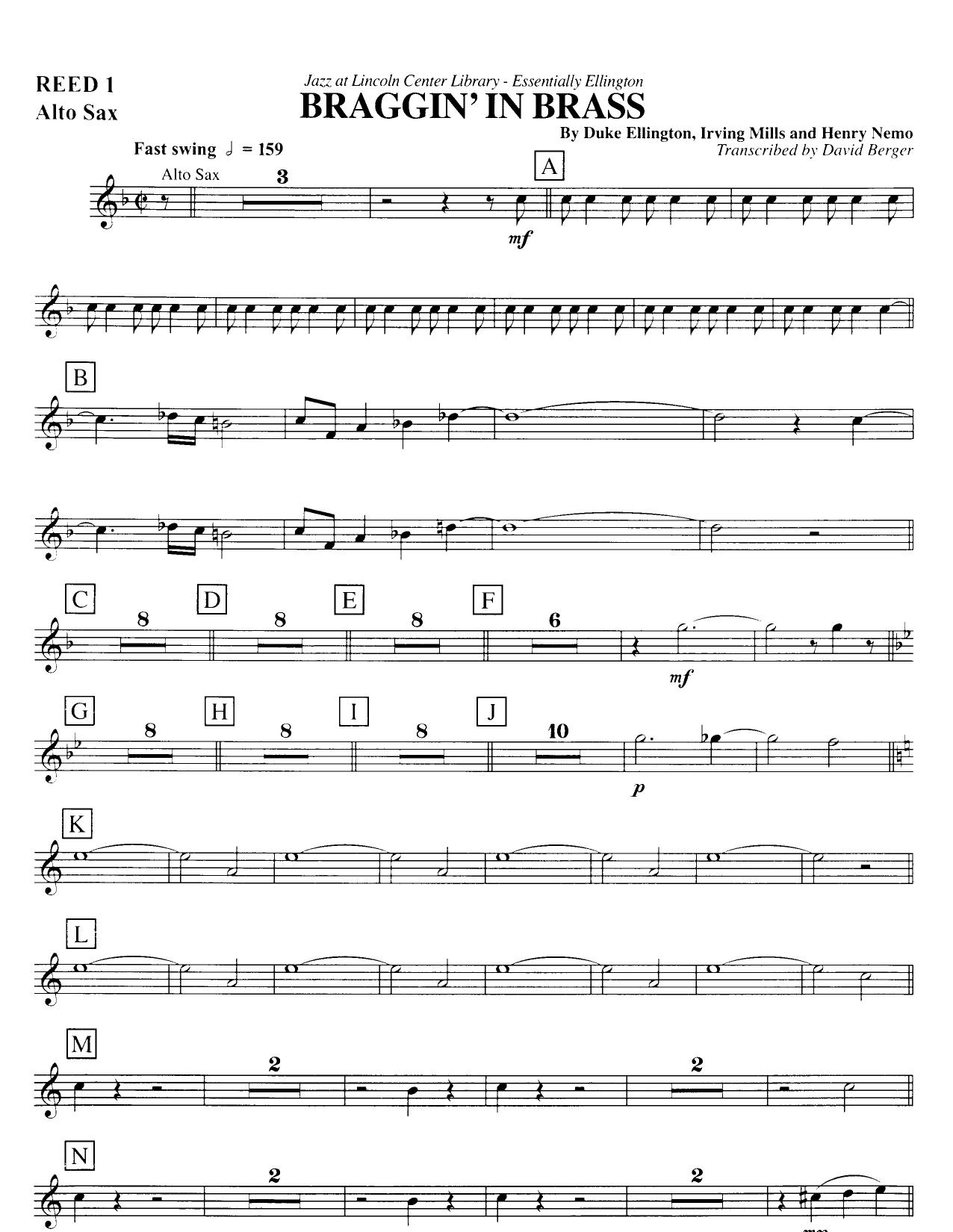
Braggin' In Brass (D.Ellington) sheet music preview

Braggin' In Brass (D.Ellington)

Composed by Duke Ellington

Arranged by Duke Ellington & B.Strayhorn.D.Berger

  • Ensemble: Big Band
  • Pages: 31
  • Instruments (13): Reed 1 (Alto Sax), Reed 2 (Alto Sax), Reed 3 (Tenor Sax), Reed 4 (Bari Sax), Trumpet 1, Trumpet 2, Trumpet 3, Trombone 1, Trombone 2, Trombone 3, Guitar, Bass, Drums
  • Difficulty: medium
  • Content: Individual Parts
  • Format: PDF Download (Instant)
  • Price: $24.99

Duke Ellington’s landmark composition "Braggin' In Brass" stands as one of the ultimate showcases for the virtuosic firepower of the legendary 1930s Ellington Orchestra. Originally recorded in 1938, this high-octane masterwork represents the pinnacle of the swing era's sectional prowess, specifically designed to highlight the inimitable talents of Ellington's powerhouse brass section, including trumpeters Cootie Williams and Rex Stewart, and trombonist Joe "Tricky Sam" Nanton. The piece is a quintessential Ellingtonian tour de force, merging aggressive, driving swing with sophisticated orchestral textures that push the boundaries of conventional big band writing. Propelled by an aggressive, fast-paced swing feel in 4/4 time, "Braggin' In Brass" crackles with an electric, combative energy. The mood is fiercely competitive, exuding confidence, swagger, and unbridled joy. The harmonic language is rich with Ellington's signature chromaticism, colorful dissonance, and dense chordal voicings that give the ensemble a massive, organ-like resonance. The musical landscape shifts rapidly between blistering ensemble passages and intricate counterpoint, evoking the breathless excitement of a high-stakes cutting contest on a Harlem dance hall stage. Adapted by the legendary collaborative team of Duke Ellington, Billy Strayhorn, and transcribed/edited by master archivist David Berger, this 9-instrument arrangement brilliantly distills the massive sonic footprint of the original 15-piece orchestra into a nimble yet potent chamber-jazz instrumentation (comprising Alto Saxophone, Tenor Saxophone, Baritone Saxophone, Trumpet, Trombone, and rhythm section support). Berger's meticulous transcription preserves the authentic Ellington/Strayhorn voicing practices, retaining the tight trumpet harmonizations, plunger-mute effects, and snarling trombone glisses that defined the original recording. Rather than diluting the score, this compressed scoring highlights the inner counterpoint and demands absolute transparency from every player on the bandstand. Performance-wise, this chart is an exhilarating challenge that places heavy demands on the entire ensemble. The reed section navigates rapid-fire scalar passages and tight, harmonized solis that mimic the agility of the brass, while the trumpet and trombone chairs must master an array of stylistic effects, including growls, plunger mutes, falls, and wide vibratos. Improvised solo space allows featured horn players to step into the spotlight with uninhibited, blues-drenched expression. The rhythmic foundation must drive relentlessly without rushing, maintaining a crisp, buoyant swing eighth-note feel beneath the cascading horn lines. Advanced high school groups, collegiate ensembles, and professional professional-level community big bands will find this chart an immensely rewarding centerpiece for a concert program. Because of its specialized 9-instrument scoring and high technical threshold, it requires seasoned players with strong section-playing skills, excellent intonation, and a deep appreciation for classic swing-era idioms. Bringing this chart to life offers modern musicians a direct, hands-on encounter with the genius of the Ellington-Strayhorn writing partnership. Executing "Braggin' In Brass" successfully requires precision, stamina, and a deep understanding of 1938-era swing conventions. The tempo is brisk and unforgiving; conductors should establish a rock-solid, driving pulse before the downbeat to prevent the ensemble from rushing during dense tutti passages. Brass players must utilize appropriate period mutes—specifically plunger mutes and cup mutes—to achieve the authentic growling, vocalized timbre demanded by the score. Technically, the primary hurdle lies in the articulation and alignment of rapid, synchronized figures between the saxophones and brass. Rehearsals should isolate the fast, interlocking rhythmic lines at a slower tempo, gradually working up to performance speed while strictly enforcing uniform articulation (short, punchy staccatos contrasting with sweeping slurs). Horn players must balance their dynamics carefully to ensure that inner-voice countermelodies are not swallowed by the lead parts. Emphasize a forward-moving, buoyant swing eighth-note feel rather than a heavy, modern rock-fusion pulse, keeping the rhythmic bounce light, agile, and fiercely energetic. Q: What instruments and parts are included in this arrangement? A: This arrangement is scored for a specialized 9-instrument ensemble, featuring Alto Saxophone, Tenor Saxophone, Baritone Saxophone, Trumpet, Trombone, and a complete rhythm section. Q: What is the difficulty level of this chart? A: This piece is best suited for advanced high school, collegiate, and professional ensembles due to its fast tempo, intricate section writing, and technical demands. Q: What is the historical background of "Braggin' In Brass"? A: Originally composed by Duke Ellington and recorded in 1938, the piece was designed as a virtuosic vehicle to showcase the unmatched technical brilliance and unique stylistic traits of the original Ellington orchestra's brass section. Q: What makes this specific arrangement unique? A: It features expert transcription and editing by David Berger of the legendary Duke Ellington and Billy Strayhorn style, compressing a massive 15-piece orchestral score into a agile 9-instrument format without losing any of its harmonic depth or iconic growl-mute textures. Q: What is the recommended performance tempo and duration? A: The arrangement is performed at a brisk, high-energy swing tempo and typically runs between 3 to 4 minutes depending on the pacing of the improvised solos.

Questions and answers

What is included in the Braggin' In Brass (D.Ellington) PDF?
The verified current file contains individual parts across 31 pages.
How many instruments or parts are listed for Braggin' In Brass (D.Ellington)?
The verified instrumentation list contains 13 entries for this Big Band arrangement.
Who is credited for Braggin' In Brass (D.Ellington)?
Composer: Duke Ellington. Arranger: Duke Ellington & B.Strayhorn.D.Berger.
What difficulty is listed for Braggin' In Brass (D.Ellington)?
The verified difficulty level is medium.
Can I preview Braggin' In Brass (D.Ellington) before buying?
Yes. The product page provides a preview generated from the current PDF file.
How is Braggin' In Brass (D.Ellington) delivered?
After successful payment, the digital PDF is made available for download. The displayed price is $24.99.

Musicians Also Search For

Braggin' In Brass Duke Ellington & B.Strayhorn.D.Berger PDFBraggin' In Brass Duke Ellington & B.Strayhorn.D.Berger sheet musicBraggin' In Brass arranged by Duke Ellington & B.Strayhorn.D.BergerDuke Ellington & B.Strayhorn.D.Berger big band chartsDuke Ellington & B.Strayhorn.D.Berger jazz arrangements PDFBraggin' In Brass Duke Ellington sheet musicBraggin' In Brass Duke Ellington big band arrangementsDuke Ellington big band chartsBraggin' In Brass big band arrangementsBraggin' In Brass big band PDF downloadBraggin' In Brass jazz sheet musicbig band sheet music downloadBraggin' In Brass individual parts downloadBraggin' In Brass sheet music PDFbuy Braggin' In Brass sheet musicdownload Braggin' In Brass PDFBraggin' In Brass jazz chartsbest Duke Ellington & B.Strayhorn.D.Berger big band arrangementsDuke Ellington arranged by Duke Ellington & B.Strayhorn.D.BergerBraggin' In Brass printable sheet musicbig band repertoire PDF

All arrangements by Duke Ellington & B.Strayhorn.D.Berger All Duke Ellington sheet music