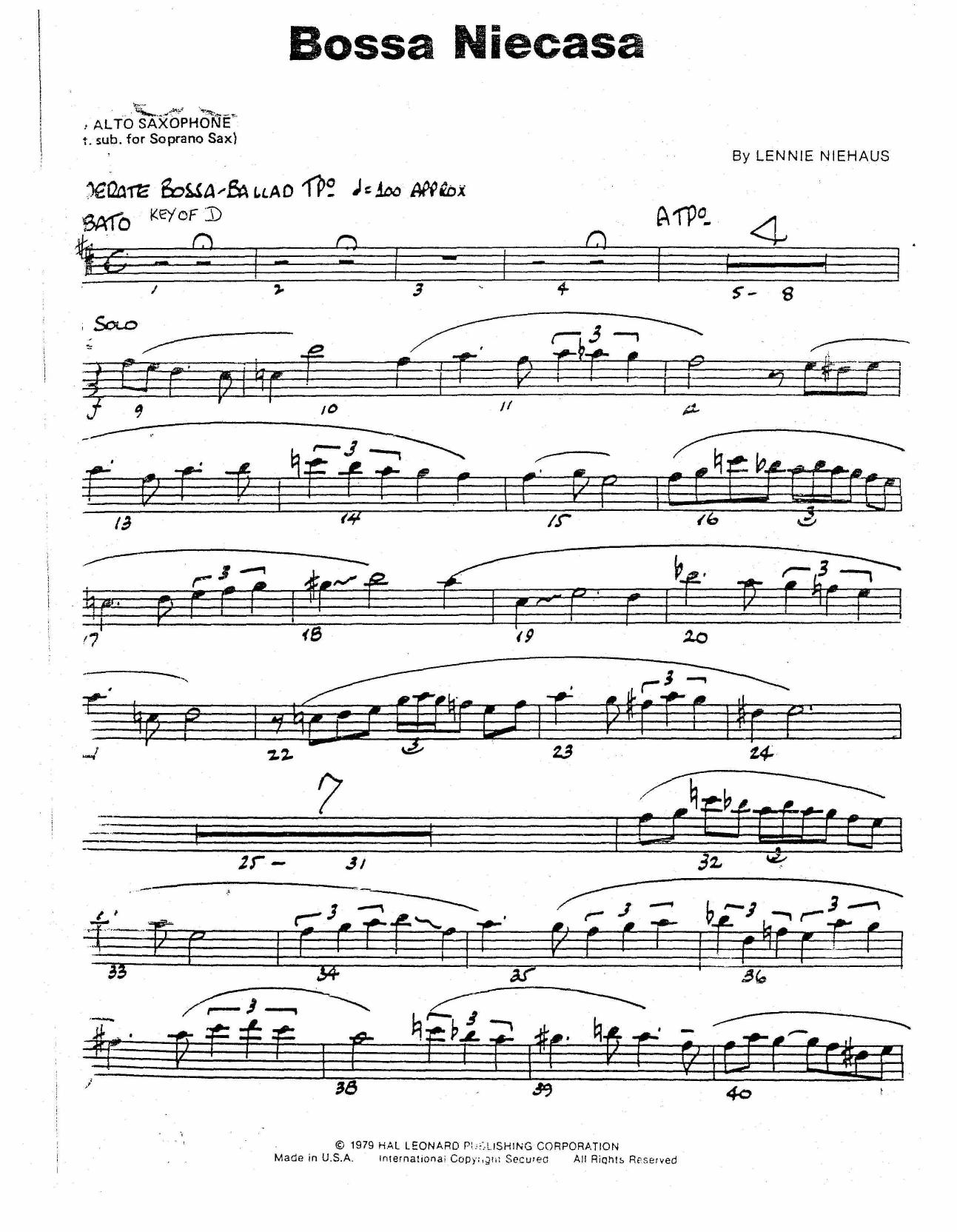
Bossa Niecasa (L.Niehaus) sheet music preview

Bossa Niecasa (L.Niehaus)

Composed by Lennie Niehaus

Arranged by Lennie Niehaus

  • Ensemble: Big Band
  • Pages: 37
  • Instruments (17): Alto Saxophone (sub. for Soprano Sax), 2nd Eb Alto Saxophone, 1st Bb Tenor Saxophone, 2nd Bb Tenor Saxophone, Baritone Saxophone, 1st Bb Trumpet (Opt. Flugelhorn), 2nd Bb Trumpet (Opt. Flugelhorn), 3rd Bb Trumpet (Opt. Flugelhorn), 4th Bb Trumpet (Opt. Flugelhorn), 1st Trombone, 2nd Trombone, 3rd Trombone, 4th Trombone, Piano, Bass, Guitar, Drums
  • Difficulty: medium
  • Content: Individual Parts
  • Format: PDF Download (Instant)
  • Price: $24.99

Lennie Niehaus carved out an indelible legacy as both a quintessential West Coast cool jazz saxophonist—honing his craft in the Stan Kenton Orchestra—and a prolific, highly respected writer for educational and professional big bands. "Bossa Niecasa" encapsulates his signature compositional voice, seamlessly blending sophisticated bebop-derived harmonic extensions with the relaxed, infectious syncopation of the Brazilian bossa nova. Composed during an era when Latin jazz integration was reshaping modern arranging, this chart demonstrates how Niehaus applied West Coast counterpoint and transparent horn voicings to a gentle, swaying Latin groove rather than a frantic up-tempo swing feel. The musical character of "Bossa Niecasa" is defined by its breezy, sophisticated mood and effortless cool. Set in an inviting, moderate Latin tempo in a concert key favorable to the brass and woodwind sections, the piece avoids dense, aggressive walls of sound in favor of airy, crystalline textures. The rhythm section lays down an authentic bossa nova foundation characterized by subtle cross-rhythms on the ride cymbal, crisp rimshots, and a rolling bassline that propels the harmony forward without ever rushing. Emotional resonance here is sophisticated and evocative, summoning sunlit coastal expanses and late-night lounge subtlety, making it a refreshing departure from high-octane shout-chorus-heavy big band literature. True to Niehaus’s pedagogical and artistic background, the arrangement balances accessibility with harmonic richness. The thematic material is introduced with immaculate clarity, often carried by the saxophones or subtle trumpet-and-sax combinations, utilizing close-interval voicings that recall the cool school aesthetic of the 1950s and 60s. Counter-melodies weave through the middle voices, providing internal motion while keeping the primary tune upfront. Solos are thoughtfully integrated into the framework, allowing featured improvisers space to stretch out over accessible chord changes without losing the atmospheric momentum of the groove. The chart features clever dynamic shifts and seamless transitions that keep the ensemble engaged from the initial downbeat to the final chord. Advanced high school ensembles, collegiate jazz orchestras, and professional community big bands will find "Bossa Niecasa" to be an exceptionally rewarding addition to their repertoire. While it does not demand the blistering endurance of a screaming bebop chart, it requires a high degree of stylistic discipline, rhythmic precision, and dynamic control. Sections must lock in their articulation—favoring smooth, legato phrasing over heavy accents—to capture the true authentic feel of the style. Directors will appreciate how this chart serves as an effective educational tool for teaching odd-eighth-note feels and ensemble blend, while audiences will be captivated by its timeless, sophisticated melodic charm. Conductors approaching "Bossa Niecasa" must first ensure the rhythm section establishes an authentic, relaxed bossa nova groove. The underlying eighth-note feel should remain even and flowing, steering completely clear of traditional swung triplets. Drummers should utilize a light touch, keeping the cross-stick pattern crisp and steady while the bass player anchors the harmonic foundation with a hypnotic, repetitive rhythmic pulse. The primary technical challenge lies in ensemble intonation and balance. Because Lennie Niehaus frequently employs tight, linear harmonic voicings across the saxophone and brass sections, minor pitch discrepancies will immediately muddy the texture. Horn players must practice their lines with a straight tone, introducing vibrato sparingly and only for expressive color at phrase endings. Articulations should be light and connected, avoiding heavy tongue attacks that disrupt the floating, effortless quality of the bossa style. Rehearsals should begin at a reduced tempo to ensure the rhythm section's syncopations lock tightly with the horn background figures. Pay close attention to the dynamic markings; keeping the backgrounds subdued allows featured soloists to improvise naturally without forcing their tone. Ensure the final cadence decays gracefully rather than cutting off abruptly, preserving the tranquil atmosphere characteristic of Niehaus’s writing. Q: What instruments and parts are included in this big band arrangement? A: The 37-page score and parts set is scored for a standard 16-instrument big band instrumentation, featuring Alto Sax 1, Alto Sax 2, Tenor Sax 1, Tenor Sax 2, and Baritone Sax, alongside standard brass and rhythm section parts. Q: What is the difficulty level of "Bossa Niecasa"? A: This arrangement is well-suited for advanced high school, collegiate, and professional jazz ensembles, offering moderate technical demands while requiring a high degree of stylistic finesse and ensemble blend. Q: What musical style and historical context define this piece? A: Written by arranger and composer Lennie Niehaus, the piece reflects the West Coast cool jazz tradition of the mid-20th century, expertly merging sophisticated bebop harmony with a relaxed, authentic bossa nova groove. Q: What makes this Lennie Niehaus arrangement unique? A: Unlike high-energy swing charts dominated by screaming brass and heavy shout choruses, this piece stands out for its transparent horn voicings, breezy Latin atmosphere, and emphasis on subtle melodic counterpoint. Q: What is the recommended performance tempo and duration? A: The chart is designed for a moderate, relaxed bossa nova tempo (around quarter note = 120–132 BPM), resulting in a performance duration of approximately 3 to 4 minutes depending on solo extensions.

Questions and answers

What is included in the Bossa Niecasa (L.Niehaus) PDF?
The verified current file contains individual parts across 37 pages.
How many instruments or parts are listed for Bossa Niecasa (L.Niehaus)?
The verified instrumentation list contains 17 entries for this Big Band arrangement.
Who is credited for Bossa Niecasa (L.Niehaus)?
Composer: Lennie Niehaus. Arranger: Lennie Niehaus.
What difficulty is listed for Bossa Niecasa (L.Niehaus)?
The verified difficulty level is medium.
Can I preview Bossa Niecasa (L.Niehaus) before buying?
Yes. The product page provides a preview generated from the current PDF file.
How is Bossa Niecasa (L.Niehaus) delivered?
After successful payment, the digital PDF is made available for download. The displayed price is $24.99.

Musicians Also Search For

Bossa Niecasa Lennie Niehaus PDFBossa Niecasa Lennie Niehaus sheet musicBossa Niecasa arranged by Lennie NiehausLennie Niehaus big band chartsLennie Niehaus jazz arrangements PDFBossa Niecasa Lennie Niehaus big band arrangementsBossa Niecasa big band arrangementsBossa Niecasa big band PDF downloadBossa Niecasa jazz sheet musicbig band sheet music downloadBossa Niecasa individual parts downloadBossa Niecasa sheet music PDFbuy Bossa Niecasa sheet musicdownload Bossa Niecasa PDFBossa Niecasa jazz chartsbest Lennie Niehaus big band arrangementsBossa Niecasa printable sheet musicbig band repertoire PDF

All arrangements by Lennie Niehaus All Lennie Niehaus sheet music