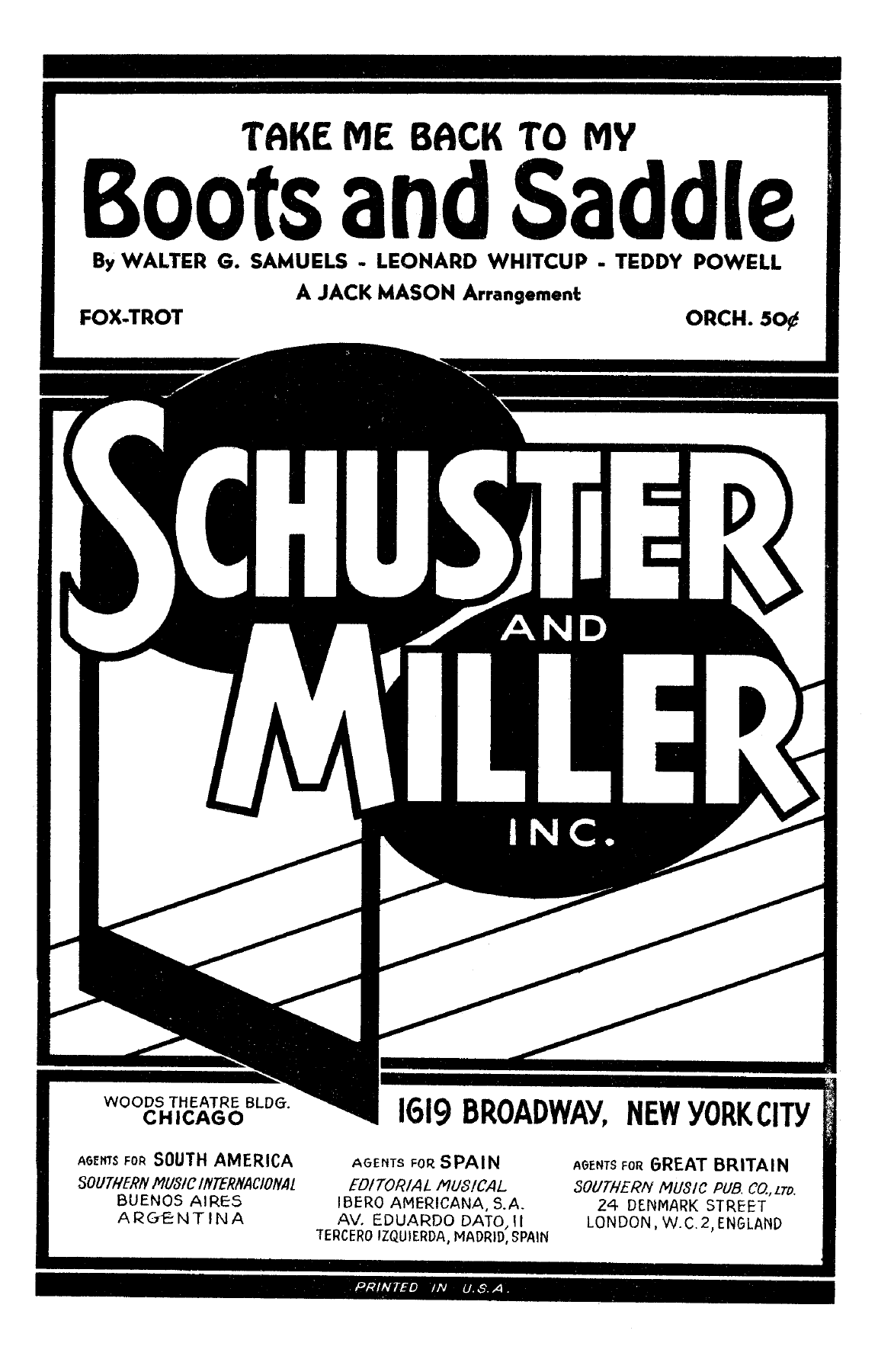
Boots And Saddle (J.Mason)
Composed by WALTER G. SAMUELS - LEONARD WHITCUP - TEDDY POWELL
Arranged by Jack Mason
- Ensemble: Big Band Dance
- Style: Foxtrot
- Pages: 29
- Instruments (14): 1st Sax Eb Alto, 2nd Sax Bb Tenor, 3rd Sax Eb Alto, 4th Sax Eb Baritone, 1st Trumpet in Bb, 2nd Trumpet in Bb, 3rd Trumpet in Bb, 1st Trombone, 2nd Trombone, Piano, Banjo, Bass, Drums, 1st Violin
- Difficulty: medium
- Content: Individual Parts
- Format: PDF Download (Instant)
- Price: $24.99
"Boots And Saddle," originally penned by Walter G. Samuels, Leonard Whitcup, and Teddy Powell, emerges from the vibrant big band era of the late 1930s and early 1940s. This period, often called the "Swing Era," saw dance bands dominate American popular music, with foxtrots, swing numbers, and ballads filling dance halls and airwaves. While not a conventional jazz "standard" in the improvisational sense, "Boots And Saddle" gained significant traction as a popular dance tune, embodying the energetic, melodic, and often novelty-driven character of the era's commercial big band repertoire. Its memorable, almost march-like rhythmic drive and singable melody made it a favorite for dancers and a staple for bands looking to inject a sense of playful Americana into their sets. This piece captures the essence of a time when big bands were the primary entertainers, providing sophisticated yet accessible music for a broad audience. J. Mason's arrangement of "Boots And Saddle" meticulously recreates the authentic foxtrot feel of its original era. Set at a bright, medium-fast tempo in 4/4, the arrangement immediately establishes a driving, yet comfortable, rhythmic pulse, perfect for dancing. The primary key of C Major lends itself to a bright, open sound, while Mason’s harmonic language, though rooted in traditional big band voicings, incorporates subtle extensions and passing dissonances that add depth without sacrificing the period authenticity. The overall mood is one of buoyant optimism and lighthearted energy, evoking images of classic Hollywood musicals or a lively Saturday night dance. Mason’s signature approach to this style often involves clear melodic statements, well-defined sectional interplay, and a strong emphasis on rhythmic precision to maintain the danceable groove. This 17-instrument arrangement is a masterclass in big band orchestration. The melody is predominantly carried by the saxophone section, often in unison or tight, harmonized soli passages that showcase their collective blend. Brass sections provide powerful, punctuating figures and rich harmonic support, frequently engaging in call-and-response with the saxes. While "Boots And Saddle" is primarily an ensemble showcase, Mason thoughtfully includes an optional, written-out tenor saxophone solo over a classic big band accompaniment, offering a moment for a featured player to shine without deviating from the arrangement's stylistic integrity. Technical challenges lie in maintaining the precise rhythmic drive, achieving tight ensemble blend in the soli sections, and executing clean brass attacks and releases. The rewarding aspect of performing this piece comes from its infectious energy, the satisfaction of nailing the period-specific stylistic nuances, and the sheer joy it brings to both performers and listeners. "Boots And Saddle" is ideally suited for college and advanced high school jazz ensembles, as well as community big bands and professional dance orchestras. Its authentic big band dance style provides an excellent educational opportunity for students to delve into the historical context and performance practices of the Swing Era foxtrot. The clear sectional writing and moderate technical demands make it accessible for developing ensembles, while the detailed orchestration and stylistic nuances offer plenty for more experienced groups to refine and perfect. It's a fantastic choice for concerts, dances, or any event where a classic, high-energy big band sound is desired. Conductors should emphasize a consistent, driving foxtrot feel, avoiding a heavy swing interpretation. The tempo should be bright, around 160-170 BPM, maintaining a light, articulate approach, especially in the brass. Key technical challenges include precise rhythmic execution in the unison saxophone soli sections and ensuring clean, synchronized brass attacks and releases. Encourage dynamic contrast, particularly between the melody lines and accompanying figures. The optional tenor saxophone solo should be played with a clear, melodic tone, avoiding excessive improvisation that might detract from the period style; the written solo provides an excellent template. Rehearsal time should focus on sectional balance, ensuring the bass and drums lock into a steady, danceable groove, and refining the ensemble’s overall blend and articulation to achieve an authentic 1940s big band sound. Q: What instruments are included in this arrangement of "Boots And Saddle"? A: This is a full big band dance arrangement for 17 instruments, including Alto Saxophone 1, Alto Saxophone 2, Tenor Saxophone 1, Tenor Saxophone 2, Baritone Saxophone, Trumpet 1, Trumpet 2, Trumpet 3, Trumpet 4, Trombone 1, Trombone 2, Trombone 3, Trombone 4, Piano, Bass, Drums, and Guitar. Q: What is the difficulty level of this arrangement? A: J. Mason's arrangement of "Boots And Saddle" is considered suitable for college and advanced high school jazz ensembles, as well as community and professional big bands. It presents moderate technical challenges focused on ensemble precision and stylistic authenticity. Q: What musical style and historical period does "Boots And Saddle" represent? A: This arrangement captures the energetic Foxtrot style prevalent during the American Swing Era of the late 1930s and early 1940s. It embodies the lively, danceable character of big band music from that period. Q: What makes J. Mason's arrangement of "Boots And Saddle" unique? A: Mason's arrangement is distinctive for its meticulous recreation of the authentic big band foxtrot sound, featuring period-accurate voicings, clear melodic statements primarily in the saxophone section, and a driving yet light rhythmic feel. It includes an optional, written-out tenor saxophone solo for a featured player. Q: What is the typical performance duration and tempo for this piece? A: While exact duration varies with interpretation, "Boots And Saddle" typically performs for approximately 2.5 to 3 minutes. It should be played at a bright, medium-fast foxtrot tempo, ideally around 160-170 beats per minute.
Questions and answers
- What is included in the Boots And Saddle (J.Mason) PDF?
- The verified current file contains individual parts across 29 pages.
- How many instruments or parts are listed for Boots And Saddle (J.Mason)?
- The verified instrumentation list contains 14 entries for this Big Band Dance arrangement.
- Who is credited for Boots And Saddle (J.Mason)?
- Composer: WALTER G. SAMUELS - LEONARD WHITCUP - TEDDY POWELL. Arranger: Jack Mason.
- What difficulty is listed for Boots And Saddle (J.Mason)?
- The verified difficulty level is medium.
- What style is listed for Boots And Saddle (J.Mason)?
- The catalog lists the style as Foxtrot.
- Can I preview Boots And Saddle (J.Mason) before buying?
- Yes. The product page provides a preview generated from the current PDF file.
- How is Boots And Saddle (J.Mason) delivered?
- After successful payment, the digital PDF is made available for download. The displayed price is $24.99.
Musicians Also Search For
Boots And Saddle Jack Mason PDF • Boots And Saddle Jack Mason sheet music • Boots And Saddle arranged by Jack Mason • Jack Mason big band dance charts • Jack Mason jazz arrangements PDF • Boots And Saddle WALTER G. SAMUELS - LEONARD WHITCUP - TEDDY POWELL sheet music • Boots And Saddle WALTER G. SAMUELS - LEONARD WHITCUP - TEDDY POWELL big band dance arrangements • WALTER G. SAMUELS - LEONARD WHITCUP - TEDDY POWELL big band dance charts • Boots And Saddle big band dance arrangements • Boots And Saddle big band dance PDF download • Boots And Saddle jazz sheet music • big band dance sheet music download • Boots And Saddle individual parts download • Boots And Saddle sheet music PDF • Boots And Saddle Foxtrot charts • Foxtrot big band dance arrangements • buy Boots And Saddle sheet music • download Boots And Saddle PDF • Boots And Saddle jazz charts • best Jack Mason big band dance arrangements • WALTER G. SAMUELS - LEONARD WHITCUP - TEDDY POWELL arranged by Jack Mason • Boots And Saddle printable sheet music • big band dance repertoire PDF