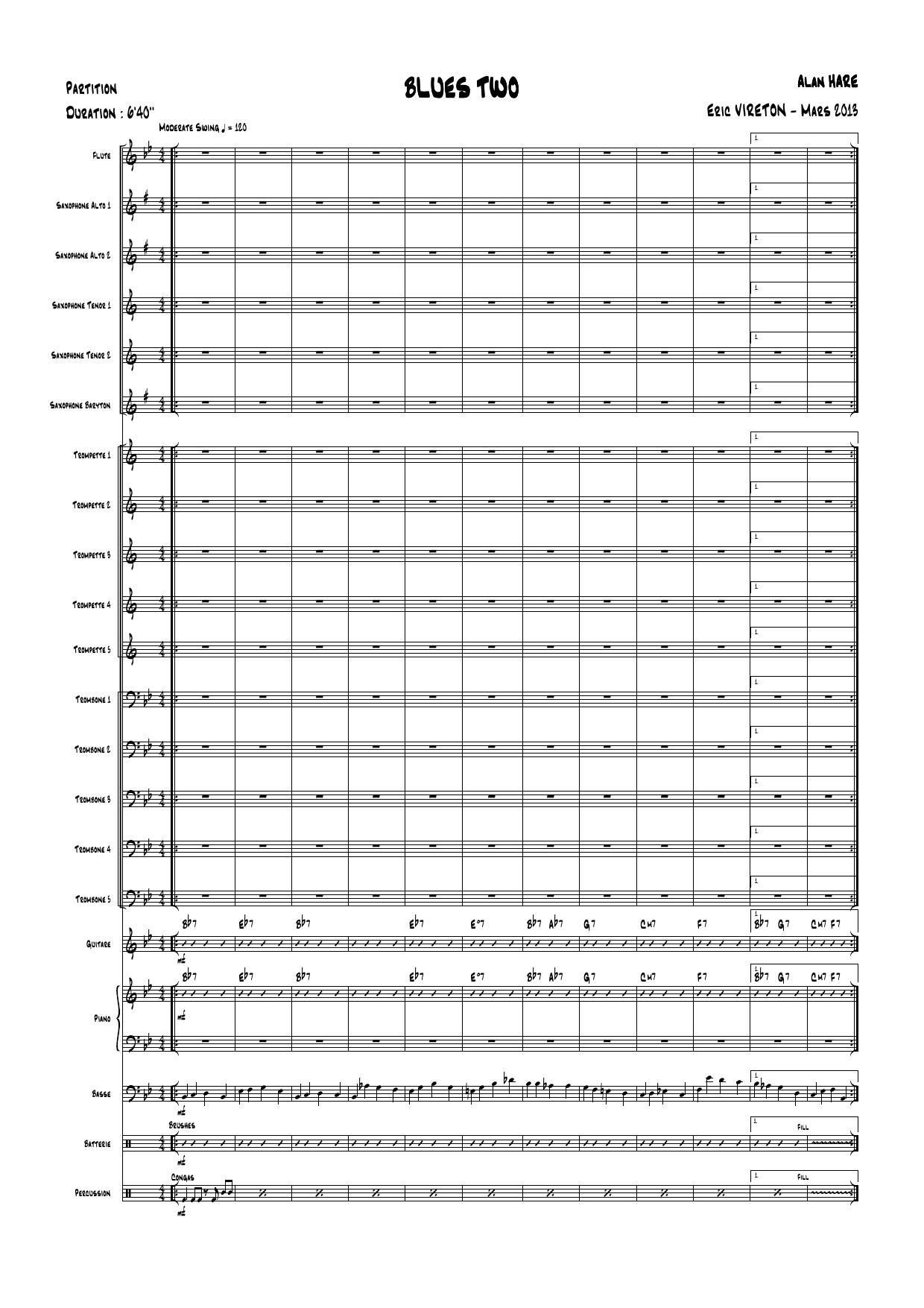
Blues Two (E.Vireton) sheet music preview

Blues Two (E.Vireton)

Composed by Eric Vireton

Arranged by Alan Hare

  • Ensemble: Big Band
  • Style: Jazz Standard
  • Pages: 91
  • Instruments (21): Flute, Alto Saxophone 1, Alto Saxophone 2, Tenor Saxophone 1, Tenor Saxophone 2, Baritone Saxophone, Trumpet 1, Trumpet 2, Trumpet 3, Trumpet 4, Trumpet 5, Trombone 1, Trombone 2, Trombone 3, Trombone 4, Trombone 5, Guitar, Piano, Bass, Drum Set, Percussion
  • Difficulty: advanced
  • Content: Individual Parts
  • Format: PDF Download (Instant)
  • Price: $24.99

Eric Vireton's "Blues Two" emerges as a vibrant and essential jazz standard, a testament to the enduring power and versatility of the blues form within a big band context. While the original composition date isn't widely publicized, its musical language firmly places it within the post-bop era, showcasing sophisticated harmonic movement and melodic invention that became characteristic of the mid-to-late 20th-century jazz scene. Vireton's composition, though perhaps not as universally recognized as some of the genre's earliest standards, is a favorite among discerning musicians for its compelling structure and improvisational potential, embodying the intellectual rigor and soulful expression that defines modern jazz. It's a piece that, in the right hands, can become a cornerstone of a band's repertoire, celebrated for its authentic jazz feel and engaging musical narrative. Alan Hare's arrangement of "Blues Two" masterfully captures the essence of Vireton's original while imbuing it with his signature blend of clarity, power, and intricate voicings. Hare, known for his meticulous attention to detail and deep understanding of big band dynamics, approaches this piece with a medium-up swing feel (around 160-180 bpm), establishing a driving yet comfortable groove from the outset. The arrangement is primarily in F minor, lending a rich, slightly melancholic, but ultimately sophisticated character to the blues progression. Hare's distinctive touch is evident in the tightly voiced saxophone soli sections, which weave complex melodic lines with remarkable precision, demanding excellent intonation and blend. The brass sections are utilized with a keen sense of balance, providing punchy accents and sustained harmonic support without overpowering the ensemble. Expect carefully crafted shout choruses that build dynamic tension and release, showcasing the full power of the 17-piece big band. The performance journey of "Blues Two" begins with the melody introduced by the alto saxophones, soon joined by the full saxophone section in a harmonized statement that sets the stage. Solo opportunities are generously provided, typically featuring the 1st Tenor Saxophone and 1st Trumpet, allowing for expressive improvisation over the blues changes. The technical challenges lie primarily in the precision required for the saxophone solis, the dynamic control needed for the brass hits, and maintaining a consistent, driving swing feel throughout. The rewarding aspect is the sheer joy of performing a well-crafted blues, with its inherent call-and-response patterns and opportunities for collective improvisation within the arranged framework. This arrangement is ideally suited for college-level jazz ensembles, advanced community bands, and professional groups seeking a challenging yet deeply satisfying addition to their repertoire. Its blend of traditional blues structure with modern big band arranging techniques makes it an excellent vehicle for developing ensemble cohesion, rhythmic tightness, and improvisational fluency. "Blues Two (E.Vireton)" demands a medium-up swing feel, ideally around 160-180 bpm, prioritizing a relaxed yet driving groove. Conductors should emphasize a strong quarter-note pulse from the rhythm section, particularly the bass and drums, ensuring the swing eighths are consistent and not rushed. Key technical challenges include the intricate saxophone solis, which require precise articulation, excellent intonation, and a unified blend; rehearsal of these sections slowly and with a focus on inner voices is crucial. The brass figures, while powerful, must be executed with dynamic control to avoid overblowing, especially during the shout choruses. Encourage trumpets to use a bright, focused tone without becoming harsh. There are no specific mute requirements beyond standard cup and straight mutes, which should be used judiciously for textural contrast as indicated. Rehearsal should also focus on the dynamic shaping of phrases, building tension and release, and ensuring the soloists feel well-supported by the ensemble. Q: What instruments are included in this arrangement of "Blues Two (E.Vireton)"? A: This is a full big band arrangement for 17 instruments, including Alto Saxophone 1 & 2, Tenor Saxophone 1 & 2, Baritone Saxophone, Trumpet 1-4, Trombone 1-4, Piano, Bass, Guitar, and Drums. Q: What is the difficulty level of Alan Hare's "Blues Two (E.Vireton)" arrangement? A: This arrangement is considered advanced intermediate to advanced, suitable for college-level jazz ensembles, advanced community bands, and professional groups due to its intricate voicings, demanding soli sections, and requirements for strong improvisational skills. Q: What musical style and historical context does "Blues Two (E.Vireton)" represent? A: "Blues Two" is a jazz standard rooted in the post-bop era, showcasing sophisticated blues changes and melodic invention characteristic of mid-to-late 20th-century jazz, arranged with a classic big band swing feel. Q: What makes Alan Hare's arrangement of "Blues Two (E.Vireton)" unique? A: Alan Hare's arrangement is distinguished by its meticulous voicings, particularly in the saxophone solis, powerful and balanced brass writing, and well-crafted shout choruses that build dynamic tension, all while maintaining a driving medium-up swing feel in F minor. Q: What is the typical performance duration for this arrangement? A: While variable depending on solo lengths, a typical performance of Alan Hare's "Blues Two (E.Vireton)" at a medium-up swing tempo (160-180 bpm) usually lasts between 4 to 6 minutes.

Musicians Also Search For

Blues Two Alan Hare PDFBlues Two Alan Hare sheet musicBlues Two arranged by Alan HareAlan Hare big band chartsAlan Hare jazz arrangements PDFBlues Two Eric Vireton sheet musicBlues Two Eric Vireton big band arrangementEric Vireton big band chartsBlues Two big band arrangementBlues Two big band PDF downloadBlues Two jazz ensemble sheet musicbig band sheet music instant downloadBlues Two conductor score PDFBlues Two individual parts downloadBlues Two sheet music with partsBlues Two Jazz Standard chartJazz Standard big band arrangementsbuy Blues Two sheet music onlinedownload Blues Two PDFBlues Two jazz chartbest Alan Hare big band arrangementsEric Vireton songs arranged by Alan HareBlues Two printable sheet musicbig band repertoire PDF

All arrangements by Alan Hare All Eric Vireton sheet music