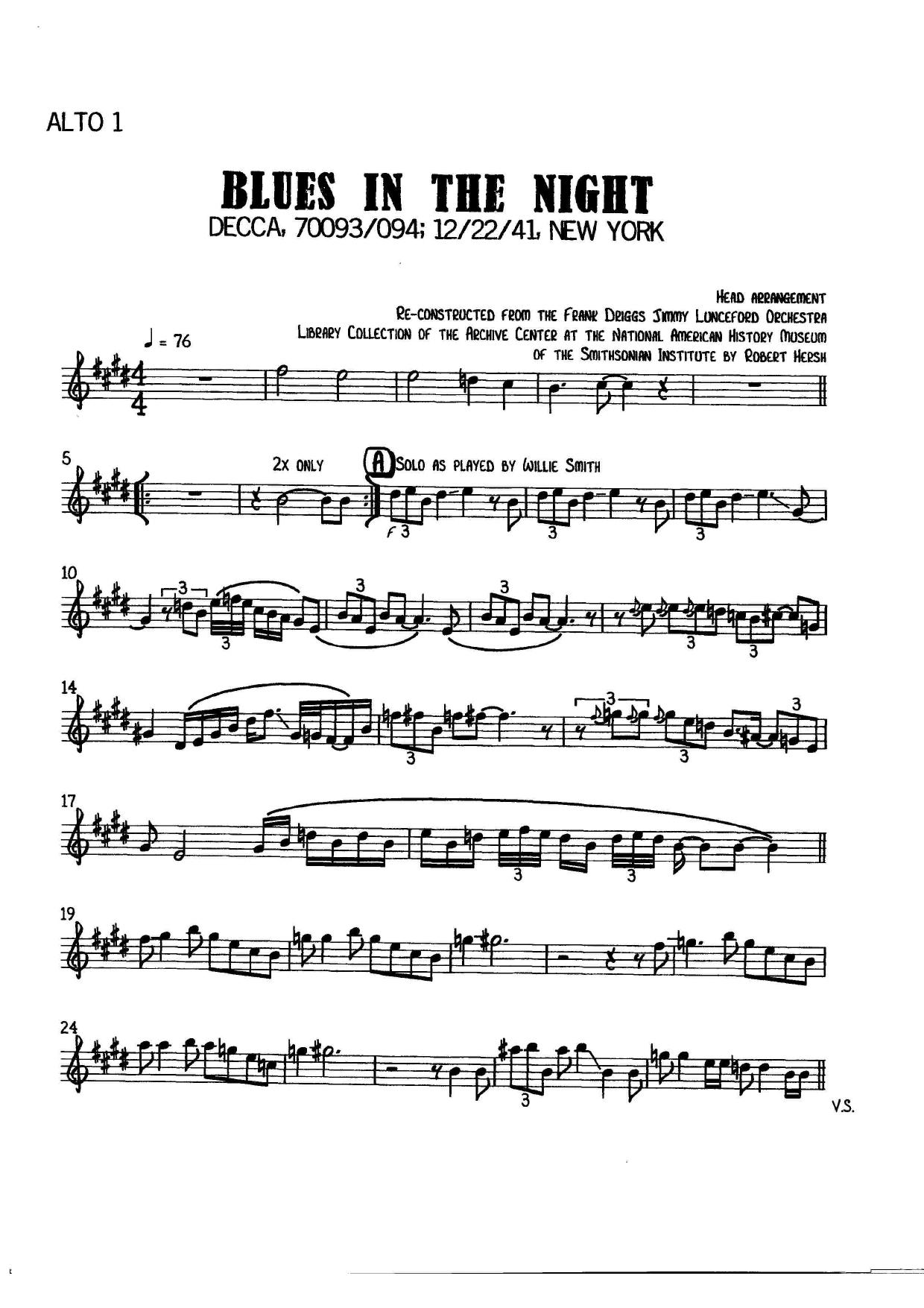
Blues In The Night (J.Lunceford)
Composed by Harold Arlen
Arranged by Jimmie Lunceford
- Ensemble: Big Band
- Pages: 33
- Instruments (15): Alto 1, Alto 2, Alto 3, Tenor Saxophone, Baritone Saxophone, Trumpet 1, Trumpet 2, Trumpet 3, Trombone 1, Trombone 2, Trombone 3, Guitar, Piano, String Bass, Drum Set
- Difficulty: medium
- Content: Individual Parts
- Format: PDF Download (Instant)
- Price: $24.99
Harold Arlen and Johnny Mercer’s iconic "Blues in the Night" stands as one of the quintessential late-night torch songs of the twentieth century, originally introduced in the 1941 film of the same name and quickly cementing its status in the Great American Songbook. While recorded by countless vocalists and instrumentalists, the tune found a particularly thrilling home in the swing era through the pioneering efforts of master bandleader Jimmie Lunceford. The Lunceford orchestra was celebrated not merely for its precision and high-octane entertainment value, but for a distinct musical sophistication characterized by two-beat rhythms, immaculate reed blends, and dramatic dynamic contrasts that set them apart from contemporaries like Benny Goodman and Count Basie. This arrangement captures the sophisticated DNA of the Lunceford style, translating a smoky vocal-and-blues vehicle into a tightly knit, swinging instrumental showcase. Opening with an atmospheric, sultry mood that evokes the melancholy of a lonely train whistle cutting through the dark, the chart quickly transitions into a infectious, driving medium-swing groove in 4/4 time. The arrangement balances a brooding, blues-drenched emotional core with the signature flash and precision that defined Lunceford’s "Harlem Express." The harmonic landscape utilizes rich, extended swing-era voicings that emphasize lush chord extensions in the brass and biting, blues-inflected intervals in the saxophone section. Listeners and performers will experience a narrative arc that moves from nocturnal introspection to a jubilant, high-energy sonic release, maintaining an irresistible forward momentum throughout its duration. Jimmie Lunceford’s signature arranging fingerprints are stamped all over this chart, showcasing trademark sectional interplay where the saxophones and brass engage in crisp, call-and-response phrasing. The arrangement features meticulously crafted soli sections that demand absolute rhythmic unison, alongside a soaring shout chorus that builds tension through dynamic swells and punchy syncopations. The melodic weight is shared dynamically across the ensemble; the lower voices occasionally anchor the sultry blues basslines while the upper horns and reeds trade lyrical statements of the primary theme. Featured solo opportunities allow individual players to step into the spotlight with authentic blues expression, while the accompanying sections maintain a feather-light, propulsive background pulse that avoids ever muddying the texture. Advanced high school, collegiate, and professional jazz ensembles will find this arrangement an exceptionally rewarding addition to their repertoire. Because it relies heavily on sectional discipline, clean articulation, and stylistic nuance rather than sheer blazing speed, it serves as an masterclass in swing-era stylistic authenticity. Directors will appreciate how the chart teaches students the importance of dynamic contrast, subtle rubato-to-tempo transitions, and the art of "swinging together." Performing this piece requires a mature sense of groove and breath support, making it an ideal centerpiece for festival programs, historical tribute concerts, or advanced educational settings aiming to explore the sophisticated orchestrational palette of 1940s big band jazz. Successfully executing this Jimmie Lunceford arrangement requires strict attention to stylistic authenticity, articulation, and dynamic shading. The conductor should establish a comfortable, confident medium-swing tempo that breathes rather than rushes, allowing the underlying blues feel to anchor the groove. Key technical challenges center on the tight sectional unisons within the 8-instrument instrumentation; the saxophones and brass must lock in their tonguing and release points to achieve the signature Lunceford polish. Pay close attention to marked dynamic contrasts—drop instantly to piano when indicated to make the subsequent crescendo into the shout chorus truly explosive. Stylistically, musicians should incorporate traditional swing-era articulation: a heavy emphasis on the upbeat, controlled use of subtle lip bends, and well-placed, dry staccatos. Brass players should utilize cup or straight mutes where specified to capture the authentic smoky, late-night timbre of the original 1941 aesthetic, ensuring that background figures never overpower the primary melodic voice. Q: What instruments and parts are included in this arrangement? A: This chart is scored for an 8-instrument ensemble comprising Alto Saxophone, Tenor Saxophone, Trumpet, Trombone, Piano, and a rhythm section framework tailored to a tight, classic big band setup. Q: What is the difficulty level of this piece? A: It is best suited for advanced high school, collegiate, and professional jazz ensembles due to its high demand for sectional precision, stylistic maturity, and tight rhythmic unisons. Q: What is the style and historical context of the arrangement? A: Written in the classic jazz style of the early 1940s swing era, it mirrors the sophisticated, precision-driven arranging approach pioneered by bandleader Jimmie Lunceford based on Harold Arlen's timeless standard. Q: What makes this particular arrangement unique? A: It translates Lunceford's legendary orchestra style—known for its dynamic surprises, crisp call-and-response sections, and lush reed voicings—into an accessible 8-instrument configuration without losing its original theatrical flair. Q: What is the performance tempo and duration of the piece? A: The arrangement is set in a driving medium-swing feel at a moderate tempo, with a typical performance duration of approximately 3 to 4 minutes depending on the length of improvised solo sections.
Questions and answers
- What is included in the Blues In The Night (J.Lunceford) PDF?
- The verified current file contains individual parts across 33 pages.
- How many instruments or parts are listed for Blues In The Night (J.Lunceford)?
- The verified instrumentation list contains 15 entries for this Big Band arrangement.
- Who is credited for Blues In The Night (J.Lunceford)?
- Composer: Harold Arlen. Arranger: Jimmie Lunceford.
- What difficulty is listed for Blues In The Night (J.Lunceford)?
- The verified difficulty level is medium.
- Can I preview Blues In The Night (J.Lunceford) before buying?
- Yes. The product page provides a preview generated from the current PDF file.
- How is Blues In The Night (J.Lunceford) delivered?
- After successful payment, the digital PDF is made available for download. The displayed price is $24.99.
Musicians Also Search For
Blues In The Night Jimmie Lunceford PDF • Blues In The Night Jimmie Lunceford sheet music • Blues In The Night arranged by Jimmie Lunceford • Jimmie Lunceford big band charts • Jimmie Lunceford jazz arrangements PDF • Blues In The Night Harold Arlen sheet music • Blues In The Night Harold Arlen big band arrangements • Harold Arlen big band charts • Blues In The Night big band arrangements • Blues In The Night big band PDF download • Blues In The Night jazz sheet music • big band sheet music download • Blues In The Night individual parts download • Blues In The Night sheet music PDF • buy Blues In The Night sheet music • download Blues In The Night PDF • Blues In The Night jazz charts • best Jimmie Lunceford big band arrangements • Harold Arlen arranged by Jimmie Lunceford • Blues In The Night printable sheet music • big band repertoire PDF