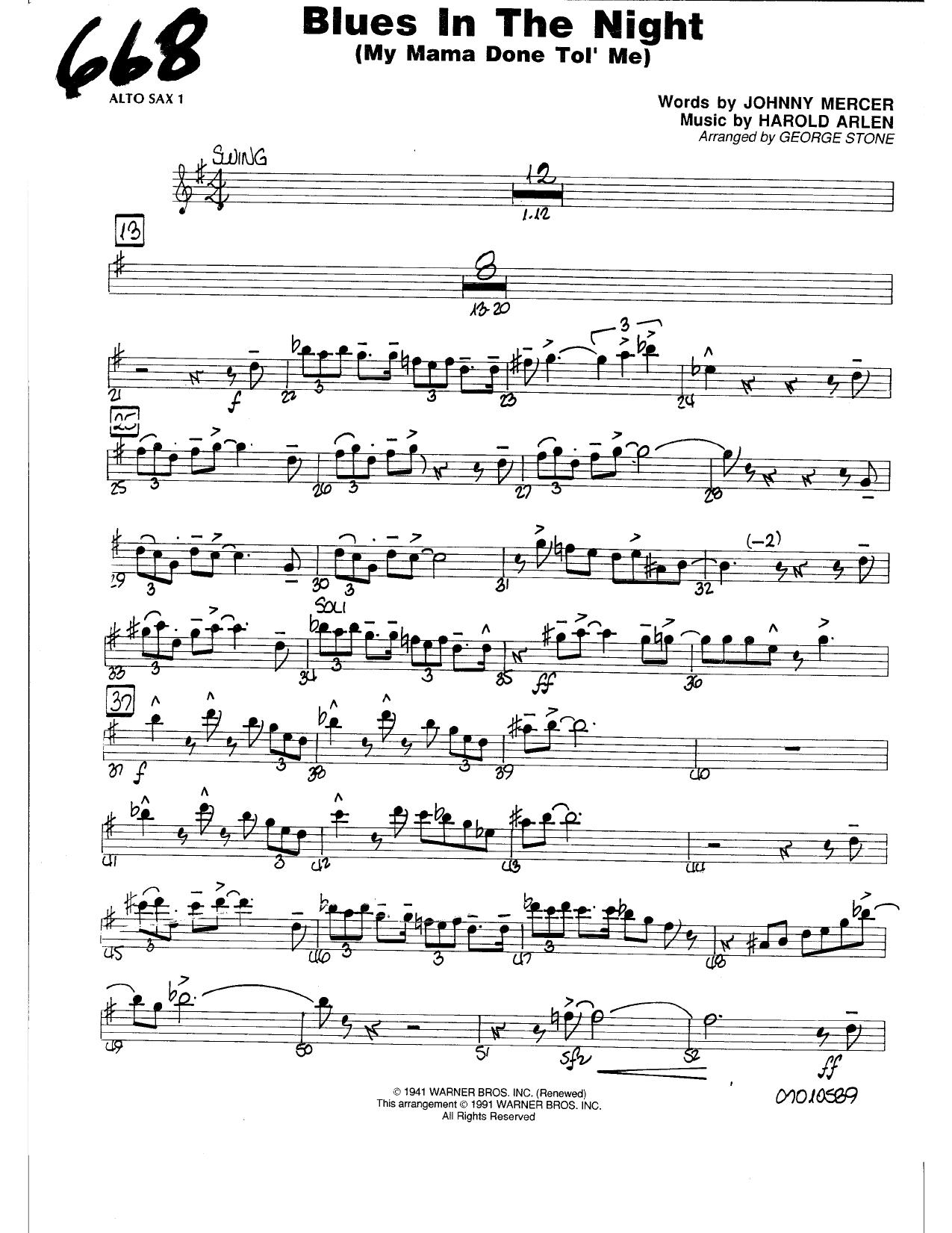
Blues In The Night (G.Stone)
Composed by Harold Arlen
Arranged by George Stone
- Ensemble: Big Band
- Pages: 38
- Instruments (17): Alto Sax 1, Alto Sax 2, Tenor Sax 1, Tenor Sax 2, Baritone Sax, Trombone 1, Trombone 2, Trombone 3, Trombone 4, Trumpet 1, Trumpet 2, Trumpet 3, Trumpet 4, Bass, Drums, Guitar, Piano
- Difficulty: medium
- Content: Individual Parts
- Format: PDF Download (Instant)
- Price: $24.99
Harold Arlen and Johnny Mercer’s iconic 1941 torch song "Blues in the Night" occupies a legendary status in the American Songbook, originally introduced in the Warner Bros. film of the same name and popularized by legendary interpreters ranging from Dinah Shore and Cab Calloway to Frank Sinatra and Artie Shaw. Defined by its haunting, twelve-bar-infused structure and Mercer's evocative, train-whistle-opening lyric ("My mama done tol' me..."), the composition bridges the gap between classic blues melancholy and sophisticated theatrical jazz. It represents the pinnacle of early-1940s popular songwriting, continuously embraced by jazz instrumentalists for its rich harmonic underpinnings and dramatic narrative arc. George Stone’s masterful big band interpretation transforms this timeless vocal classic into a sophisticated instrumental showcase. Unfolding at a sultry, brooding medium-slow swing tempo (approx. Quarter Note = 104), the arrangement sets a cinematic mood that marries smoky blues textures with modern harmonic tension. Stone utilizes lush, contemporary saxophone voicings and dense brass clusters to evoke the midnight chug of a distant steam train, capturing both the desolate isolation and the rhythmic drive inherent in Arlen's original melody. The emotional landscape shifts dynamically from hushed, suspenseful interludes to explosive, brass-heavy climaxes that rumble with latent power. Stone’s signature arranging style shines through in the clever interplay between the rhythm section and the horn tiers, avoiding predictable scoring in favor of shifting textures and unexpected harmonic resolutions. The melody is initially introduced with smoky subtlety by the lead alto saxophone and muted trumpets before expanding into rich, full-ensemble soli passages. A standout feature of the chart is its inventive shout chorus, which builds organically from a low-register ostinato into a towering wall of sound, showcasing modern extended chord extensions while staying true to the root blues feeling. Solos are strategically placed to highlight expressive lead players, particularly within the tenor saxophone and trumpet sections, demanding both lyrical maturity and deep phrasing control. Advanced high school, collegiate, and professional big bands will find this 38-page manuscript an exceptional vehicle for developing stylistic depth and section cohesion. While the individual technical demands do not rely on breakneck speed, the true challenge lies in the nuanced execution of the swing groove, dynamic control at extreme soft volumes, and maintaining intonation through complex, modern chord voicings. The rhythm section—particularly the pianist and drummer—must anchor the subtle push-and-pull of the tempo, utilizing authentic blues articulation to bring George Stone’s sophisticated writing to life. Conductors should approach George Stone’s setting of "Blues in the Night" with an emphasis on relaxed, behind-the-beat phrasing and meticulous dynamic control. The primary technical hurdle rests in the execution of unhurried medium swing; avoid rushing the triplets, ensuring the underlying groove remains heavy and grounded. Brass players should make expressive use of cup and harmon mutes where indicated to achieve the requisite smoky, nocturnal coloration, reserving open horns for the dramatic dynamic peaks. Rehearsal should begin with the rhythm section isolating the foundational groove, ensuring the bass and drums lock into an unyielding, blues-drenched pocket before adding the horn sections. Pay close attention to the exposed ensemble solis, balancing the inner voices to let the lead alto and tenor lines breathe without forcing the tone. Balance is paramount during the dynamic swells; horns must back off during dense chord clusters so that the altered fifths and ninths speak with clarity rather than harshness. Q: What instruments and parts are included in this 17-instrument big band arrangement? A: The instrumentation comprises a standard 17-piece big band lineup: Alto Saxophone 1 & 2, Tenor Saxophone 1 & 2, Baritone Saxophone, 4 Trumpets, 4 Trombones, Piano, Guitar, Bass, and Drums, spanning a 38-page score and parts set. Q: What is the difficulty level of this George Stone arrangement? A: This arrangement is calibrated for advanced high school, collegiate, and professional big bands, presenting moderate technical demands offset by high requirements for stylistic maturity, intonation, and dynamic control. Q: What musical style and historical context does this chart represent? A: It is a sophisticated, modern big-band jazz interpretation of Harold Arlen and Johnny Mercer's 1941 classic blues standard, blending traditional blues melancholy with contemporary harmonic voicings and cinematic textures. Q: What makes George Stone's arrangement unique compared to other big band versions of this standard? A: Stone's chart stands out through its innovative, shifting saxophone voicings, clever use of modern extended harmonies, and a masterfully constructed shout chorus that builds organically from a low-register ostinato into a powerful brass climax. Q: What is the recommended performance tempo and duration for this piece? A: The arrangement is set at a sultry, brooding medium-slow swing tempo (approximately Quarter Note = 104) and typically runs around 4 to 5 minutes depending on the length of the featured solo sections.
Questions and answers
- What is included in the Blues In The Night (G.Stone) PDF?
- The verified current file contains individual parts across 38 pages.
- How many instruments or parts are listed for Blues In The Night (G.Stone)?
- The verified instrumentation list contains 17 entries for this Big Band arrangement.
- Who is credited for Blues In The Night (G.Stone)?
- Composer: Harold Arlen. Arranger: George Stone.
- What difficulty is listed for Blues In The Night (G.Stone)?
- The verified difficulty level is medium.
- Can I preview Blues In The Night (G.Stone) before buying?
- Yes. The product page provides a preview generated from the current PDF file.
- How is Blues In The Night (G.Stone) delivered?
- After successful payment, the digital PDF is made available for download. The displayed price is $24.99.
Musicians Also Search For
Blues In The Night George Stone PDF • Blues In The Night George Stone sheet music • Blues In The Night arranged by George Stone • George Stone big band charts • George Stone jazz arrangements PDF • Blues In The Night Harold Arlen sheet music • Blues In The Night Harold Arlen big band arrangements • Harold Arlen big band charts • Blues In The Night big band arrangements • Blues In The Night big band PDF download • Blues In The Night jazz sheet music • big band sheet music download • Blues In The Night individual parts download • Blues In The Night sheet music PDF • buy Blues In The Night sheet music • download Blues In The Night PDF • Blues In The Night jazz charts • best George Stone big band arrangements • Harold Arlen arranged by George Stone • Blues In The Night printable sheet music • big band repertoire PDF