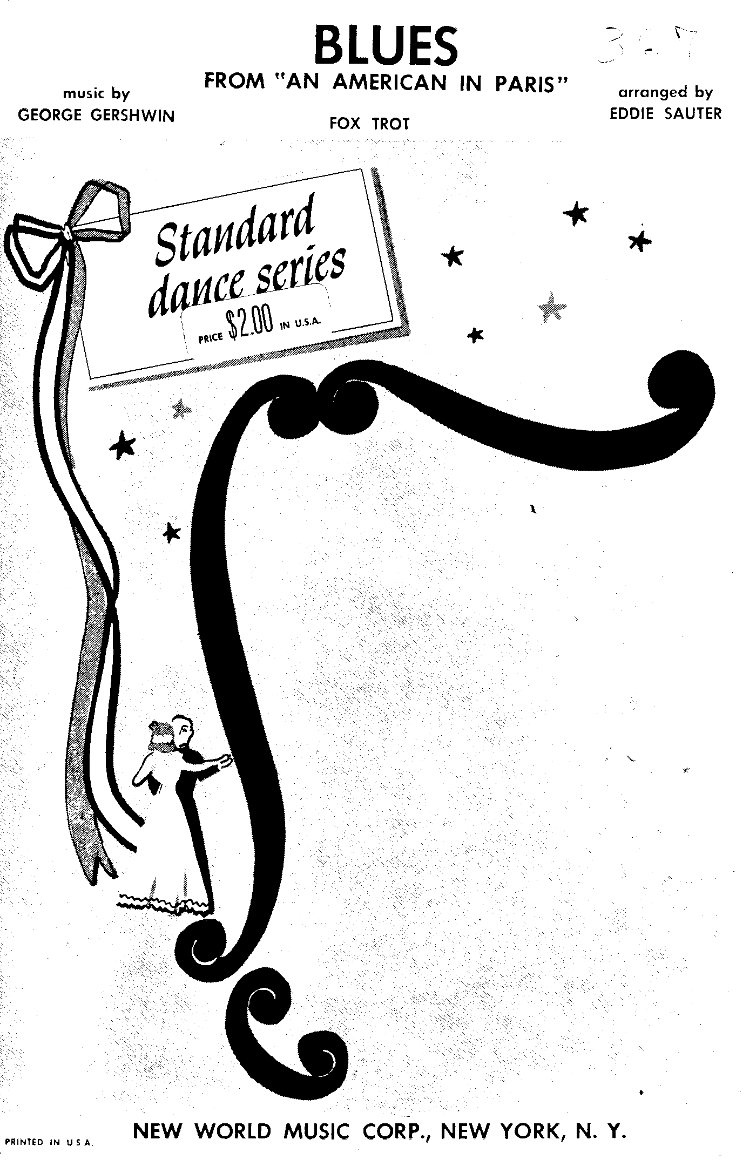
Blues From An American In Paris (E.Sauter)
Composed by George Gershwin
Arranged by E. Sauter
- Ensemble: Big Band
- Style: Foxtrot
- Pages: 36
- Instruments (15): Violin, Alto Saxophone 1, Tenor Saxophone 2, Alto Saxophone 3, Baritone Saxophone 5, Trumpet 1, Trumpet 2, Trumpet 3, Trombone 1, Trombone 2, Trombone 3, Bass, Guitar, Piano, Drum Set
- Difficulty: medium
- Content: Individual Parts
- Format: PDF Download (Instant)
- Price: $24.99
George Gershwin's monumental tone poem, "An American in Paris," premiered in 1928, stands as a quintessential representation of the Jazz Age's vibrant energy and the burgeoning fusion of classical orchestration with jazz idioms. While not originally a jazz standard in the conventional sense, its evocative melodies and sophisticated harmonies have long captivated arrangers and improvisers alike, offering rich material for reinterpretation. This particular arrangement, "Blues From An American In Paris," by the ingenious E. Sauter, extracts and recontextualizes a core blues-inflected section of Gershwin's masterpiece, transforming it into a compelling big band foxtrot. The original work, famous for its depiction of a bustling Parisian street scene and a homesick American tourist, is celebrated for its innovative use of taxi horns and its seamless blend of European classical structure with American jazz rhythms and blues scales. Sauter's arrangement reimagines this iconic material as a medium-tempo foxtrot, establishing a relaxed yet propulsive 4/4 groove from the outset. The mood is sophisticated and slightly melancholic, infused with the characteristic blues sensibility that Gershwin so masterfully wove into his larger work. While the original features a broad orchestral palette, Sauter distills its essence into the dynamic language of the big band, focusing on rich, often close-voiced harmonies and a subtle interplay between sections. The piece typically remains in a comfortable concert key, allowing the ensemble to focus on articulation and ensemble blend rather than extreme technical demands related to pitch. The energy builds organically, driven by the rhythmic section's steady pulse and the saxophones' lyrical lines. E. Sauter's distinctive arranging style is immediately apparent in this treatment. Known for his innovative voicings and often intricate counterpoint, Sauter approaches "Blues From An American In Paris" with a characteristic blend of reverence for the source material and a fresh, big band perspective. Expect lush saxophone soli sections that carry the primary melodic and harmonic weight, often featuring sophisticated inner-voice movement. Brass sections provide powerful, yet always tasteful, punctuations and sustained harmonic pads, building to a controlled and elegant shout chorus that avoids overt bombast. While specific solo opportunities are often indicated for tenor saxophone or trumpet, the arrangement emphasizes the collective ensemble sound, with intricate sectional interplay being a hallmark. Sauter's signature is in his ability to make complex harmonic structures sound effortless and flowing, demanding precision in balance and intonation from all players. Performing this arrangement is a rewarding experience, offering a unique blend of historical appreciation and contemporary big band artistry. The primary melody is often shared or passed between the saxophone section and lead trumpet, requiring strong lead players in both sections. Technical challenges lie less in individual virtuosity and more in achieving a cohesive ensemble sound, particularly in navigating Sauter's nuanced voicings and dynamic shifts. Articulation, blend, and precise rhythmic placement are paramount. The piece is highly suitable for advanced high school, college, community, and professional big bands seeking a sophisticated, historically rich, and musically engaging addition to their repertoire. It provides an excellent vehicle for developing ensemble sensitivity, harmonic awareness, and an appreciation for the art of big band arranging. "Blues From An American In Paris" thrives on a relaxed, medium foxtrot feel, around 120-130 BPM. The rhythm section should establish a steady, unhurried 4/4 pulse with a gentle swing eighth-note feel, ensuring the bass line is both supportive and propulsive without rushing. Key technical challenges include achieving precise balance and intonation within Sauter's often dense saxophone soli sections, where inner voices are crucial to the overall harmonic color. Conductors should emphasize careful listening across the ensemble. Brass players must execute sustained chords with controlled vibrato and precise attacks, particularly in the more lyrical passages. There are no special mute requirements beyond standard cup or straight mutes for brass, used sparingly for specific color. Rehearsal time should be dedicated to shaping dynamic contours, ensuring a natural build and release of tension, and perfecting the seamless transitions between melodic statements and harmonic pads. Focus on the 'blues' inflection in phrasing, even without explicit blues scales, to capture the piece's underlying mood. Q: What instruments and parts are included in this arrangement? A: This arrangement is scored for a full big band, including 17 instruments: Alto Saxophone 1 & 2, Tenor Saxophone 1 & 2, Baritone Saxophone, Trumpet 1-4, Trombone 1-4, Piano, Bass, Drums, and Guitar. Q: What is the difficulty level of "Blues From An American In Paris"? A: This arrangement is considered advanced intermediate to advanced. It requires strong ensemble playing, good intonation, and an understanding of sophisticated harmonic voicings, making it suitable for advanced high school, college, community, and professional jazz ensembles. Q: What is the musical style and historical context of this arrangement? A: This piece is a big band foxtrot arrangement of a blues-inflected section from George Gershwin's 1928 tone poem "An American in Paris." It captures the sophisticated jazz-classical fusion popular during the Jazz Age. Q: What makes E. Sauter's arrangement of this piece unique? A: Sauter's distinctive approach is evident in his lush, often close-voiced saxophone soli, intricate counterpoint, and elegant harmonic treatment, transforming Gershwin's orchestral material into a compelling big band vehicle without losing its original character. Q: What is the typical performance duration and tempo for this arrangement? A: The performance duration typically ranges from 4 to 5 minutes, depending on any improvised solos. It is designed to be played at a medium foxtrot tempo, approximately 120-130 beats per minute.
Musicians Also Search For
Blues From An American In Paris E. Sauter PDF • Blues From An American In Paris E. Sauter sheet music • Blues From An American In Paris arranged by E. Sauter • E. Sauter big band charts • E. Sauter jazz arrangements PDF • Blues From An American In Paris George Gershwin sheet music • Blues From An American In Paris George Gershwin big band arrangement • George Gershwin big band charts • Blues From An American In Paris big band arrangement • Blues From An American In Paris big band PDF download • Blues From An American In Paris jazz ensemble sheet music • big band sheet music instant download • Blues From An American In Paris individual parts download • Blues From An American In Paris sheet music with parts • Blues From An American In Paris Foxtrot chart • Foxtrot big band arrangements • buy Blues From An American In Paris sheet music online • download Blues From An American In Paris PDF • Blues From An American In Paris jazz chart • best E. Sauter big band arrangements • George Gershwin songs arranged by E. Sauter • Blues From An American In Paris printable sheet music • big band repertoire PDF