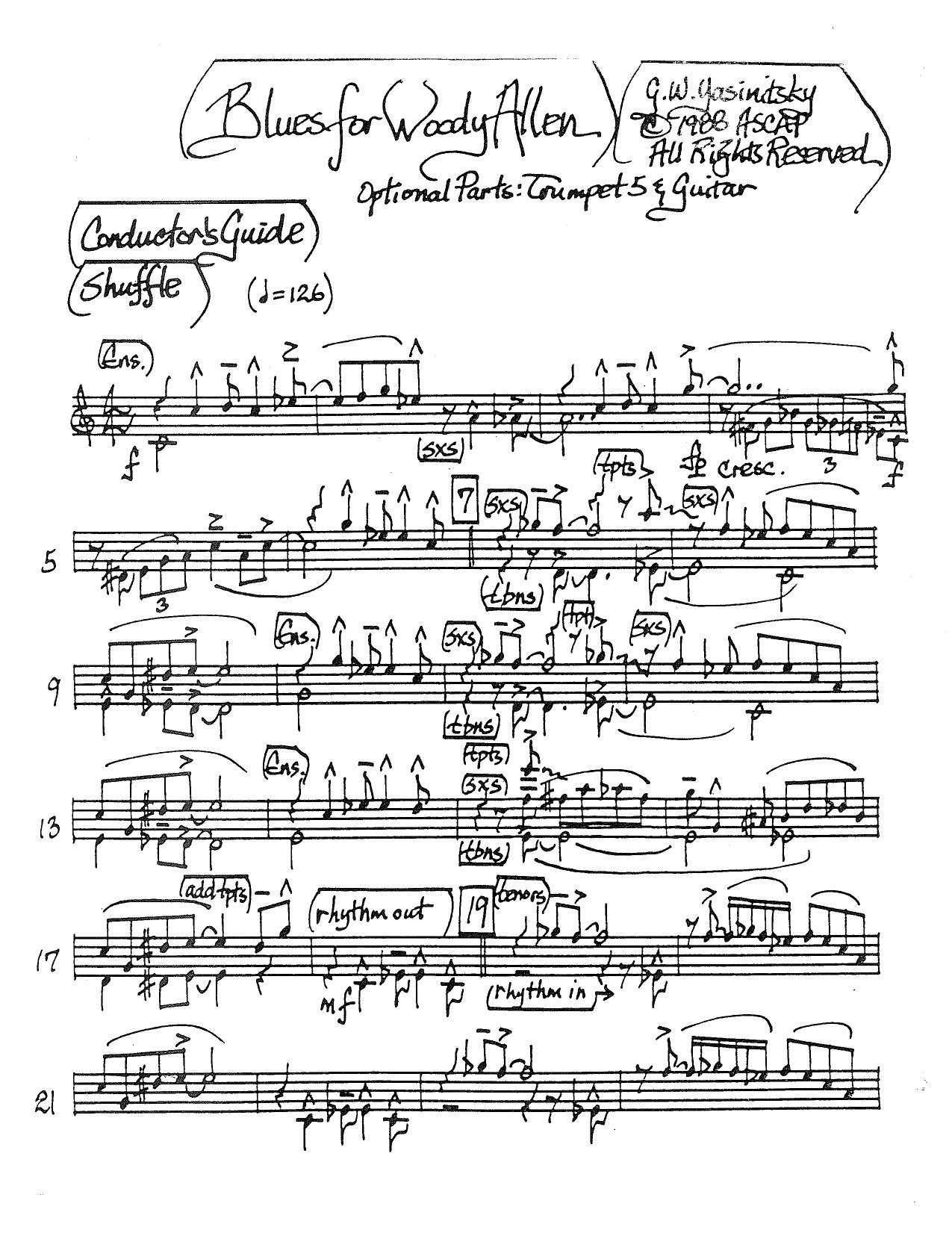
Blues For Woody Allen (G.Yasinitsky) sheet music preview

Blues For Woody Allen (G.Yasinitsky)

Composed by Gregory Yasinitsky

Arranged by Gregory Yasinitsky

  • Ensemble: Big Band
  • Pages: 54
  • Instruments (18): Alto Saxophone 1, Alto Saxophone 2, Tenor Saxophone 1, Tenor Saxophone 2, Baritone Saxophone, Trumpet 1, Trumpet 2, Trumpet 3, Trumpet 4, Trumpet 5, Trombone 1, Trombone 2, Trombone 3, Bass Trombone, Guitar, Piano, Bass, Drums
  • Difficulty: advanced
  • Content: Individual Parts
  • Format: PDF Download (Instant)
  • Price: $24.99

Regents Professor Emeritus at Washington State University and a renowned National Endowment for the Arts fellow, composer-arranger Gregory Yasinitsky crafted "Blues For Woody Allen" as a sophisticated contemporary tribute that bridges classic hard-bop sensibilities with modern, harmonically adventurous big band writing. While paying homage to the cinematic and intellectual wit associated with its namesake, the work avoids pastiche, instead offering a fresh, structurally rigorous take on the 12-bar blues form that has become a staple in modern educational and professional jazz libraries. Yasinitsky’s compositional voice consistently marries intricate contrapuntal lines with an immediate, swinging accessibility, making his charts favorites among directors seeking to stretch their ensembles' stylistic range without sacrificing groove. Driven by a crisp, mid-tempo swing feel, "Blues For Woody Allen" establishes an intellectual yet inherently foot-tapping mood characterized by clever motivic development and sly chromatic shifts. The harmonic landscape moves beyond standard blues changes by incorporating altered dominants, deceptive resolutions, and rich, contemporary voicings that give the brass and saxophones a lush, sophisticated palette. The emotional arc swings dynamically from playful, understated introspection during the head statements to high-octane communal joy when the ensemble opens up. The rhythm section anchors the piece with an insistent, driving pulse, allowing the horn sections to float effortless, syncopated figures over top. Yasinitsky structures the arrangement to highlight both ensemble solidarity and individual expression, utilizing tight, interlocking sax solis and biting brass punch lines that recall the finest traditions of the Thad Jones or Bob Mintzer libraries. The melody is initially stated with a sly, conversational phrasing shared between the alto and tenor saxophones, setting an intimate yet driving tone before expanding into full-ensemble tutti sections. Solo opportunities are provided over standard blues changes, allowing developing and advanced improvisers alike to stretch out comfortably. Technical demands focus primarily on clean articulation, accurate stylistic interpretation of swung eighth notes, and a keen awareness of internal ensemble balance, ensuring that the intricate countermelodies remain transparent beneath the primary thematic material. Advanced high school ensembles, collegiate jazz orchestras, and professional regional big bands will find this chart to be an ideal vehicle for developing sophisticated section playing and modern blues vocabulary. Because the scoring is optimized for a flexible 7-instrument frontline backed by a full rhythm section, it offers the transparent texture of a small-group writing style combined with the sheer dynamic weight of a larger ensemble. Directors will appreciate how the chart naturally teaches students the art of conversational phrasing and dynamic contrast, transforming a familiar 12-bar blues progression into a masterclass in contemporary big band arrangement. Rehearsing "Blues For Woody Allen" successfully requires a strict commitment to a relaxed, forward-moving medium swing tempo—do not allow the groove to rush or drag. The rhythm section is the engine; the drummer should maintain a crisp, conversational ride cymbal pattern with crisp hi-hat chicks on beats two and four, while the bassist walks a robust, acoustic-style line that locks tightly with the piano's comping voicings. Horn players must pay close attention to articulation markings, ensuring that short notes are properly clipped and accented notes receive a vocal, blues-inflected drop or fall where indicated. During the saxophone soli, balance is paramount: the lead alto must project clearly while the inner voices blend to create a unified, organ-like sonority. Conductors should rehearse the dynamic shifts separately, ensuring the sudden drops from shouting ensemble fortes to subtle piano comping are executed with precision to maximize the chart's inherent comedic and dramatic timing. Q: What instruments and parts are included in this arrangement? A: This arrangement is scored for a flexible 7-instrument ensemble featuring Alto Saxophone, Tenor Saxophone, Trumpet, Trombone, and a complete rhythm section including Piano, Bass, and Drums, spread across a comprehensive 54-page score and parts set. Q: What is the difficulty level of this chart? A: It is graded as advanced intermediate to advanced, making it ideal for skilled high school jazz bands, collegiate ensembles, and professional community big bands looking for sophisticated modern blues repertoire. Q: What is the musical style and historical context of the piece? A: Written by renowned jazz educator and composer Gregory Yasinitsky, the piece is a contemporary medium-swing 12-bar blues that blends hard-bop traditions with modern, harmonically adventurous big band writing. Q: What makes this specific Yasinitsky arrangement unique? A: It uniquely combines the transparent, linear clarity of a small-group workout with the rich, harmonically sophisticated voicings and punchy shout choruses typical of a full-scale contemporary big band. Q: What is the performance duration and tempo feel of the arrangement? A: The piece runs approximately 4 to 5 minutes in length and is anchored by a steady, driving medium-swing groove designed to test and showcase an ensemble's internal clock and stylistic flexibility.

Questions and answers

What is included in the Blues For Woody Allen (G.Yasinitsky) PDF?
The verified current file contains a conductor score and individual parts across 54 pages.
How many instruments or parts are listed for Blues For Woody Allen (G.Yasinitsky)?
The verified instrumentation list contains 18 entries for this Big Band arrangement.
Who is credited for Blues For Woody Allen (G.Yasinitsky)?
Composer: Gregory Yasinitsky. Arranger: Gregory Yasinitsky.
What difficulty is listed for Blues For Woody Allen (G.Yasinitsky)?
The verified difficulty level is advanced.
Can I preview Blues For Woody Allen (G.Yasinitsky) before buying?
Yes. The product page provides a preview generated from the current PDF file.
How is Blues For Woody Allen (G.Yasinitsky) delivered?
After successful payment, the digital PDF is made available for download. The displayed price is $24.99.

Musicians Also Search For

Blues For Woody Allen Gregory Yasinitsky PDFBlues For Woody Allen Gregory Yasinitsky sheet musicBlues For Woody Allen arranged by Gregory YasinitskyGregory Yasinitsky big band chartsGregory Yasinitsky jazz arrangements PDFBlues For Woody Allen Gregory Yasinitsky big band arrangementsBlues For Woody Allen big band arrangementsBlues For Woody Allen big band PDF downloadBlues For Woody Allen jazz sheet musicbig band sheet music downloadBlues For Woody Allen conductor score PDFBlues For Woody Allen individual parts downloadBlues For Woody Allen sheet music PDFbuy Blues For Woody Allen sheet musicdownload Blues For Woody Allen PDFBlues For Woody Allen jazz chartsbest Gregory Yasinitsky big band arrangementsBlues For Woody Allen printable sheet musicbig band repertoire PDF

All arrangements by Gregory Yasinitsky All Gregory Yasinitsky sheet music