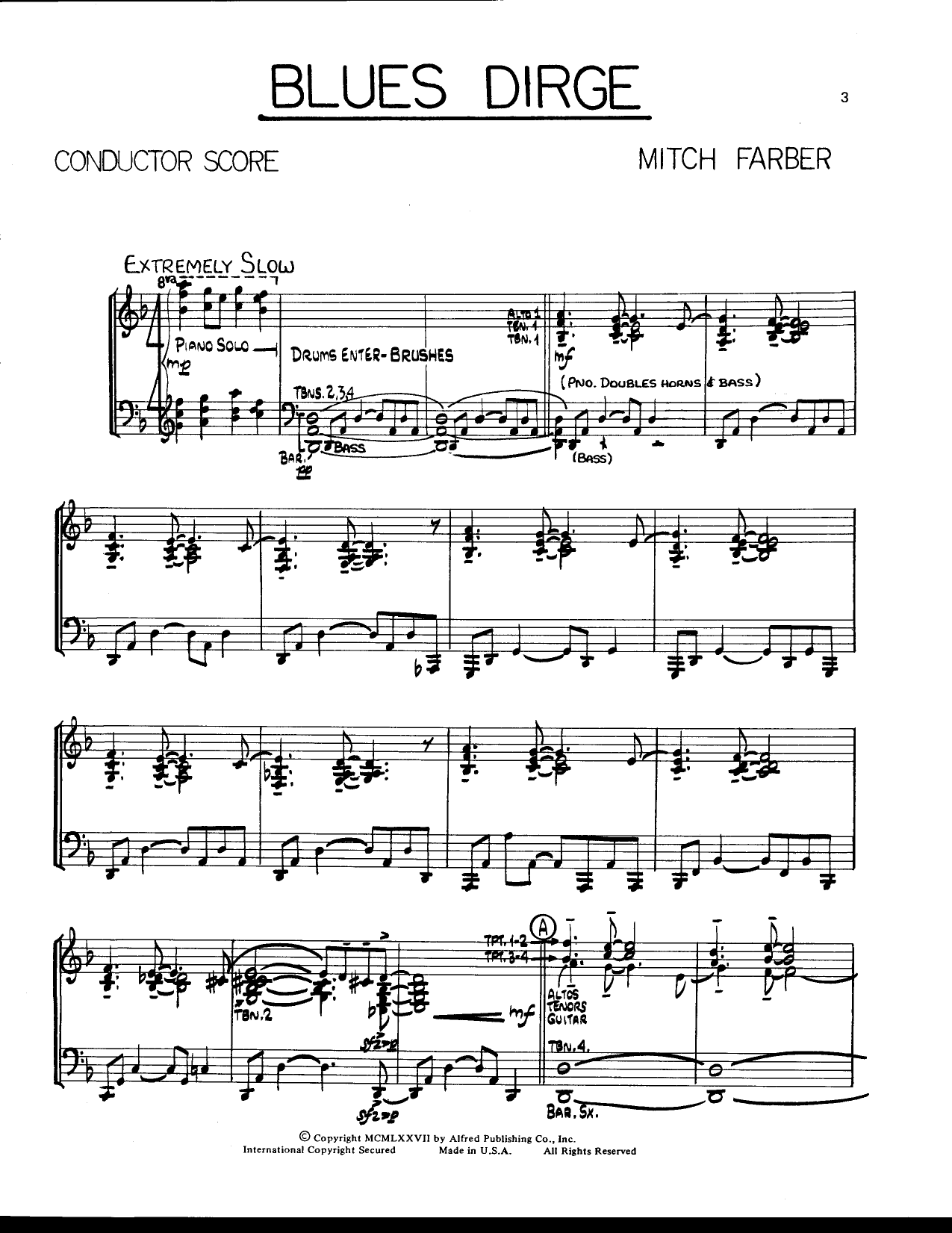
Blues Dirge (M.Farber)
Composed by Mitch Farber
Arranged by M.Farber
- Ensemble: Big Band
- Pages: 31
- Instruments (17): 1st Alto Saxophone, 2nd Alto Saxophone, 1st Tenor Saxophone, 2nd Tenor Saxophone, Baritone Saxophone, 1st Trumpet, 2nd Trumpet, 3rd Trumpet, 4th Trumpet, 1st Trombone, 2nd Trombone, 3rd Trombone, 4th Trombone (Bass Trombone Optional), Bass (Acoustic if possible), Drums, Piano, Guitar
- Difficulty: medium
- Content: Individual Parts
- Format: PDF Download (Instant)
- Price: $24.99
Deep within the subterranean roots of American music lies the timeless architecture of the twelve-bar blues, a structural canvas that has accommodated everything from joyous jubilation to profound lamentation. "Blues Dirge," drawing from the fertile soil of traditional blues and early New Orleans funeral march idioms, reimagines the traditional blues form through a modern, sophisticated big band lens. While the foundational thematic material borrows from anonymous spirituals and delta field hollers passed down through generations, this incarnation elevates the source material into a contemporary jazz art form. It bridges the stylistic chasm between early 20th-century processionals and the sophisticated harmonic language of post-war modal jazz. Plunging the ensemble into a brooding, atmospheric minor-key landscape, the arrangement opens with a slow, deliberate tempo feel that drips with heavy melancholy and dramatic tension. The mood is solemn yet intensely swinging, evoking the smoky atmosphere of an after-hours basement club where time seems to slow down. Rich, extended voicings in the brass section create towering harmonic walls, while the rhythm section lays down a heavy, hypnotic groove anchored by a sparse, driving bassline and sophisticated cymbal work. The emotional trajectory shifts masterfully from whispered introspection to towering walls of collective grief and explosive, cathartic release. Arranger M.Farber infuses the score with a distinctive compositional voice, utilizing dense cluster voicings, parallel motion, and unexpected chromatic mediant modulations that subvert traditional blues expectations. Rather than relying on standard stock shout choruses, Farber crafts a meticulously interwoven counterpoint where sections converse with one another, utilizing subtle dynamic swells and intricate cross-rhythms. The saxophones are treated as a unified choir capable of both velvety whispers and biting, angular lines, while the brass employment balances warm, muted textures with sudden, arresting open-horn stabs that command immediate attention from both listener and performer. The melodic weight is shared dynamically across the ensemble, though the 1st Alto Saxophone and 1st Tenor Saxophone take primary leadership roles in carrying the principal thematic statements. Open solo space is provided for featured improvisers to stretch out over traditional slow-blues changes, demanding a deep sense of phrasing, blues vocabulary, and emotional restraint rather than mere technical dexterity. Technical challenges lie primarily in maintaining pristine intonation during ultra-slow sustained chords, executing precise ensemble balance at whisper-soft dynamics, and locking in the heavy, behind-the-beat micro-groove. Advanced high school bands with mature sections, as well as collegiate and professional ensembles, will find this chart an intellectually stimulating and deeply moving centerpiece for any serious concert program. Conductors should approach "Blues Dirge" with an emphasis on breath control, patience, and deep vertical alignment across the entire big band. The primary technical hurdle rests in the extreme demand for sustained breath support during slow-tempo passages; players must avoid pinching notes or letting intonation sag during long, harmonically complex chord sequences. The tempo must remain locked, avoiding the common trap of dragging while maintaining a heavy, laid-back feel that leans slightly behind the pulse. Brass players should master a variety of mutes—particularly cup and harmon mutes—to achieve the veiled, vocal-like timbres called for in the opening choruses. Rehearsals should begin by isolating the rhythm section to solidify the subterranean groove before introducing the horn sections layer by layer. Pay meticulous attention to dynamic markings; the contrast between the muted, whispered background figures and the roaring, full-ensemble climaxes is what gives this chart its profound dramatic architecture. Q: What instruments and parts are included in this publication? A: The physical and digital scores comprise a comprehensive 16-instrument big band instrumentation, including Piano, Drum Set, 1st and 2nd Alto Saxophones, 1st and 2nd Tenor Saxophones, Baritone Saxophone, Trumpet and Trombone sections, complete with a dedicated full conductor score across 31 detailed pages. Q: What is the designated difficulty level of this arrangement? A: This chart is graded as advanced-intermediate to advanced, making it ideal for mature high school jazz ensembles, collegiate bands, and professional community big bands that possess strong sectional intonation and mature soloists. Q: What is the historical context and musical style of "Blues Dirge"? A: Drawing from traditional blues roots and early New Orleans dirge traditions, the piece translates historic lamentations into a contemporary jazz big band idiom characterized by deep emotional gravity and modern harmonic extensions. Q: What makes M.Farber's arrangement unique compared to standard blues charts? A: Farber subverts conventional blues expectations by incorporating dense cluster voicings, chromatic mediant modulations, intricate conversational counterpoint, and dynamic shifts that transition from whispered intimacy to explosive collective catharsis. Q: What is the performance duration and tempo feel of the piece? A: The arrangement is built around a slow, deliberate tempo feel (typically clocking in at a brooding ballad or slow-groove pace) designed to maximize dramatic tension, resulting in a performance duration of approximately 5 to 7 minutes depending on improvised solo lengths.
Questions and answers
- What is included in the Blues Dirge (M.Farber) PDF?
- The verified current file contains a conductor score and individual parts across 31 pages.
- How many instruments or parts are listed for Blues Dirge (M.Farber)?
- The verified instrumentation list contains 17 entries for this Big Band arrangement.
- Who is credited for Blues Dirge (M.Farber)?
- Composer: Mitch Farber. Arranger: M.Farber.
- What difficulty is listed for Blues Dirge (M.Farber)?
- The verified difficulty level is medium.
- Can I preview Blues Dirge (M.Farber) before buying?
- Yes. The product page provides a preview generated from the current PDF file.
- How is Blues Dirge (M.Farber) delivered?
- After successful payment, the digital PDF is made available for download. The displayed price is $24.99.
Musicians Also Search For
Blues Dirge M.Farber PDF • Blues Dirge M.Farber sheet music • Blues Dirge arranged by M.Farber • M.Farber big band charts • M.Farber jazz arrangements PDF • Blues Dirge Mitch Farber sheet music • Blues Dirge Mitch Farber big band arrangements • Mitch Farber big band charts • Blues Dirge big band arrangements • Blues Dirge big band PDF download • Blues Dirge jazz sheet music • big band sheet music download • Blues Dirge conductor score PDF • Blues Dirge individual parts download • Blues Dirge sheet music PDF • buy Blues Dirge sheet music • download Blues Dirge PDF • Blues Dirge jazz charts • best M.Farber big band arrangements • Mitch Farber arranged by M.Farber • Blues Dirge printable sheet music • big band repertoire PDF