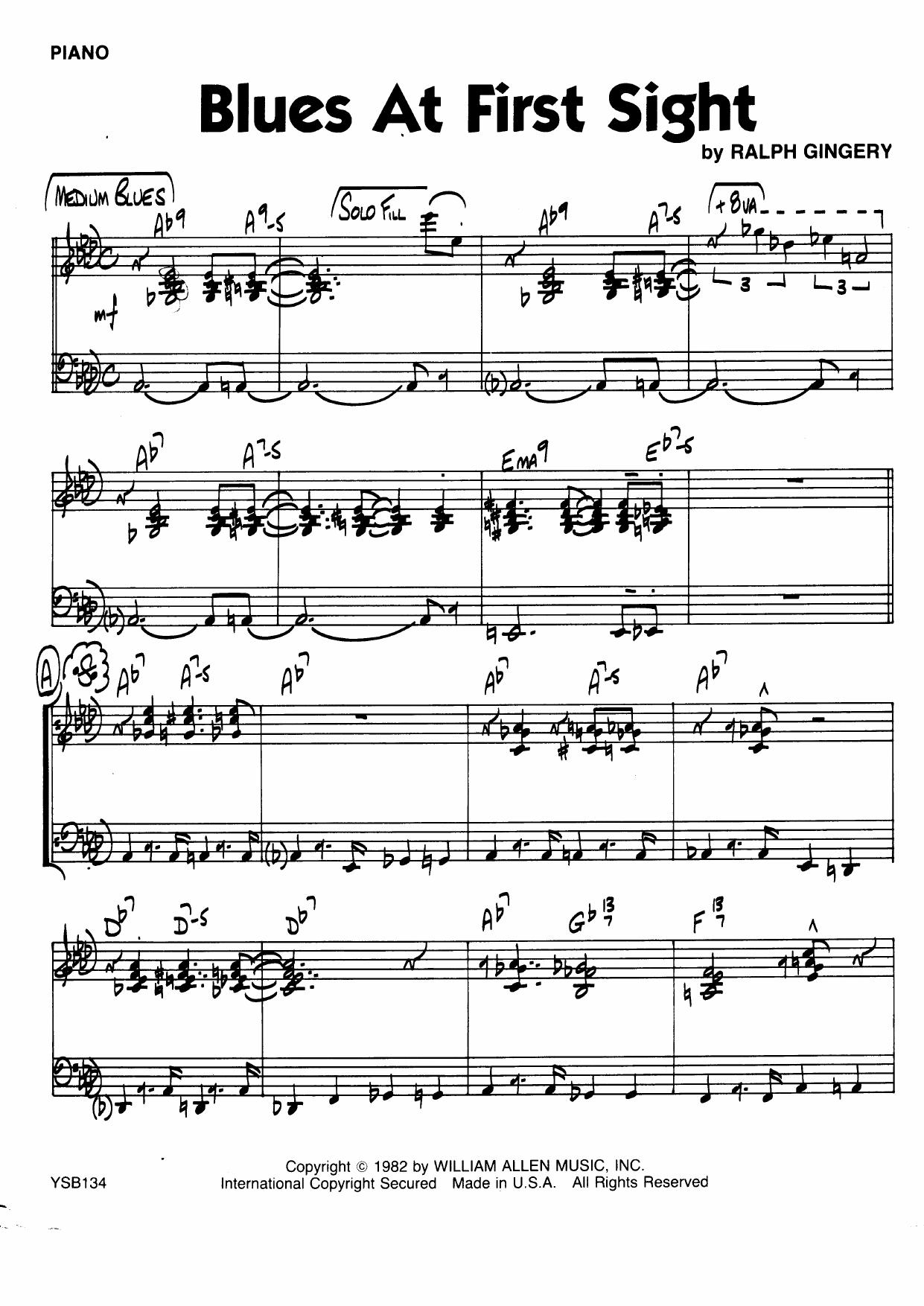
Blues At First Sight (R.Gingery) sheet music preview

Blues At First Sight (R.Gingery)

Composed by R.Gingery

Arranged by R.Gingery

  • Ensemble: Big Band
  • Style: Jazz Standard
  • Pages: 25
  • Instruments (17): Alto Sax I, Alto Sax II, Tenor Sax I, Tenor Sax II, Baritone Sax, Trumpet I, Trumpet II, Trumpet III, Trumpet IV, Trombone I, Trombone II, Trombone III, Trombone IV, Guitar, Piano, Bass, Drums
  • Difficulty: easy
  • Content: Individual Parts
  • Format: PDF Download (Instant)
  • Price: $24.99

Composed and arranged by R.Gingery, "Blues At First Sight" captures the vibrant, driving essence of mid-century modern big band jazz while injecting a fresh, contemporary harmonic sensibility. Rooted in the rich tradition of the blues-based jazz standard, this composition bridges the gap between classic swing-era sectional writing and the more sophisticated, harmonically adventurous language of post-bop and modern mainstream jazz. R.Gingery has long been celebrated for penning charts that respect historical idioms while pushing ensemble interaction to new heights, making this piece a standout addition to any serious big band library. Driving forward with an infectious, medium-up swing tempo in 4/4 time, the piece opens with a sleek, conversational theme traded between the trumpet and alto saxophone sections before expanding into full ensemble counterpoint. The mood is confident, sophisticated, and high-energy, evoking late-night smoky club atmospheres contrasted with the bright, punchy power of a full-throttle brass section. R.Gingery utilizes rich, extended tertian and quartal harmonies, giving the chord progressions a lush, contemporary color without losing the gritty, blues-soaked foundation that anchors the tune. Dynamic contrast is a major structural feature, moving seamlessly from whisper-quiet, muted background figures to roaring, brass-heavy climaxes. The arrangement showcases a meticulously crafted saxophone soli that requires tight blend, agile articulation, and acute intonation across the reed section. Following the soli, the chart opens up into dedicated solo changes—traditionally allotted to tenor saxophone and piano—backed by dynamic, riff-driven background cues from the brass. The ultimate architectural peak arrives in the final third of the 25-page conductor score with a blistering shout chorus. This section demands absolute rhythmic precision, crisp articulation on short accented notes, and controlled power from the lead trumpet, who sits comfortably in the upper register without sacrificing tone quality. Advanced high school ensembles with strong section leaders, as well as collegiate and professional community big bands, will find "Blues At First Sight" to be an exceptionally rewarding centerpiece for a concert program or festival performance. Because the rhythm section acts as the primary engine—driving the groove with a steady walking bass line and interactive drumming—it also provides an ideal vehicle for developing authentic swing feel and section-to-section listening skills. Every phrase is thoughtfully voiced, ensuring that even complex chord extensions project clearly across the ensemble. Achieving an authentic performance of "Blues At First Sight" requires careful attention to the stylistic nuances of medium-up swing. The rhythm section must establish a relentless, forward-moving groove; the drummer should feather the bass drum lightly while maintaining a crisp ride cymbal pattern, and the bassist needs to emphasize a strong, connected walking feel with accented downbeats on beats two and four. Technically, the primary challenge lies in the execution of the ensemble syncopations and the intricate saxophone soli. Conductors should rehearse the horns separately to lock in the articulation, ensuring that all written staccatos are crisp and short, and that un-muted brass falls and doits are executed with natural, uniform pitch decay. Brass players should utilize cup or bucket mutes where indicated in the score to achieve the required textural contrast during the head-in. Balance is critical during the shout chorus; the saxophones and trombones must project their counter-lines clearly underneath the soaring lead trumpet melody without forcing their tone. Q: What instrumentation and parts are included in this publication? A: The 25-page package includes a complete, transposed conductor score alongside standard big band instrumentation: 5 saxophones (alto 1-2, tenor 1-2, baritone), 4 trumpets, 4 trombones, and a full rhythm section comprising piano, guitar, bass, and drums. Q: What is the official difficulty level of this arrangement? A: This arrangement is graded as advanced (approximate grade 4 to 5), making it best suited for accomplished high school bands, collegiate ensembles, and professional community jazz orchestras with strong soloists and experienced lead players. Q: What is the musical style and historical context of "Blues At First Sight"? A: Written by R.Gingery, the piece is a contemporary jazz standard that honors the classic 12-bar blues and swing traditions while incorporating modern harmonic voicings and sophisticated post-bop compositional devices. Q: What makes this specific arrangement unique within a jazz repertoire? A: It stands out due to R.Gingery’s signature approach to voice-leading, featuring an interlocking saxophone soli, dynamically shifting background figures, and a meticulously structured shout chorus that builds maximum tension and release. Q: What is the performance duration and suggested tempo for this piece? A: The arrangement runs approximately 4 to 5 minutes in duration when performed at the recommended medium-up swing tempo of around 168 to 176 beats per minute.

Questions and answers

What is included in the Blues At First Sight (R.Gingery) PDF?
The verified current file contains individual parts across 25 pages.
How many instruments or parts are listed for Blues At First Sight (R.Gingery)?
The verified instrumentation list contains 17 entries for this Big Band arrangement.
Who is credited for Blues At First Sight (R.Gingery)?
Composer: R.Gingery. Arranger: R.Gingery.
What difficulty is listed for Blues At First Sight (R.Gingery)?
The verified difficulty level is easy.
What style is listed for Blues At First Sight (R.Gingery)?
The catalog lists the style as Jazz Standard.
Can I preview Blues At First Sight (R.Gingery) before buying?
Yes. The product page provides a preview generated from the current PDF file.
How is Blues At First Sight (R.Gingery) delivered?
After successful payment, the digital PDF is made available for download. The displayed price is $24.99.

Musicians Also Search For

Blues At First Sight R.Gingery PDFBlues At First Sight R.Gingery sheet musicBlues At First Sight arranged by R.GingeryR.Gingery big band chartsR.Gingery jazz arrangements PDFBlues At First Sight R.Gingery big band arrangementsBlues At First Sight big band arrangementsBlues At First Sight big band PDF downloadBlues At First Sight jazz sheet musicbig band sheet music downloadBlues At First Sight individual parts downloadBlues At First Sight sheet music PDFBlues At First Sight Jazz Standard chartsJazz Standard big band arrangementsbuy Blues At First Sight sheet musicdownload Blues At First Sight PDFBlues At First Sight jazz chartsbest R.Gingery big band arrangementsBlues At First Sight printable sheet musicbig band repertoire PDF

All arrangements by R.Gingery All R.Gingery sheet music