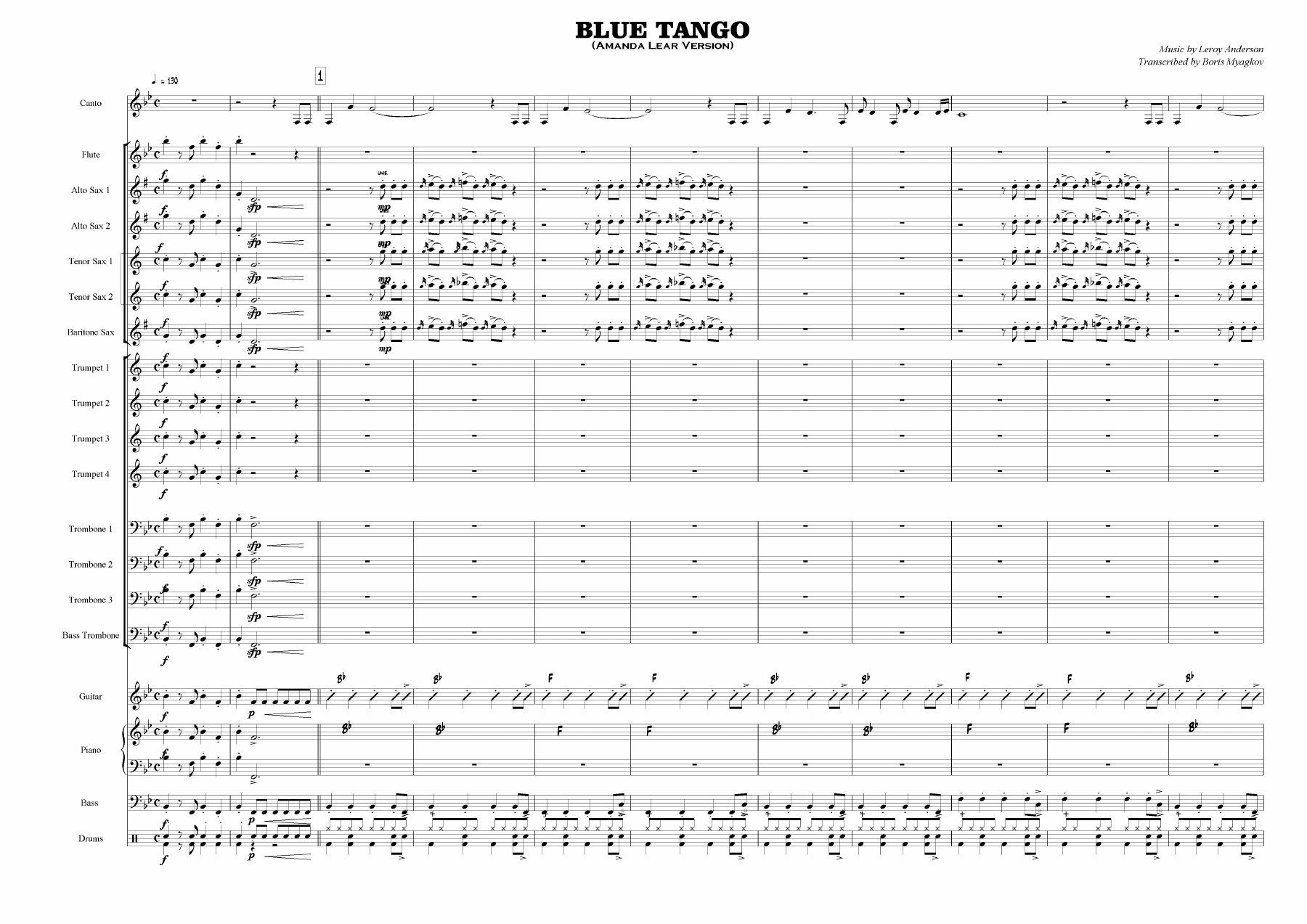
Blue Tango (B.Myagkov)
Composed by Leroy Anderson
Arranged by Boris Myagkov
- Ensemble: Big Band
- Style: Tango
- Pages: 34
- Instruments (19): Flute, Alto Saxophone 1, Alto Saxophone 2, Tenor Saxophone 1, Tenor Saxophone 2, Baritone Saxophone, Trumpet 1, Trumpet 2, Trumpet 3, Trumpet 4, Trombone 1, Trombone 2, Trombone 3, Bass Trombone, Guitar, Piano, Bass, Drum Set, Canto
- Difficulty: medium
- Content: Individual Parts
- Format: PDF Download (Instant)
- Price: $24.99
Leroy Anderson's iconic "Blue Tango," originally composed in 1951, stands as a seminal work in the orchestral pop canon, bridging the gap between classical light music and popular appeal. It was the first instrumental piece to sell over one million copies and achieve number one status on the American charts, a testament to its immediate and widespread charm. Anderson, renowned for his innovative use of orchestral color and memorable melodies, crafted a piece that, while not explicitly jazz, possessed a rhythmic sophistication and melodic magnetism that lent itself readily to diverse interpretations. Its enduring popularity stems from its instantly recognizable melody and its evocative, yet accessible, Latin American dance rhythm. The original composition, typically performed by a string orchestra with percussion, captured the melancholic elegance and passionate undertones characteristic of the tango, filtered through Anderson's distinctive American orchestral lens. Boris Myagkov’s big band arrangement of "Blue Tango" reimagines this classic with a vibrant, authentic tango feel, masterfully translating its orchestral grandeur into the dynamic language of a modern jazz ensemble. Eschewing a traditional swing or Latin jazz interpretation, Myagkov commits fully to the *tango milonga* character, establishing a medium-slow, deliberate tempo in 4/4 (with a strong 2-feel) that emphasizes the dance's inherent drama and grace. The arrangement is set primarily in the original key of A minor, preserving the melancholic yet passionate mood. Myagkov's signature approach involves rich, dense voicings that leverage the full harmonic capabilities of the big band, creating a lush soundscape that both honors Anderson's original orchestration and injects a contemporary jazz sensibility. The arrangement opens with a captivating ensemble statement, immediately establishing the tango rhythm and the haunting main theme. Myagkov skillfully distributes the melody across various sections, often featuring the saxophone section in unison or tight harmony for the primary melodic statements, sometimes echoed or complemented by the brass. Expect intricate soli passages, particularly within the saxophones, showcasing Myagkov's penchant for sophisticated counterpoint and harmonic depth. While there are no extended improvised solo sections in the traditional jazz sense, the arrangement features brief, expressive melodic features for lead alto saxophone and trumpet, allowing for nuanced interpretation within the tango framework. The technical demands are moderate to advanced, requiring precise rhythmic articulation, strong ensemble blend, and an understanding of tango phrasing from all players. The brass sections will need good control over dynamics and tone, especially in the sustained, expressive lines, while the rhythm section must maintain a rock-solid, authentic tango groove. The reward for the ensemble lies in performing a piece that is both familiar and refreshingly new, offering a unique challenge in stylistic authenticity and ensemble cohesion. This arrangement is ideally suited for college, university, and advanced community jazz ensembles, as well as professional big bands looking to expand their repertoire with a distinctive and engaging piece. Its blend of historical reverence and contemporary jazz orchestration makes it an excellent choice for concert programs seeking variety, offering a sophisticated alternative to standard big band fare. The detailed scoring and authentic stylistic approach provide a valuable educational experience in rhythmic precision and ensemble dynamics, while its inherent musicality ensures a rewarding performance for both musicians and audience. Conductors should emphasize a strict, yet flexible, *tango milonga* rhythmic feel from the outset, prioritizing a strong, grounded pulse over a driving swing. The tempo should be kept at a medium-slow pace, allowing for the inherent drama and melodic expressiveness to unfold. Pay close attention to the dynamic contrasts, which are crucial for conveying the tango's emotional arc; Myagkov's scoring provides ample opportunities for dramatic swells and subtle diminuendos. The primary technical challenge lies in achieving unified articulation, particularly in the saxophone soli sections where precise rhythmic unison is paramount. Brass players should focus on warm, sustained tones in lyrical passages and crisp, unified attacks in rhythmic figures. The rhythm section must maintain a consistent, authentic tango groove, with the bass providing a steady, walking foundation and the piano/guitar offering rhythmic and harmonic punctuation without overpowering. Rehearsal time should be dedicated to perfecting the ensemble blend and ensuring all sections understand the nuanced phrasing characteristic of the tango style. Q: What instruments are included in this arrangement? A: This big band arrangement is scored for 17 instruments: Alto Saxophone 1, Alto Saxophone 2, Tenor Saxophone 1, Tenor Saxophone 2, Baritone Saxophone, Trumpet 1, Trumpet 2, Trumpet 3, Trumpet 4, Trombone 1, Trombone 2, Trombone 3, Trombone 4, Piano, Bass, Drums, and Guitar. The complete set includes 34 pages of music. Q: What is the difficulty level of Boris Myagkov's "Blue Tango" arrangement? A: This arrangement is considered advanced intermediate to advanced. It requires strong ensemble playing, precise rhythmic articulation, and a nuanced understanding of the tango style from all musicians, making it suitable for college, university, and professional big bands. Q: What is the musical style and historical context of this piece? A: This is a big band arrangement of Leroy Anderson's "Blue Tango," originally composed in 1951. While the original is an orchestral pop classic, Myagkov's arrangement interprets it with an authentic *tango milonga* feel, blending the original's melancholic charm with sophisticated jazz orchestration. Q: What makes Boris Myagkov's arrangement of "Blue Tango" unique? A: Myagkov's arrangement stands out for its faithful commitment to an authentic tango feel, its rich, dense voicings that fully utilize the big band's harmonic capabilities, and its intricate soli sections. It offers a sophisticated, non-swinging interpretation that provides a unique stylistic challenge and rewarding performance. Q: What is the typical performance duration and tempo for this arrangement? A: The performance duration is approximately 3-4 minutes, depending on the chosen tempo and interpretation. The arrangement maintains a medium-slow, deliberate tempo, characteristic of a *tango milonga*, emphasizing the dance's inherent drama and grace.
Musicians Also Search For
Blue Tango Boris Myagkov PDF • Blue Tango Boris Myagkov sheet music • Blue Tango arranged by Boris Myagkov • Boris Myagkov big band charts • Boris Myagkov jazz arrangements PDF • Blue Tango Leroy Anderson sheet music • Blue Tango Leroy Anderson big band arrangement • Leroy Anderson big band charts • Blue Tango big band arrangement • Blue Tango big band PDF download • Blue Tango jazz ensemble sheet music • big band sheet music instant download • Blue Tango conductor score PDF • Blue Tango individual parts download • Blue Tango sheet music with parts • Blue Tango Tango chart • Tango big band arrangements • buy Blue Tango sheet music online • download Blue Tango PDF • Blue Tango jazz chart • best Boris Myagkov big band arrangements • Leroy Anderson songs arranged by Boris Myagkov • Blue Tango printable sheet music • big band repertoire PDF