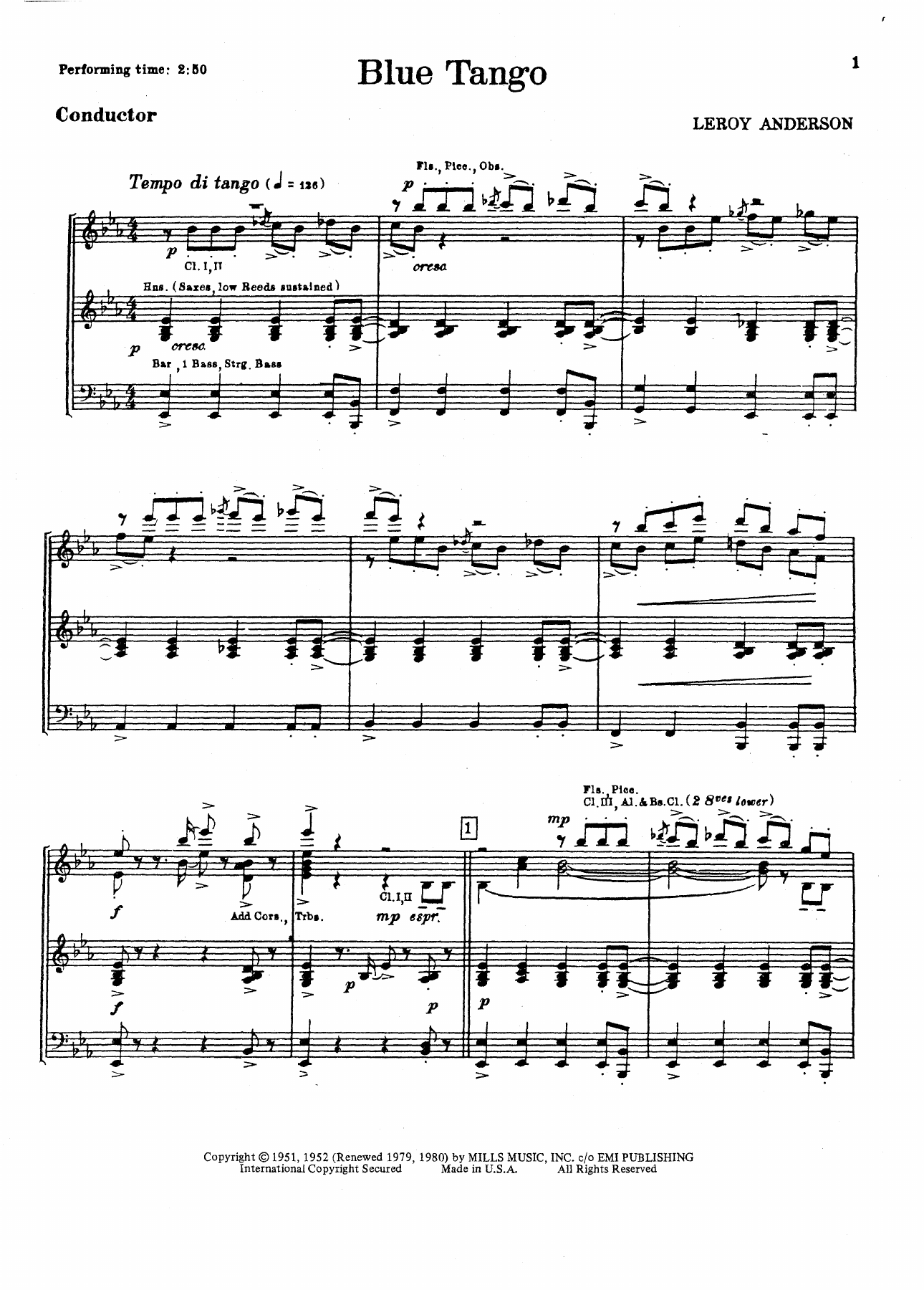
Blue Tango (L.Anderson)
Composed by Leroy Anderson
Arranged by L.Anderson
- Ensemble: Concert Band
- Style: Tango
- Pages: 40
- Instruments (36): Conductor, Flutes, Piccolo, Oboes, Bassoons, Eb Clarinet, 1st Bb Clarinet, 2nd Bb Clarinet, 3rd Bb Clarinet, Eb Alto Clarinet, Bb Bass Clarinet, 1st Eb Alto Saxophone, 2nd Eb Alto Saxophone, Bb Tenor Saxophone, Eb Baritone Saxophone, 1st Bb Cornet, 2nd Bb Cornet, 3rd Bb Cornet, Bb Trumpets, 1st Eb Horn, 2nd Eb Horn, 3rd Eb Horn, 4th Eb Horn, 1st Horn in F, 2nd Horn in F, 3rd Horn in F, 4th Horn in F, 1st Trombone, 2nd Trombone, 3rd Trombone, Baritone (Treble Clef), Baritone (Bass Clef), Basses, String Bass, Drums, Bells
- Difficulty: medium
- Content: Individual Parts
- Format: PDF Download (Instant)
- Price: $22.99
Leroy Anderson's iconic "Blue Tango," originally composed in 1951, stands as a testament to the composer's unparalleled ability to craft orchestral miniatures that transcend genre. While not a traditional jazz standard, its immense popularity and distinctive rhythmic drive have made it a staple in various musical settings, often adapted by big bands and concert ensembles. Anderson himself was a master of light classical music, known for his inventive orchestrations and memorable melodies that often incorporated novel instrumental effects, such as the typewriter in "The Syncopated Clock" or sandpaper in "Sandpaper Ballet." "Blue Tango" quickly became a global sensation, topping charts and becoming the first instrumental recording to sell over one million copies, cementing its place in mid-20th-century popular music history. Its enduring appeal lies in its sophisticated yet accessible melody, coupled with an irresistible, melancholic tango rhythm that evokes both romance and a subtle sense of drama. This concert band arrangement by L.Anderson masterfully captures the original's evocative spirit while translating its unique character for a wind and percussion ensemble. The piece maintains its characteristic medium tempo, firmly rooted in a 4/4 meter with a pronounced tango feel. The key of A minor (with relative C major passages) contributes to its inherent wistfulness and passion. L.Anderson’s approach emphasizes rich, full-bodied scoring, utilizing the diverse timbres of the concert band to create a lush soundscape. Expect carefully voiced woodwind sections carrying the primary melodic lines, often doubled or harmonized with brass for added warmth and projection. The arrangement skillfully balances the lyrical beauty of the main theme with the rhythmic precision required for an authentic tango. Performance of this arrangement offers numerous rewarding moments for the ensemble. The melody is primarily carried by the upper woodwinds (flute, oboe, clarinet) and occasionally passed to the trumpets or alto saxophones, allowing various sections to shine. While there are no extended improvised solos, the arrangement features intricate soli passages for different instrumental families, demanding blend and rhythmic precision. The technical challenges lie primarily in maintaining the consistent, driving tango rhythm throughout, ensuring precise articulation, and achieving a balanced dynamic contrast to highlight the piece's inherent drama. The arrangement builds to a powerful climax before returning to a more subdued, reflective close, mirroring the original's emotional arc. This rendition is particularly well-suited for high school and college concert bands seeking to explore a classic orchestral work reimagined for their instrumentation, offering both educational value in ensemble playing and a highly engaging piece for audiences. Community bands will also find it a satisfying and popular addition to their repertoire. Conductors should emphasize a consistent, driving tango rhythm from the outset, ensuring the bass line and percussion lay a solid, unwavering foundation. The tempo should be a moderate *Andante moderato* (approx. quarter note = 108-116 bpm), allowing for both rhythmic clarity and melodic expressiveness. Articulation is key: woodwinds should aim for a legato-tenuto feel on sustained notes within the melody, contrasting with crisper, detached eighth notes in accompanying figures. Brass should strive for warmth and blend, avoiding overly aggressive attacks. Pay close attention to dynamic swells and diminuendos, as these are crucial for conveying the piece's emotional depth. Rehearsal time should focus on balancing the intricate inner voices during soli sections and ensuring seamless transitions between melodic statements. Percussionists should practice the characteristic tango rhythms diligently, using mallets on bells or xylophone for melodic accents and a clean snare drum sound for rhythmic punctuation. Q: What instruments and parts are included in this arrangement? A: This arrangement for concert band typically includes full scores and parts for standard woodwinds (flute, oboe, bassoon, clarinet, bass clarinet, alto/tenor/baritone saxophone), brass (trumpet, horn, trombone, euphonium, tuba), and a comprehensive percussion section. Q: What is the difficulty level of this "Blue Tango" arrangement? A: This arrangement is rated as a Medium (Grade 3-4) difficulty, making it appropriate for advanced high school, college, and community concert bands. It requires solid ensemble playing, rhythmic precision, and attention to dynamics. Q: What musical style does "Blue Tango" represent, and what is its historical context? A: "Blue Tango" is a light classical orchestral piece composed by Leroy Anderson in 1951, characterized by its distinctive tango rhythm and melancholic melody. It became a global hit and is a prime example of mid-20th-century popular orchestral music. Q: What makes L.Anderson's arrangement of "Blue Tango" unique for concert band? A: This arrangement by L.Anderson is unique for its rich, full-bodied scoring that translates the original's orchestral charm effectively for wind and percussion. It features intricate soli passages, careful voicings, and a faithful adherence to the original's emotional arc, leveraging the diverse timbres of the concert band. Q: What is the typical performance duration and recommended tempo for this piece? A: The typical performance duration for this arrangement is approximately 2 minutes and 45 seconds to 3 minutes. The recommended tempo is a medium *Andante moderato*, around quarter note = 108-116 bpm, to capture the authentic tango feel.
Questions and answers
- What is included in the Blue Tango (L.Anderson) PDF?
- The verified current file contains a conductor score and individual parts across 40 pages.
- How many instruments or parts are listed for Blue Tango (L.Anderson)?
- The verified instrumentation list contains 36 entries for this Concert Band arrangement.
- Who is credited for Blue Tango (L.Anderson)?
- Composer: Leroy Anderson. Arranger: L.Anderson.
- What difficulty is listed for Blue Tango (L.Anderson)?
- The verified difficulty level is medium.
- What style is listed for Blue Tango (L.Anderson)?
- The catalog lists the style as Tango.
- Can I preview Blue Tango (L.Anderson) before buying?
- Yes. The product page provides a preview generated from the current PDF file.
- How is Blue Tango (L.Anderson) delivered?
- After successful payment, the digital PDF is made available for download. The displayed price is $22.99.
Musicians Also Search For
Blue Tango L.Anderson PDF • Blue Tango L.Anderson sheet music • Blue Tango arranged by L.Anderson • L.Anderson concert band charts • L.Anderson jazz arrangements PDF • Blue Tango Leroy Anderson sheet music • Blue Tango Leroy Anderson concert band arrangements • Leroy Anderson concert band charts • Blue Tango concert band arrangements • Blue Tango concert band PDF download • Blue Tango jazz sheet music • concert band sheet music download • Blue Tango conductor score PDF • Blue Tango individual parts download • Blue Tango sheet music PDF • Blue Tango Tango charts • Tango concert band arrangements • buy Blue Tango sheet music • download Blue Tango PDF • Blue Tango jazz charts • best L.Anderson concert band arrangements • Leroy Anderson arranged by L.Anderson • Blue Tango printable sheet music • concert band repertoire PDF