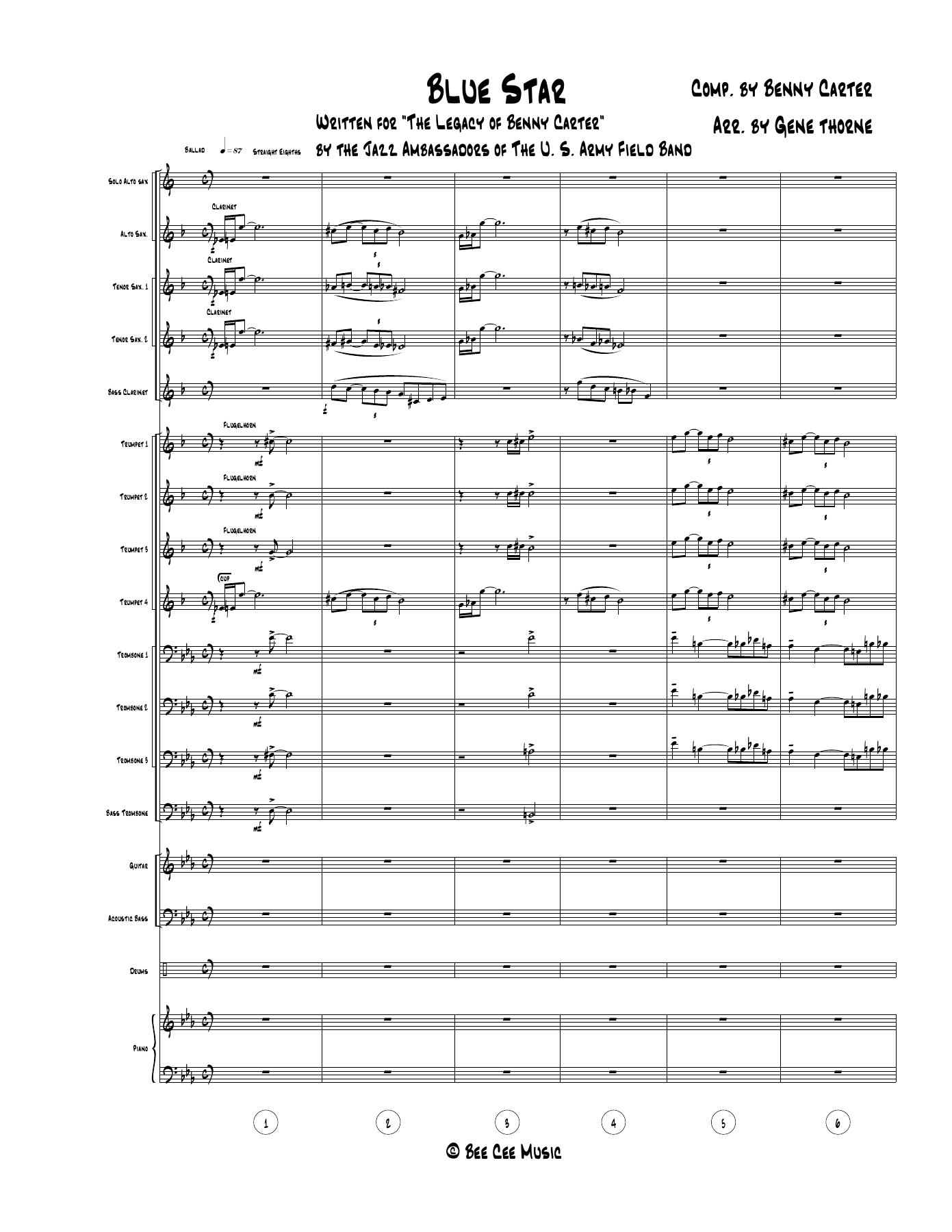
Blue Star (J.Thorne) sheet music preview

Blue Star (J.Thorne)

Composed by Benny Carter

Arranged by Benny Carter

  • Ensemble: Big Band
  • Style: Jazz Standard
  • Pages: 21
  • Instruments (19): Alto Saxophone (Solo), Alto Saxophone, Clarinet, Tenor Saxophone 1, Tenor Saxophone 2, Bass Clarinet, Flugelhorn, Trumpet 1, Trumpet 2, Trumpet 3, Trumpet 4, Trombone 1, Trombone 2, Trombone 3, Bass Trombone, Guitar, Acoustic Bass, Drum Set, Piano
  • Difficulty: medium
  • Content: Individual Parts
  • Format: PDF Download (Instant)
  • Price: $24.99

Benny Carter's "Blue Star," though often attributed to J. Thorne, is a quintessential example of his genius as both a composer and arranger, embodying the sophisticated swing era aesthetic that defined much of his illustrious career. Composed and recorded during a period when big band jazz was at its zenith, this piece reflects the elegance and melodic invention characteristic of the 1930s and 40s. While not as universally recognized as some of Carter's other compositions, "Blue Star" showcases his unparalleled ability to craft memorable melodies and intricate harmonies, making it a valuable addition to the repertoire of any band exploring the foundational sounds of big band jazz. Its enduring appeal lies in its timeless swing feel and the masterful orchestration that only an artist of Carter's caliber could achieve. This arrangement of "Blue Star" unfolds as a medium swing, typically set in a comfortable 4/4 time signature, likely in a key that allows for rich horn voicings and fluid melodic lines, such as F or Bb major. The mood is one of relaxed confidence and understated sophistication, evoking the classic dance hall or concert stage of the swing era. It possesses a warm, inviting energy, driven by a solid rhythm section foundation that supports the lyrical horn passages. The piece balances moments of lush, harmonically rich ensemble playing with opportunities for soloistic expression, creating a dynamic yet cohesive musical journey. Listeners and performers alike will appreciate its melodic clarity and the subtle harmonic shifts that keep the ear engaged without resorting to overt complexity. Benny Carter's distinctive arranging style is immediately apparent in this treatment. Expect his signature "saxophone choir" voicings, where the saxophones are treated as a unified, expressive unit, often featuring close-knit harmonies that create a smooth, almost vocal quality. The brass sections will likely feature carefully crafted soli passages, showcasing their power and precision, often in call-and-response with the reeds. Carter was a master of counterpoint and melodic development, so anticipate interwoven lines and a sense of forward motion throughout. His arrangements are known for their clarity, balance, and the way they allow each section to shine while contributing to the overall ensemble sound. There are no abrupt modulations or overly extended harmonies; instead, the beauty lies in the elegant progression and the impeccable voice leading. The melody of "Blue Star" is typically introduced by the lead alto saxophone or a combined sax section, establishing the piece's lyrical character. Featured solos are almost certainly present, offering opportunities for improvisation over the standard changes, likely for tenor saxophone or trumpet, in keeping with the era's tradition. Technical challenges are moderate, focusing on clean articulation, precise ensemble blend, and maintaining a consistent swing feel. The brass will need good breath support for sustained phrases, and the saxophones will require excellent intonation within their close voicings. The reward for performing this piece lies in experiencing Carter's masterful orchestration firsthand, contributing to a truly authentic swing sound, and delighting an audience with its timeless charm. This arrangement is ideally suited for college-level jazz ensembles, advanced high school bands, and community big bands seeking to perform authentic, high-quality swing repertoire with historical significance. Professional bands will also find it a rewarding and stylistically accurate addition to their charts. "Blue Star" requires a consistent, relaxed medium swing feel from the outset; avoid rushing or dragging. The rhythm section should lay down a solid, unhurried foundation, emphasizing a light, walking bass line and a ride cymbal pattern that propels the ensemble without being overly aggressive. Key technical challenges include achieving precise intonation within Benny Carter's characteristic close-voiced saxophone soli sections and ensuring clean, unified articulation across all horn sections. Brass players should focus on warmth of tone and controlled dynamics, particularly in sustained passages. Mutes are generally not specified for this piece, but a straight mute for trumpets in certain soli sections could add stylistic authenticity if desired. Rehearsal time should be dedicated to balancing the sax section's blend and ensuring the brass attacks are unified and crisp, particularly in shout choruses. Pay close attention to dynamics, as Carter's arrangements often feature subtle shifts that enhance the melodic contours. Q: What instruments and parts are included in this arrangement? A: This arrangement is scored for a full 17-piece big band, including Alto Saxophone 1, Alto Saxophone 2, Tenor Saxophone 1, Tenor Saxophone 2, Baritone Saxophone, Trumpet 1, Trumpet 2, Trumpet 3, Trumpet 4, Trombone 1, Trombone 2, Trombone 3, Trombone 4, Piano, Bass, Drums, and Guitar. A full conductor score is also included. Q: What is the difficulty level of "Blue Star (J.Thorne)" by Benny Carter? A: This arrangement is rated as medium difficulty, making it appropriate for college-level ensembles, advanced high school bands, and experienced community big bands. It requires solid instrumental technique, good intonation, and an understanding of authentic swing style. Q: What musical style and historical context does this arrangement represent? A: "Blue Star" is a classic jazz standard in the medium swing style, embodying the sophisticated big band sound of the 1930s and 1940s. It showcases Benny Carter's masterful approach to composition and orchestration during the height of the swing era. Q: What makes this particular arrangement unique or special? A: This arrangement is unique because it is by Benny Carter himself, showcasing his iconic "saxophone choir" voicings, elegant melodic lines, and balanced orchestration that allows each section to contribute to a cohesive, authentic swing sound. It's a direct insight into the mind of a jazz giant. Q: What is the typical performance duration and tempo for this piece? A: "Blue Star" is typically performed at a medium swing tempo, around 120-140 beats per minute. The performance duration will vary slightly depending on solo lengths, but generally falls within the 3 to 5-minute range.

Musicians Also Search For

Blue Star Benny Carter PDFBlue Star Benny Carter sheet musicBlue Star arranged by Benny CarterBenny Carter big band chartsBenny Carter jazz arrangements PDFBlue Star Benny Carter big band arrangementBlue Star big band arrangementBlue Star big band PDF downloadBlue Star jazz ensemble sheet musicbig band sheet music instant downloadBlue Star individual parts downloadBlue Star sheet music with partsBlue Star Jazz Standard chartJazz Standard big band arrangementsbuy Blue Star sheet music onlinedownload Blue Star PDFBlue Star jazz chartbest Benny Carter big band arrangementsBlue Star printable sheet musicbig band repertoire PDF

All arrangements by Benny Carter All Benny Carter sheet music