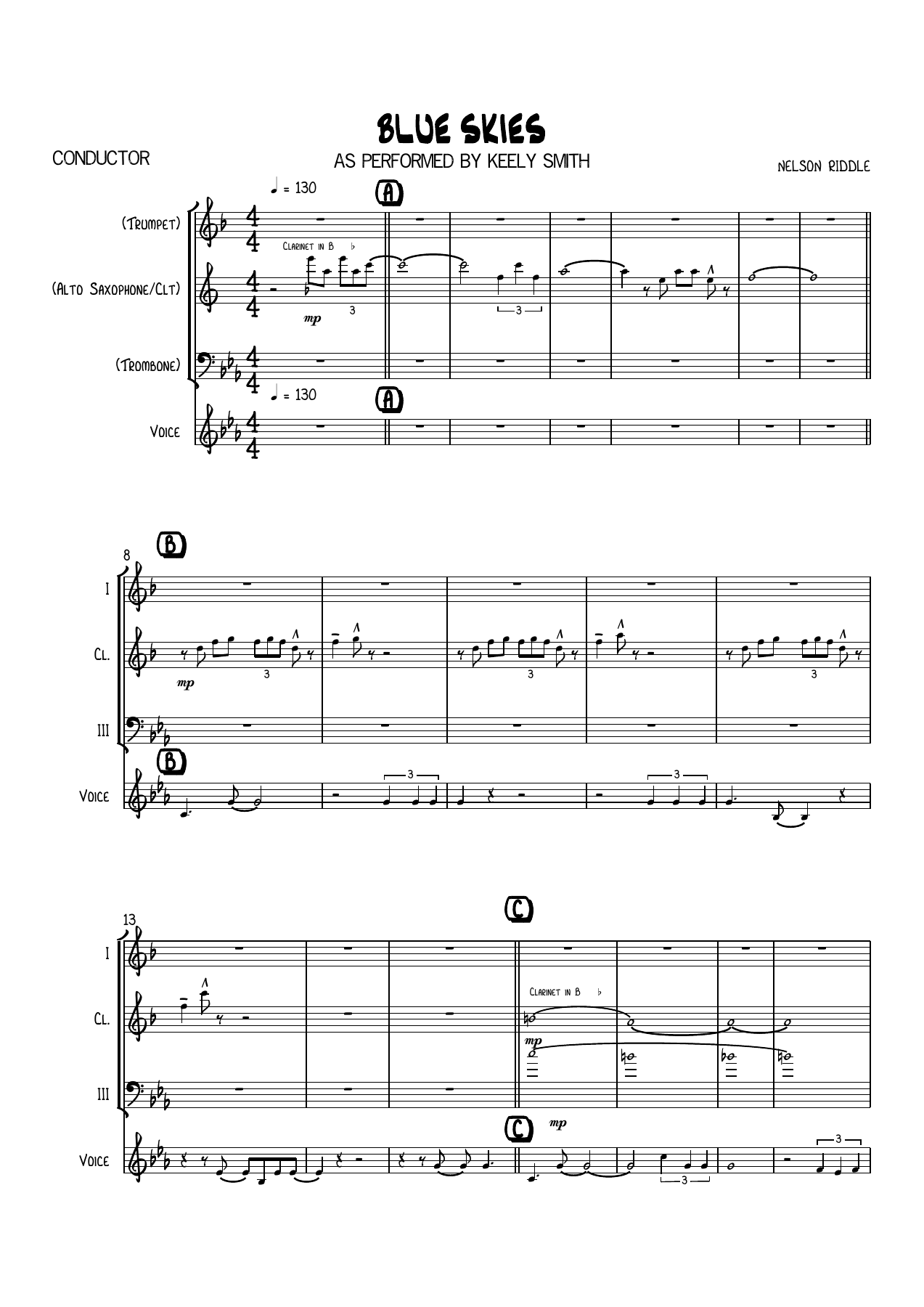
Blue Skies vocal Eb (K.Riddle)
Composed by Irving Berlin
Arranged by Keely Smith - Nelson Riddle
- Ensemble: Big Band Vocal
- Style: Jazz Standard
- Pages: 41
- Instruments (20): Conductor, Alto Saxophone 1, Clarinet in Bb, Alto Saxophone 2, Tenor Saxophone 1, Tenor Saxophone 2, Baritone Saxophone, Trumpet 1, Trumpet 2, Trumpet 3, Trumpet 4, Trombone 1, Trombone 2, Trombone 3, Bass Trombone, Piano, Bass, Guitar, Drums, Vocal
- Difficulty: medium
- Content: Individual Parts
- Format: PDF Download (Instant)
- Price: $24.99
Irving Berlin's iconic "Blue Skies," penned in 1926, stands as a timeless cornerstone of the Great American Songbook, having graced Broadway in *Betsy* and famously featured in the first full-length sound film, *The Jazz Singer*. This enduring standard quickly became a jazz staple, celebrated for its optimistic melody and versatile harmonic structure, lending itself to countless interpretations across various eras. Its simple yet profound message of hope and renewal has resonated with audiences for nearly a century, solidifying its place in the pantheon of popular music and making it a perennial favorite for vocalists and instrumentalists alike. This particular arrangement, "Blue Skies vocal Eb (K.Riddle)," presents a captivating medium-swing interpretation in the key of Eb, meticulously crafted in the signature style of the legendary Nelson Riddle, often associated with his work with Keely Smith. The mood is one of sophisticated exuberance, maintaining the original's bright outlook while infusing it with a classic, West Coast big band polish. The arrangement opens with a warm, inviting ensemble introduction, setting a comfortable medium-swing tempo in 4/4 time. Riddle’s genius for elegant voicings is immediately apparent, with rich saxophone pads and brass flourishes supporting the vocal line. The energy builds organically, peaking in a vibrant shout chorus that showcases the full power and precision of the big band. The arranger's approach is characterized by Nelson Riddle's hallmark blend of lush orchestration and rhythmic drive. Expect intricate yet highly playable soli sections for the saxophones, often featuring tight, harmonized lines that weave around the vocal. Brass figures are precise and impactful, employing tasteful plunger mute work in places to add texture and character. While the arrangement is primarily a feature for the vocalist, there are moments of instrumental brilliance, including a concise, swinging trombone solo that provides a contrasting texture before returning to the vocal. The chart masterfully navigates dynamic contrasts, from delicate ensemble support to powerful full-band statements, all designed to elevate the vocalist's performance. The melody is carried almost exclusively by the vocalist, allowing them to truly shine. Technical demands for the band are moderate to advanced, requiring strong section playing, precise articulation, and a solid understanding of swing rhythm. The brass sections will need good breath support and clean attacks, particularly in the more energetic shout sections. The rhythm section is tasked with maintaining a consistent, grooving medium-swing feel, providing a rock-solid foundation. Rewarding to perform, this arrangement offers a band the opportunity to explore the nuanced dynamics and sophisticated textures characteristic of mid-20th-century big band jazz, culminating in a powerful, uplifting final chorus and a classic big band ending. This chart is ideally suited for college-level ensembles, community bands with strong players, and professional groups seeking an authentic and highly polished rendition of this beloved standard. Conductors should emphasize a consistent, relaxed medium-swing feel from the rhythm section, avoiding any rushing. Articulation is key; ensure brass attacks are clean and precise, while saxophones maintain a smooth, connected legato in melodic passages and crisp staccatos in rhythmic figures. The trombone solo (or optional tenor sax solo) should be encouraged to be lyrical and bluesy, contrasting with the full ensemble. Pay close attention to dynamic markings, particularly the crescendos leading into the shout chorus, to build excitement effectively. Mute changes for brass must be executed cleanly and quickly. Rehearsal time should focus on balancing the ensemble behind the vocalist, ensuring the accompaniment supports without overpowering, and perfecting the tight ensemble voicings and cut-offs, especially in the final measures. Q: What instruments are included in this arrangement? A: This big band vocal arrangement typically includes parts for a lead vocalist, 5 saxophones (2 altos, 2 tenors, 1 baritone), 4 trumpets, 4 trombones, piano, bass, and drums. Q: What is the difficulty level of "Blue Skies vocal Eb (K.Riddle)"? A: This arrangement is considered medium-advanced, suitable for college-level jazz ensembles, skilled community bands, and professional groups due to its intricate voicings, dynamic demands, and precise ensemble playing requirements. Q: What is the musical style and historical context of this arrangement? A: This is a classic jazz standard arranged in a sophisticated, medium-swing big band style reminiscent of Nelson Riddle's work from the mid-20th century, embodying the elegance and polish of the Great American Songbook era. Q: What makes this specific arrangement unique compared to other versions of "Blue Skies"? A: This arrangement stands out due to Nelson Riddle's signature orchestration, featuring lush saxophone voicings, precise brass figures, a tasteful trombone solo, and dynamic contrasts that elevate the vocal performance with classic big band flair. Q: What is the typical performance duration and tempo for this piece? A: "Blue Skies vocal Eb (K.Riddle)" is typically performed at a medium-swing tempo, around 120-130 BPM, resulting in a performance duration of approximately 3 to 4 minutes, depending on the soloist's improvisation and any optional repeats.
Questions and answers
- What is included in the Blue Skies vocal Eb (K.Riddle) PDF?
- The verified current file contains a conductor score and individual parts across 41 pages.
- How many instruments or parts are listed for Blue Skies vocal Eb (K.Riddle)?
- The verified instrumentation list contains 20 entries for this Big Band Vocal arrangement.
- Who is credited for Blue Skies vocal Eb (K.Riddle)?
- Composer: Irving Berlin. Arranger: Keely Smith - Nelson Riddle.
- What difficulty is listed for Blue Skies vocal Eb (K.Riddle)?
- The verified difficulty level is medium.
- What style is listed for Blue Skies vocal Eb (K.Riddle)?
- The catalog lists the style as Jazz Standard.
- Can I preview Blue Skies vocal Eb (K.Riddle) before buying?
- Yes. The product page provides a preview generated from the current PDF file.
- How is Blue Skies vocal Eb (K.Riddle) delivered?
- After successful payment, the digital PDF is made available for download. The displayed price is $24.99.
Musicians Also Search For
Blue Skies vocal Eb Keely Smith - Nelson Riddle PDF • Blue Skies vocal Eb Keely Smith - Nelson Riddle sheet music • Blue Skies vocal Eb arranged by Keely Smith - Nelson Riddle • Keely Smith - Nelson Riddle big band vocal charts • Keely Smith - Nelson Riddle jazz arrangements PDF • Blue Skies vocal Eb Irving Berlin sheet music • Blue Skies vocal Eb Irving Berlin big band vocal arrangements • Irving Berlin big band vocal charts • Blue Skies vocal Eb big band vocal arrangements • Blue Skies vocal Eb big band vocal PDF download • Blue Skies vocal Eb jazz sheet music • big band vocal sheet music download • Blue Skies vocal Eb conductor score PDF • Blue Skies vocal Eb individual parts download • Blue Skies vocal Eb sheet music PDF • Blue Skies vocal Eb Jazz Standard charts • Jazz Standard big band vocal arrangements • buy Blue Skies vocal Eb sheet music • download Blue Skies vocal Eb PDF • Blue Skies vocal Eb jazz charts • best Keely Smith - Nelson Riddle big band vocal arrangements • Irving Berlin arranged by Keely Smith - Nelson Riddle • Blue Skies vocal Eb printable sheet music • big band vocal repertoire PDF