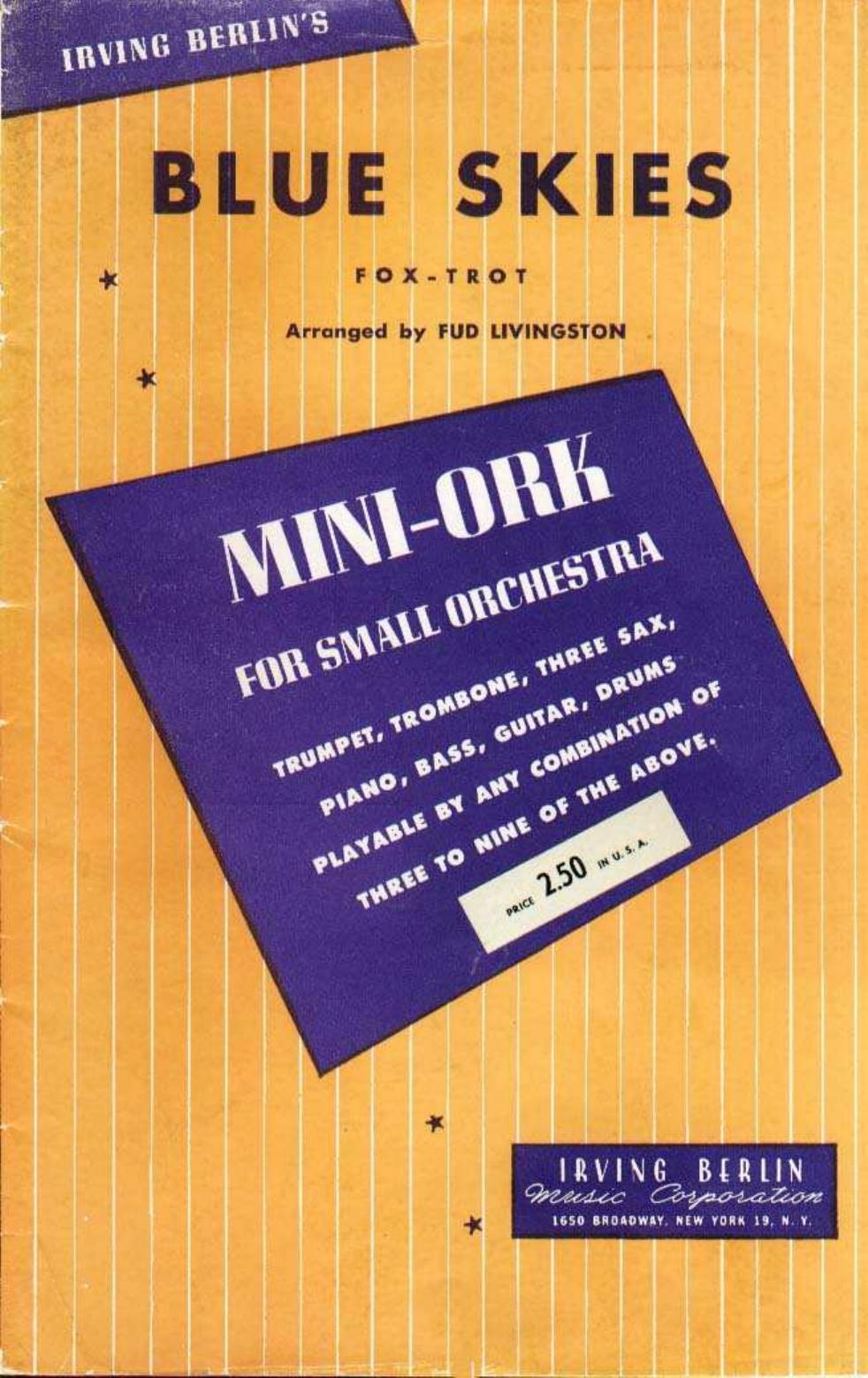
Blue Skies (F.Livingston)
Composed by Irving Berlin
Arranged by Fud Livingston
- Ensemble: Big Band
- Pages: 22
- Instruments (9): 1st Saxophone Eb Alto, 2nd Saxophone Bb Tenor, 3rd Saxophone Eb Alto, 1st Trombone, 1st Trumpet in Bb, Piano, Guitar, Bass, Drums
- Difficulty: medium
- Content: Individual Parts
- Format: PDF Download (Instant)
- Price: $24.99
Irving Berlin originally penned "Blue Skies" in 1926 for the Broadway musical *Rodgers and Hart’s Betsy*, though it quickly transcended the stage to become an indispensable pillar of the Great American Songbook. Immortalized early on by jazz icons like Benny Goodman, Ella Fitzgerald, and later reimagined in countless bebop and modal contexts, the tune's alternating minor-to-major harmonic structure provides an ideal vehicle for jazz interpretation. This classic big band iteration captures the effervescent spirit of the late 1920s and swing era transition, radiating an irrepressible optimism that contrasts sharply with the minor-key tension of its verse and the first half of its chorus. Driving forward with a bright, buoyant medium-up swing feel in 4/4 time, this arrangement radiates an infectious, high-octane energy. The harmonic landscape shifts masterfully between the brooding D minor intro/verse sections and the sweeping, triumphant release into F major for the chorus. Listeners will immediately recognize the breathless, kinetic momentum that defines vintage swing, evoking packed dance halls, smoky prohibition-era ballrooms, and the golden age of radio broadcast jazz. The mood is simultaneously nostalgic and exhilarating, demanding immaculate time-feel and rhythmic precision from the entire ensemble. Fud Livingston, a legendary arranger and multi-instrumentalist celebrated for his ingenious work with the transitional big bands of the late 1920s and 1930s, brings his signature ear for dense, harmonically colorful voicings to this score. Rather than relying on a massive 17-piece modern instrumentation, Livingston crafts a brilliantly balanced texture utilizing an 8-instrument core (including Alto Saxophone, Tenor Saxophone, Trumpet, Trombone, and Piano rhythm section). His writing exploits the unique timbral blend of this compact horn section, employing tight, harmonized ensemble solis and clever counterpoint that sound remarkably full, mimicking the impact of a much larger orchestra without sacrificing transparency or agility. Throughout the 22 pages of score and parts, the melodic weight is shared fluidly between the trumpet and saxophone sections, punctuated by punchy, syncopated trombone interjections. Improvisational opportunities are integrated seamlessly into the form, allowing featured soloists on tenor sax or piano to stretch out over changes that brilliantly bridge early jazz vernacular with swing era sophistication. Technical challenges lie primarily in maintaining a light, articulate swing eighth-note feel at brisk tempos, as well as executing Livingston’s intricate secondary dominants and tight voice-leading. Advanced high school ensembles, collegiate jazz bands, and professional repertory groups will find this arrangement an exceptionally rewarding addition to their libraries. Because of its specialized 8-instrument scoring, it serves as an ideal showcase for smaller big bands or diminished horn sections seeking authentic vintage repertoire that packs the contrapuntal punch of a full-scale historical transcription. Success with this Fud Livingston chart hinges on achieving an authentic 1920s-to-30s swing feel, characterized by a lighter, more transparent rhythmic approach than post-war big band styles. The tempo should remain brisk and driving, but never rushed; aim for a sparkling, danceable pulse rather than an aggressive bebop burn. Horn players must pay strict attention to articulation markings, keeping short notes crisp and utilizing natural tongue-releases on upbeats to preserve the buoyant rhythmic momentum. The rhythm section is the engine: the piano should comp with sparse, buoyant Charleston-style or four-to-the-bar voicings that do not crowd the horns, while the bass and drums lock into a steady, unforced acoustic swing groove. Balance is paramount; because this is an 8-instrument arrangement, inner-voice blend within the sax and brass solis dictates the overall success of the dynamic contour. Rehearsal should begin slowly, isolating the countermelodies to ensure every player hears how their individual line fits into Livingston's intricate harmonic web before bringing the chart up to performance speed. Q: What instruments and parts are included in this arrangement? A: This arrangement is scored for an 8-instrument ensemble comprising Alto Saxophone, Tenor Saxophone, Trumpet, Trombone, Piano, and rhythm section support across 22 total pages of music. Q: What is the difficulty level of this Fud Livingston chart? A: It is best suited for advanced high school, collegiate, and professional musicians who possess strong sight-reading skills, solid ensemble intonation, and fluency with swing-era stylistic articulations at brisk tempos. Q: What is the style and historical context of the music? A: The piece is a classic jazz big band arrangement written in the late 1920s/early swing style, transforming Irving Berlin’s 1926 Tin Pan Alley standard into a vehicle for vintage jazz ensemble brilliance. Q: What makes this specific arrangement unique? A: Fud Livingston’s brilliant 8-instrument voicing creates the sonic illusion and rich harmonic depth of a much larger big band while maintaining chamber-like transparency and intricate counterpoint. Q: What is the recommended performance tempo and duration? A: The arrangement is designed for a bright, energetic medium-up swing tempo (approximately quarter note = 200–220 BPM), yielding a performance duration of roughly 3 to 4 minutes depending on solo choruses.
Questions and answers
- What is included in the Blue Skies (F.Livingston) PDF?
- The verified current file contains individual parts across 22 pages.
- How many instruments or parts are listed for Blue Skies (F.Livingston)?
- The verified instrumentation list contains 9 entries for this Big Band arrangement.
- Who is credited for Blue Skies (F.Livingston)?
- Composer: Irving Berlin. Arranger: Fud Livingston.
- What difficulty is listed for Blue Skies (F.Livingston)?
- The verified difficulty level is medium.
- Can I preview Blue Skies (F.Livingston) before buying?
- Yes. The product page provides a preview generated from the current PDF file.
- How is Blue Skies (F.Livingston) delivered?
- After successful payment, the digital PDF is made available for download. The displayed price is $24.99.
Musicians Also Search For
Blue Skies Fud Livingston PDF • Blue Skies Fud Livingston sheet music • Blue Skies arranged by Fud Livingston • Fud Livingston big band charts • Fud Livingston jazz arrangements PDF • Blue Skies Irving Berlin sheet music • Blue Skies Irving Berlin big band arrangements • Irving Berlin big band charts • Blue Skies big band arrangements • Blue Skies big band PDF download • Blue Skies jazz sheet music • big band sheet music download • Blue Skies individual parts download • Blue Skies sheet music PDF • buy Blue Skies sheet music • download Blue Skies PDF • Blue Skies jazz charts • best Fud Livingston big band arrangements • Irving Berlin arranged by Fud Livingston • Blue Skies printable sheet music • big band repertoire PDF