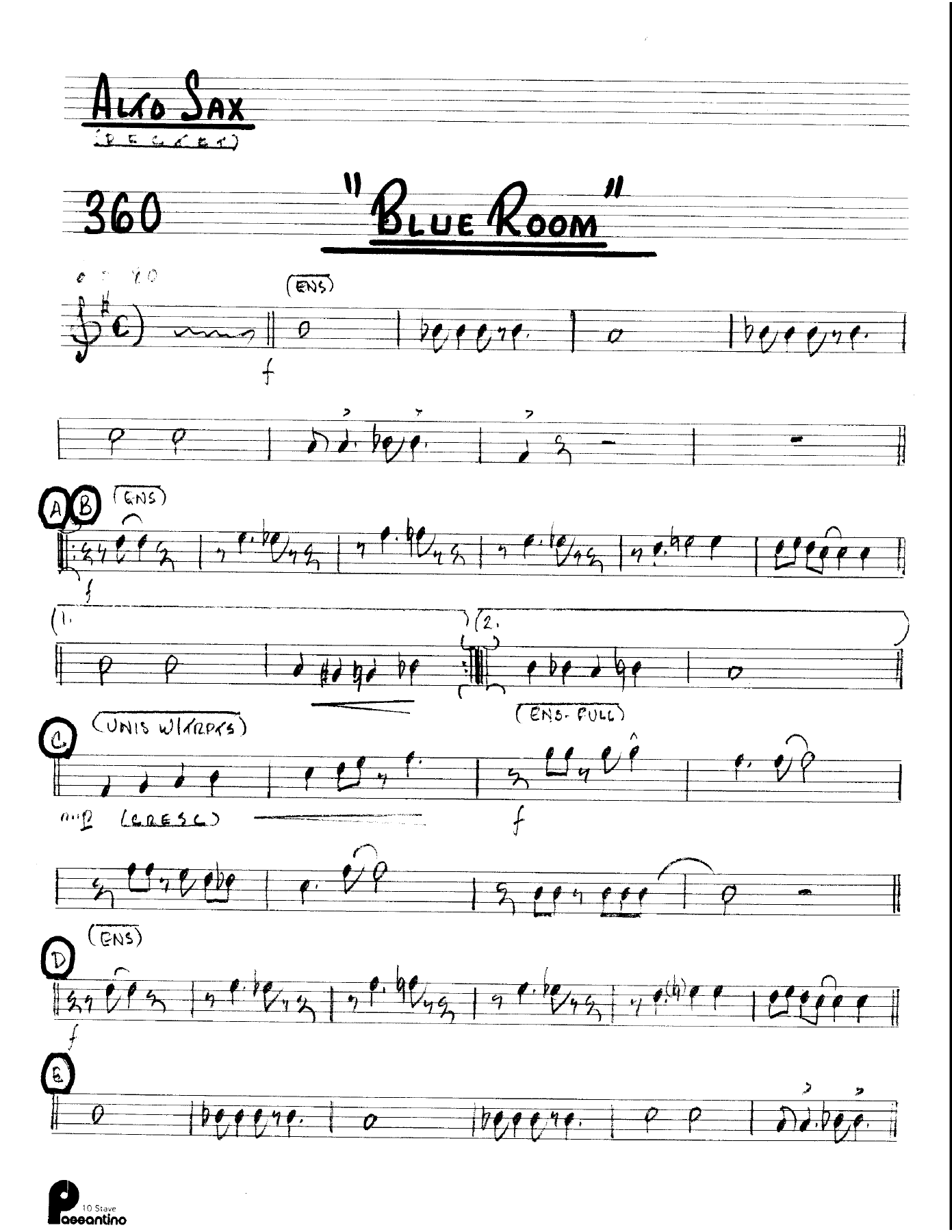
Blue Room (Kenton Dectet #360)
Composed by Richard Rodgers
Arranged by Stan Kenton Dected 176
- Ensemble: Small Ensemble
- Style: Jazz Standard
- Pages: 26
- Instruments (9): Alto Sax, Tenor Sax, Baritone Sax, Trumpet 1, Trumpet 2, Trombone, Piano, Bass, Drums
- Difficulty: easy
- Content: Individual Parts
- Format: PDF Download (Instant)
- Price: $12.99
Richard Rodgers' timeless melody, "Blue Room," first enchanted audiences in the 1926 Broadway musical *The Girl Friend*, where it was introduced by Eva Puck and Sammy White. This enduring show tune, with lyrics by Lorenz Hart, quickly transcended its theatrical origins to become a foundational piece of the Great American Songbook and a beloved jazz standard. Its simple yet elegant 32-bar AABA form, combined with a memorable, singable melody and a compact harmonic structure, made it ripe for jazz interpretation. The song evokes a romantic, intimate mood, describing a dream of shared domestic bliss in a cozy "blue room." Over the decades, it has been famously recorded by a diverse array of artists, from early big bands like the Dorsey Brothers Orchestra to jazz legends such as Ella Fitzgerald, Miles Davis, and Chet Baker, solidifying its place in the jazz canon. This arrangement of "Blue Room" by the Stan Kenton Dectet (catalog #360) presents the classic standard in a sophisticated, medium swing feel, typically set in the key of F major, though Kenton's arrangements often explore rich harmonic extensions. The musical character is one of understated elegance, imbued with the distinctive Kenton sound even within a smaller ensemble context. While Kenton's larger orchestras were known for their "bombastic, dissonant, and aggressive" qualities, his dectet arrangements often showcase a more nuanced approach, emphasizing intricate voicings and melodic interplay. The mood is generally warm and inviting, perfect for setting a refined atmosphere, yet it retains a subtle underlying energy that propels the swing. Stan Kenton's approach to small ensemble arranging, particularly for his dectets, is characterized by his innovative use of instrumentation and complex harmonic structures. For "Blue Room," expect meticulously crafted voicings that create a full, rich sound despite the reduced instrumentation, often featuring close-knit brass and saxophone sections. Kenton was known for his "layering techniques," where different sections play complementary melodic lines, building a complex sonic tapestry. The melody is typically carried by various lead voices, often trading between the trumpet and saxophone, with a strong emphasis on ensemble soli sections that highlight the dectet's blend and precision. Featured solo opportunities are likely to be present, providing space for improvisation over the song's familiar changes. The arrangement's reward lies in its sophisticated harmonic language and the challenge of achieving a cohesive, polished ensemble sound that captures Kenton's signature style in a more intimate setting. This arrangement is ideally suited for college or advanced high school jazz ensembles, as well as community and professional small jazz groups. The technical demands, while not extreme, require a solid grasp of jazz articulation, blend, and intonation, particularly in the tightly voiced ensemble passages. Musicians will find it rewarding to delve into the harmonic depth and the interplay between parts, developing a keen sense of ensemble listening. The arrangement offers an excellent opportunity to explore the nuances of a classic jazz standard through the lens of one of jazz's most influential and progressive arrangers. To achieve the characteristic Stan Kenton Dectet sound in "Blue Room," focus on precise articulation and dynamic contrast. The medium swing tempo should be maintained with a relaxed yet driving feel, emphasizing a subtle forward momentum rather than a rushed pace. Pay close attention to the balance within the ensemble soli sections; Kenton's voicings are dense and require each voice to be heard clearly without overpowering others. Key technical challenges include navigating the extended harmonies and maintaining consistent intonation within the close voicings. Rehearse these passages slowly, ensuring each player understands their role in the chord. Brass players should aim for a warm, controlled tone, while saxophones should blend seamlessly. If plunger mutes are indicated, practice their precise application for consistent tone and pitch. Emphasize a collective understanding of the melodic contour and emotional arc of the piece, allowing the romantic character of the original song to shine through Kenton's sophisticated arrangement. **Q: What instruments and parts are included in this arrangement?** A: This Stan Kenton Dectet arrangement of "Blue Room" includes parts for a small ensemble, typically consisting of three saxophones (alto, tenor, baritone), three trumpets, one trombone, and a rhythm section (piano, bass, drums). **Q: What is the difficulty level of this arrangement?** A: This arrangement is considered appropriate for college and advanced high school jazz ensembles, as well as proficient community and professional small groups. It requires solid technical skills, advanced harmonic understanding, and a developed sense of jazz ensemble playing. **Q: What is the historical context and musical style of "Blue Room"?** A: "Blue Room" is a jazz standard composed by Richard Rodgers in 1926 for the musical *The Girl Friend*. It embodies the elegant, romantic show tune style of the 1920s, adapted here into a sophisticated medium swing jazz arrangement. **Q: What makes this Stan Kenton Dectet arrangement unique?** A: This arrangement stands out due to Stan Kenton's distinctive harmonic language and layering techniques, applying his signature "progressive jazz" sound to a small ensemble. It features intricate voicings, ensemble soli sections, and a refined yet swinging interpretation of the classic standard. **Q: What is the typical performance duration or tempo for this piece?** A: "Blue Room" is arranged as a medium swing, allowing for a comfortable, unhurried tempo that highlights its melodic and harmonic richness. The exact performance duration will vary slightly with interpretation and the length of improvised solos, but typically falls within the 3-5 minute range.
Questions and answers
- What is included in the Blue Room (Kenton Dectet #360) PDF?
- The verified current file contains individual parts across 26 pages.
- How many instruments or parts are listed for Blue Room (Kenton Dectet #360)?
- The verified instrumentation list contains 9 entries for this Small Ensemble arrangement.
- Who is credited for Blue Room (Kenton Dectet #360)?
- Composer: Richard Rodgers. Arranger: Stan Kenton Dected 176.
- What difficulty is listed for Blue Room (Kenton Dectet #360)?
- The verified difficulty level is easy.
- What style is listed for Blue Room (Kenton Dectet #360)?
- The catalog lists the style as Jazz Standard.
- Can I preview Blue Room (Kenton Dectet #360) before buying?
- Yes. The product page provides a preview generated from the current PDF file.
- How is Blue Room (Kenton Dectet #360) delivered?
- After successful payment, the digital PDF is made available for download. The displayed price is $12.99.
Musicians Also Search For
Blue Room Stan Kenton Dected 176 PDF • Blue Room Stan Kenton Dected 176 sheet music • Blue Room arranged by Stan Kenton Dected 176 • Stan Kenton Dected 176 small ensemble charts • Stan Kenton Dected 176 jazz arrangements PDF • Blue Room Richard Rodgers sheet music • Blue Room Richard Rodgers small ensemble arrangements • Richard Rodgers small ensemble charts • Blue Room small ensemble arrangements • Blue Room small ensemble PDF download • Blue Room jazz sheet music • small ensemble sheet music download • Blue Room individual parts download • Blue Room sheet music PDF • Blue Room Jazz Standard charts • Jazz Standard small ensemble arrangements • buy Blue Room sheet music • download Blue Room PDF • Blue Room jazz charts • best Stan Kenton Dected 176 small ensemble arrangements • Richard Rodgers arranged by Stan Kenton Dected 176 • Blue Room printable sheet music • small ensemble repertoire PDF