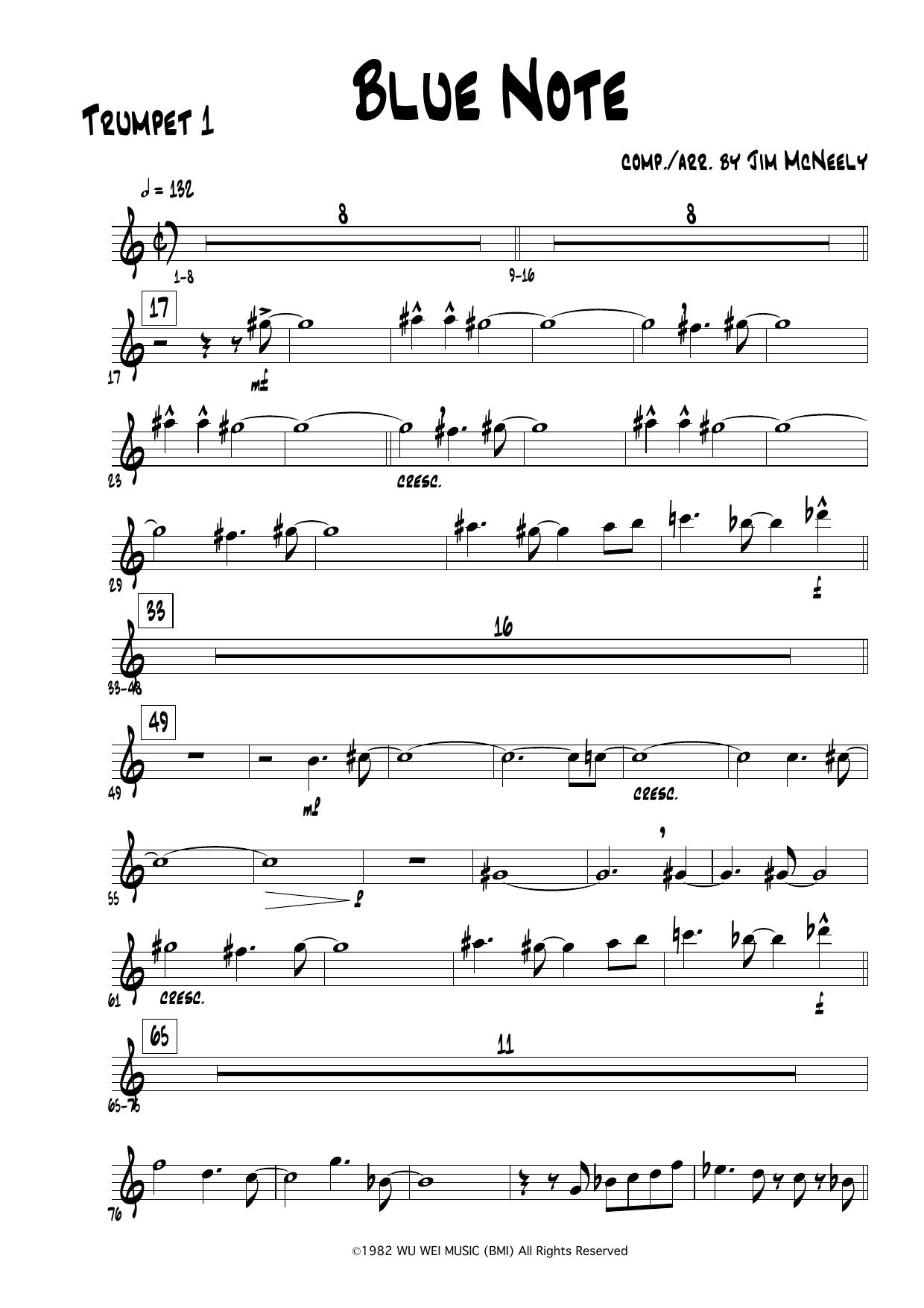
Blue Note (J.McNeeley) sheet music preview

Blue Note (J.McNeeley)

Composed by Jim McNeely

Arranged by Jim McNeely

  • Ensemble: Big Band
  • Pages: 222
  • Instruments (18): Trumpet 1, Trumpet 2, Trumpet 3, Trumpet 4, Opt. Trumpet 5 (F. Hn.), Trombone 1, Trombone 2, Trombone 3, Trombone 4, Reed 1 (Flute/Soprano/Alto), Reed 2 (Flute/Soprano), Reed 3 (Tenor), Reed 4 (Clarinet/Tenor), Reed 5 (Opt. Baritone), Reed 5 (Bass Clarinet/Baritone), Bass, Drums, Piano
  • Difficulty: advanced
  • Content: Individual Parts
  • Format: PDF Download (Instant)
  • Price: $24.99

Master composer and arranger Jim McNeely has long stood as a titan of modern big band writing, known for his sophisticated harmonic palette and intricate textural interplay. "Blue Note," originating from McNeely's acclaimed catalog of contemporary large ensemble works, embodies the pinnacle of post-bop big band sophistication. Written during an era where modern jazz composition pushed beyond traditional boundaries into modal exploration and advanced chromaticism, this piece reflects McNeely's deep roots in the tradition while showcasing his forward-thinking architectural approach to ensemble writing. It serves as a benchmark for contemporary jazz composition, frequently studied in academic circles and performed by elite professional and collegiate repertory orchestras worldwide. Driven by a sophisticated, pulsing medium-up swing feel in 4/4 time, "Blue Note" establishes an atmosphere of intellectual intensity balanced by an irrepressible rhythmic momentum. The mood is taut, urban, and sophisticated, evoking the smoky ambiance of classic modern jazz clubs while demanding absolute precision. McNeely constructs the piece around shifting tonal centers and dense, cascading chord structures that move fluidly between angular bebop-inflected lines and lush, impressionistic chord clusters. The harmonic language relies heavily on extended and altered dominants, creating an underlying tension that resolves in surprising yet deeply satisfying ways, keeping both performers and listeners thoroughly engaged from the first downbeat. McNeely's distinctive arranging approach shines through the meticulous voice-leading and multi-layered sectional writing. Rather than relying on standard block voicings, he utilizes a horizontal writing style where inner voices move independently, creating rich counterpoint between the brass and saxophones. The arrangement features sophisticated soli sections that test the articulation and intonation of the horn sections, alongside a dynamic, meticulously structured shout chorus that builds organically through rhythmic displacement and rising harmonic plateaus. The melody is shared fluidly across sections, often introduced by the saxophones before being punctuated by aggressive, brass-heavy interjections that highlight McNeely's genius for orchestral color and dynamic contrast. Improvisation is a central pillar of the chart, providing designated solo space over sophisticated harmonic changes that challenge advanced soloists to stretch their improvisational vocabulary. Technically demanding throughout, the chart requires exceptional control of dynamic shading, flawless section blend, and complete rhythmic mastery of syncopated figures crossing the bar line. Because of its demanding harmonic requirements, intricate rhythmic unisons, and sophisticated stylistic nuances, "Blue Note" is ideally suited for advanced collegiate jazz ensembles, top-tier high school honor bands, and professional or community big bands looking to elevate their repertoire with a masterclass in modern jazz orchestration. Navigating Jim McNeely’s "Blue Note" requires meticulous attention to articulation, balance, and rhythmic precision. The tempo must remain steady and driving; avoid rushing the medium-up swing feel, as the complex inner voicings rely on a relaxed yet authoritative pulse to speak clearly. The primary technical challenge lies in the execution of tight, highly syncopated unison lines between the saxophones and brass. Conductors should rehearse these passages slowly at first, ensuring that all players match each other's articulation—particularly regarding short, accented notes and subtle bebop phrasing. Pay close attention to dynamic markings; McNeely’s writing depends heavily on sudden sub-ito dynamics and careful layering to bring out countermelodies buried in the inner voices. Section leaders must enforce a unified concept of intonation, especially on the altered chord extensions common in modern big band charts. Horn players should balance their volume carefully against the rhythm section, ensuring that piano and guitar voicings—which often double or color the ensemble harmonies—remain distinct without cluttering the texture. Q: What instruments and parts are included in this arrangement? A: This arrangement is scored for a standard 18-instrument big band instrumentation, featuring 4 trumpets (with an optional 5th trumpet or French horn part), 4 trombones, 5 saxophones (typically AATTB), and a full rhythm section of piano, bass, and drums, along with a comprehensive conductor score. Q: What is the difficulty level of this arrangement? A: This piece is rated as advanced, making it best suited for collegiate jazz ensembles, professional big bands, and elite high school groups with strong improvisers and mature section players. Q: What is the musical style and historical context of "Blue Note"? A: Composed in the contemporary post-bop idiom by Jim McNeely, the piece represents the pinnacle of modern big band writing, bridging traditional swinging jazz momentum with advanced 20th-century harmonic concepts. Q: What makes this Jim McNeely arrangement unique? A: It features McNeely's signature horizontal voice-leading, independent inner-voice movement, and dense chromatic textures that replace standard block voicings with rich, impressionistic counterpoint. Q: What is the performance duration and tempo feel of the piece? A: The arrangement is built around a driving, sophisticated medium-up swing feel in 4/4 time, with a typical performance duration ranging between 6 to 7 minutes depending on solo lengths.

Questions and answers

What is included in the Blue Note (J.McNeeley) PDF?
The verified current file contains a conductor score and individual parts across 222 pages.
How many instruments or parts are listed for Blue Note (J.McNeeley)?
The verified instrumentation list contains 18 entries for this Big Band arrangement.
Who is credited for Blue Note (J.McNeeley)?
Composer: Jim McNeely. Arranger: Jim McNeely.
What difficulty is listed for Blue Note (J.McNeeley)?
The verified difficulty level is advanced.
Can I preview Blue Note (J.McNeeley) before buying?
Yes. The product page provides a preview generated from the current PDF file.
How is Blue Note (J.McNeeley) delivered?
After successful payment, the digital PDF is made available for download. The displayed price is $24.99.

Musicians Also Search For

Blue Note Jim McNeely PDFBlue Note Jim McNeely sheet musicBlue Note arranged by Jim McNeelyJim McNeely big band chartsJim McNeely jazz arrangements PDFBlue Note Jim McNeely big band arrangementsBlue Note big band arrangementsBlue Note big band PDF downloadBlue Note jazz sheet musicbig band sheet music downloadBlue Note conductor score PDFBlue Note individual parts downloadBlue Note sheet music PDFbuy Blue Note sheet musicdownload Blue Note PDFBlue Note jazz chartsbest Jim McNeely big band arrangementsBlue Note printable sheet musicbig band repertoire PDF

All arrangements by Jim McNeely All Jim McNeely sheet music