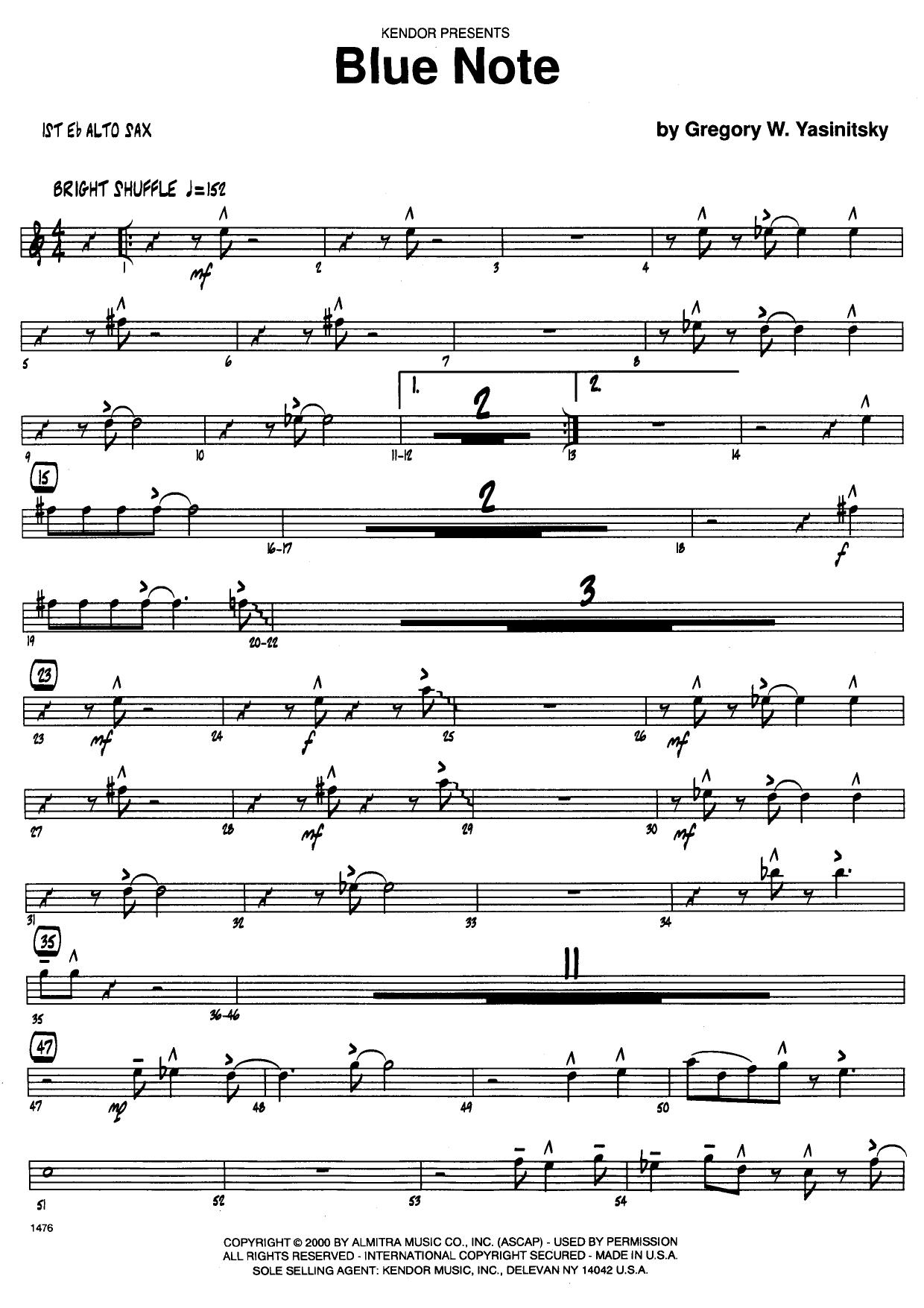
Blue Note (G.Yasinitsky)
Composed by Gregory Yasinitsky
Arranged by Gregory Yasinitsky
- Ensemble: Big Band
- Pages: 76
- Instruments (18): 1st Eb Alto Sax, 2nd Eb Alto Sax, 1st Bb Tenor Sax, 2nd Bb Tenor Sax, Eb Baritone Sax, 1st Bb Trumpet, 2nd Bb Trumpet, 3rd Bb Trumpet, 4th Bb Trumpet, 5th Bb Trumpet (Optional), 1st Trombone, 2nd Trombone, 3rd Trombone, 4th Trombone (Bass), Guitar, Piano, Bass, Drums
- Difficulty: advanced
- Content: Individual Parts
- Format: PDF Download (Instant)
- Price: $24.99
Composed and arranged by renowned saxophonist, composer, and Regents Professor Emeritus at Washington State University Gregory Yasinitsky, "Blue Note" stands as a quintessential modern contribution to the contemporary big band repertoire. Capturing the sophisticated, driving aesthetic associated with the legendary Blue Note Records label of the 1960s, this original composition bridges the gap between hard bop urgency and contemporary modal jazz accessibility. Yasinitsky, celebrated worldwide for his prolific output of engaging, pedagogically sound, and harmonically rich jazz ensemble literature, crafted this work to showcase the power and nuance of a full 18-piece jazz orchestra while maintaining an undeniable groove that instantly connects with audiences. Driven by an infectious, energetic medium-tempo swing feel in 4/4 time, "Blue Note" exudes a confident, street-smart attitude characterized by blues-infused motifs and sophisticated chromatic harmonies. The piece opens with a punchy, declarative brass figure that immediately sets a sleek, nocturnal mood before launching into a compelling head statement. Yasinitsky’s compositional approach utilizes dense, modern voicings for the saxophones and brass, punctuated by crisp rhythmic hits from the rhythm section. Throughout the arrangement, the melodic weight shifts dynamically between soaring brass counterlines and lush, harmonically rich saxophone solis that demand precision and blend. A standout feature of this arrangement is its brilliant structural arc, which builds tension through clever developmental sections before culminating in a high-octane shout chorus. This climactic section stretches the ensemble’s dynamic range and articulative discipline, requiring tight ensemble integration, especially in the section figures and stylistic syncopations. Solo opportunities are provided for featured improvisers—typically adaptable for alto saxophone and piano—allowing soloists to stretch out over accessible yet stimulating chord changes that evoke the classic post-bop era. The arrangement balances sophisticated harmonic extensions with clear, transparent scoring that ensures every voice cuts through the mix without muddying the texture. Advanced high school, collegiate, and professional community big bands will find "Blue Note" to be an ideal centerpiece for festival programs, formal concerts, or recorded projects. The 76-page publication includes a comprehensive conductor score and all necessary instrumental parts for an 18-piece big band configuration. Because of its idiomatic writing and careful attention to register and endurance, it provides a rewarding challenge that refines an ensemble's swing feel, section blend, and stylistic execution while remaining thoroughly exhilarating to perform from downbeat to final chord. Succeeding with "Blue Note" requires meticulous attention to articulation, particularly regarding the crisp execution of swing eighth notes at a driving medium tempo. The rhythm section acts as the engine; the drummer should maintain a steady, propulsive ride cymbal pattern with a strong, interactive hi-hat on beats two and four, while the bassist locks in with a walking line that emphasizes the forward momentum without rushing. Brass players must execute short notes with authority, utilizing a clean "dah" or "dit" tongue placement, while longer notes should feature a warm, controlled vibrato typical of classic 1960s big band recordings. Directors should spend initial rehearsals focusing exclusively on the balance of the saxophone soli, ensuring the inner voices project clearly beneath the lead alto. Pay close attention to dynamic contrast; the transition from the roaring shout chorus back to the understated recap requires strict dynamic discipline to maximize emotional impact. Q: What instruments and parts are included in this publication? A: The 76-page publication includes a full conductor score and complete instrumental parts for an 18-piece big band, featuring standard configurations for five saxophones (Alto 1-2, Tenor 1-2, Baritone), four trumpets, four trombones, and a full rhythm section of piano, guitar, bass, and drums. Q: What is the difficulty level of this arrangement? A: This piece is graded as advanced-intermediate to advanced, making it ideally suited for skilled high school jazz ensembles, collegiate bands, and professional community big bands looking for post-bop repertoire. Q: What is the musical style and historical context of "Blue Note"? A: Written by Gregory Yasinitsky, the piece is styled in the tradition of 1960s hard bop and modal jazz associated with the legendary Blue Note Records label, emphasizing a sophisticated blues-inflected groove and modern harmonic language. Q: What makes this specific arrangement unique? A: Yasinitsky’s writing stands out for its masterful balance of dense, contemporary harmonic voicings with transparent scoring, featuring a driving groove, lush saxophone solis, and a powerful, high-energy shout chorus. Q: What is the performance duration and tempo feel of the piece? A: "Blue Note" is designed with an energetic medium-swing tempo feel in 4/4 time, yielding a performance duration of approximately 4 to 5 minutes depending on the length of the improvised solos.
Questions and answers
- What is included in the Blue Note (G.Yasinitsky) PDF?
- The verified current file contains a conductor score and individual parts across 76 pages.
- How many instruments or parts are listed for Blue Note (G.Yasinitsky)?
- The verified instrumentation list contains 18 entries for this Big Band arrangement.
- Who is credited for Blue Note (G.Yasinitsky)?
- Composer: Gregory Yasinitsky. Arranger: Gregory Yasinitsky.
- What difficulty is listed for Blue Note (G.Yasinitsky)?
- The verified difficulty level is advanced.
- Can I preview Blue Note (G.Yasinitsky) before buying?
- Yes. The product page provides a preview generated from the current PDF file.
- How is Blue Note (G.Yasinitsky) delivered?
- After successful payment, the digital PDF is made available for download. The displayed price is $24.99.
Musicians Also Search For
Blue Note Gregory Yasinitsky PDF • Blue Note Gregory Yasinitsky sheet music • Blue Note arranged by Gregory Yasinitsky • Gregory Yasinitsky big band charts • Gregory Yasinitsky jazz arrangements PDF • Blue Note Gregory Yasinitsky big band arrangements • Blue Note big band arrangements • Blue Note big band PDF download • Blue Note jazz sheet music • big band sheet music download • Blue Note conductor score PDF • Blue Note individual parts download • Blue Note sheet music PDF • buy Blue Note sheet music • download Blue Note PDF • Blue Note jazz charts • best Gregory Yasinitsky big band arrangements • Blue Note printable sheet music • big band repertoire PDF