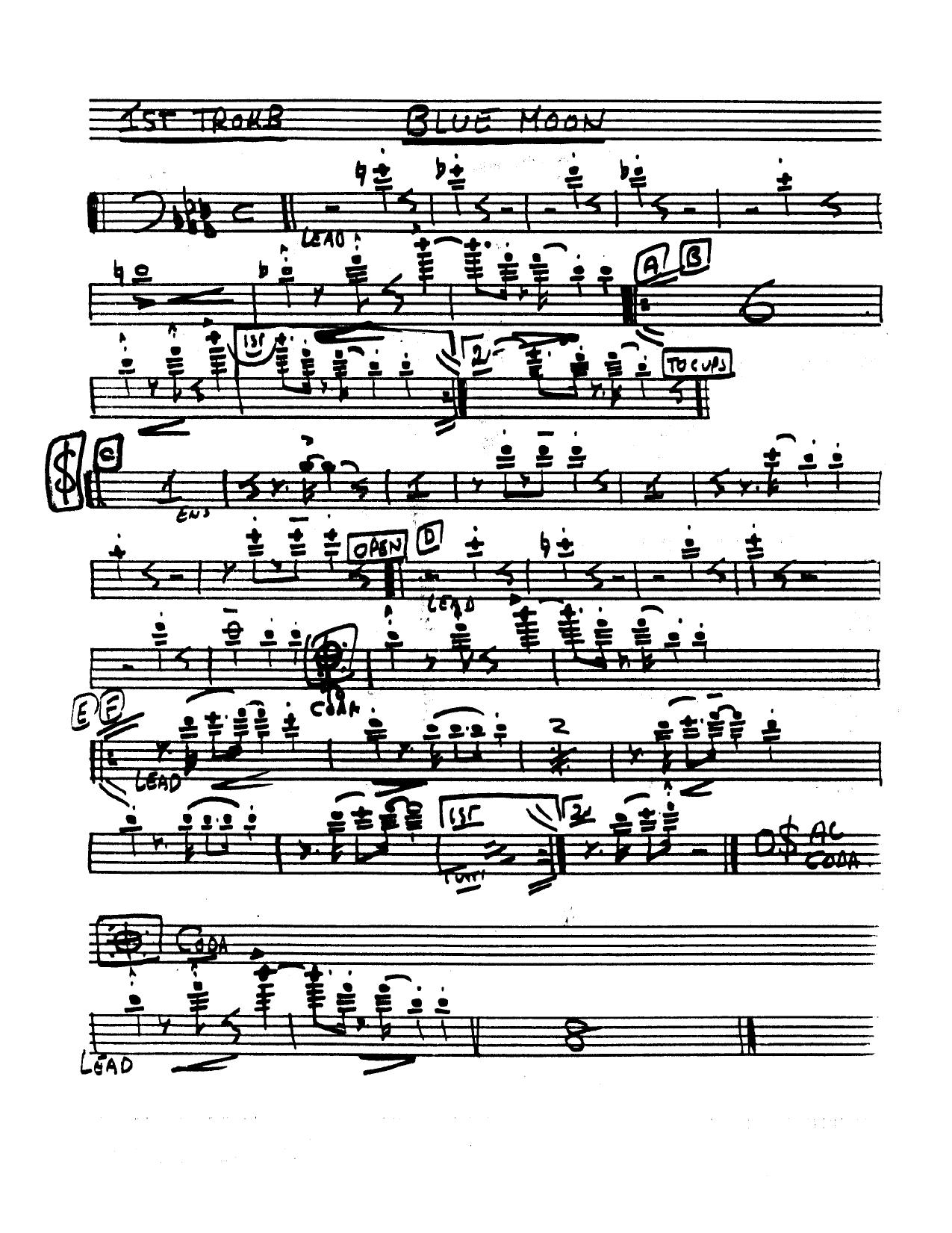
Blue Moon (J.Farley)
Composed by Richard Rodgers
Arranged by John Farley
- Ensemble: Big Band
- Pages: 18
- Instruments (17): 1st Trombone, 2nd Trombone, 3rd Trombone, 4th Trombone, 1st Trumpet, 2nd Trumpet, 3rd Trumpet, 4th Trumpet, Vocal, 1st Alto Saxophone, 2nd Alto Saxophone, Baritone Saxophone, Bass, Drums, Piano, 1st Tenor Saxophone, 2nd Tenor Saxophone
- Difficulty: easy
- Content: Individual Parts
- Format: PDF Download (Instant)
- Price: $24.99
Richard Rodgers and Lorenz Hart crafted one of the most enduring jewels of the Great American Songbook when they penned "Blue Moon" in 1934. Originally conceived for Hollywood before becoming a staple of Tin Pan Alley, the tune achieved immortal status through countless jazz interpretations, most notably Billie Holiday’s poignant 1935 recording and Mel Tormé’s silky vocal treatments, later pivoting into an upbeat pop-jazz crossover by The Marcels. As a jazz standard, its underlying AABA form and sophisticated harmonic progression have invited endless reharmonization, making it a canvas for arrangers seeking to balance nostalgic melancholy with modern harmonic sophistication. John Farley’s big band setting approaches this classic with a sophisticated, late-night atmospheric feel, anchored in a lush, medium-slow swing tempo (approx. 104 BPM). Eschewing a purely predictable ballad format, Farley infuses the chart with a rich, cinematic mood characterized by cascading saxophone solis, velvety muted brass counterlines, and a lingering, contemplative energy. The emotional landscape shifts gracefully from introspective vulnerability to moments of warm, full-ensemble triumph, evoking the ambiance of a dimly lit, smoke-filled jazz club in the small hours of the morning. Farley’s distinctive arranging voice shines through his meticulous attention to extended tertian harmonies and chromatic voice leading within the reed section. Rather than relying on standard block voicing, the arrangement utilizes contemporary cluster-adjacent voicings in the brass that give the harmonic backdrop a modern, sophisticated edge reminiscent of the Thad Jones or Bob Brookmeyer schools. A gorgeously sculpted soli section for the saxophones serves as the emotional core of the chart, seamlessly handing off melodic responsibilities to a soaring trumpet lead before building organically into a restrained, tasteful shout chorus that prioritizes dynamic nuance over sheer volume. Designed with advanced high school, collegiate, and professional community big bands in mind, this 18-page chart requires a mature ensemble capable of blending, intonation control, and subtle rubato-esque phrasing within a strict tempo framework. The lead trumpet player will need a secure upper register for occasional climactic high notes, while the rhythm section—particularly the pianist—must possess a strong grasp of comping with ninth and thirteenth chord voicings. Offering a rewarding balance of accessible melodic familiarity and sophisticated harmonic challenges, Farley’s "Blue Moon" stands out as a standout program centerpiece that will captivate sophisticated jazz audiences from the opening chord to the final fading cadence. Balancing the delicate emotional core of this arrangement with its lush harmonic textures requires rigorous attention to blend and intonation across all sections. The tempo should remain steady at a relaxed medium swing (around quarter note = 104), avoiding any tendency to drag during the rubato-leaning transitions. The brass section should utilize cup mutes or harmon mutes (stem out) where indicated to achieve the desired intimate, smoky timbre during the head statements, ensuring that the muted passages never mask the underlying tenor saxophone countermelodies. Pay close attention to dynamic markings: the chart relies heavily on sub-ito pianos and gradual swells to create its cinematic depth. Rehearsal should begin by isolating the saxophone soli, ensuring uniform articulation and tight stylistic phrasing before integrating the rhythm section. Pianists and guitarists must keep their comping sparse and transparent, allowing the rich chord extensions to breathe without cluttering the harmonic space. Finally, work carefully on the transition into the shout chorus, ensuring the ensemble builds organically rather than forcing the volume too early. Q: What instruments and parts are included in this big band arrangement? A: The 18-page score and set of parts feature a standard 17-instrument big band instrumentation, including a full reed section (alto, tenor, and baritone saxophones), trumpets 1 through 4, trombones 1 through 4, and a complete rhythm section (piano, bass, drums, and optional guitar). Q: What is the difficulty level of this chart? A: This arrangement is graded as advanced-intermediate, making it exceptionally well-suited for advanced high school ensembles, collegiate jazz orchestras, and professional community big bands that excel at ballad and medium-swing nuance. Q: How does this arrangement fit into the historical context of jazz standards? A: It builds directly upon the rich tradition of vocal and instrumental interpretations of the 1934 Rodgers and Hart classic, channeling the sophisticated harmonic language of modern big band arrangers while honoring the timeless AABA form of the Great American Songbook. Q: What makes John Farley’s arrangement of "Blue Moon" unique? A: Farley distinguishes his chart through contemporary, extended chord voicings, a gorgeous cascading saxophone soli, and a restrained, cinematic dynamic arc that favors lush textures and sophisticated voice-leading over heavy-handed volume. Q: What is the performance duration and tempo of this piece? A: The arrangement runs approximately 4 to 5 minutes in length and is set at a relaxed, atmospheric medium-swing tempo of around 104 beats per minute.
Questions and answers
- What is included in the Blue Moon (J.Farley) PDF?
- The verified current file contains individual parts across 18 pages.
- How many instruments or parts are listed for Blue Moon (J.Farley)?
- The verified instrumentation list contains 17 entries for this Big Band arrangement.
- Who is credited for Blue Moon (J.Farley)?
- Composer: Richard Rodgers. Arranger: John Farley.
- What difficulty is listed for Blue Moon (J.Farley)?
- The verified difficulty level is easy.
- Can I preview Blue Moon (J.Farley) before buying?
- Yes. The product page provides a preview generated from the current PDF file.
- How is Blue Moon (J.Farley) delivered?
- After successful payment, the digital PDF is made available for download. The displayed price is $24.99.
Musicians Also Search For
Blue Moon John Farley PDF • Blue Moon John Farley sheet music • Blue Moon arranged by John Farley • John Farley big band charts • John Farley jazz arrangements PDF • Blue Moon Richard Rodgers sheet music • Blue Moon Richard Rodgers big band arrangements • Richard Rodgers big band charts • Blue Moon big band arrangements • Blue Moon big band PDF download • Blue Moon jazz sheet music • big band sheet music download • Blue Moon individual parts download • Blue Moon sheet music PDF • buy Blue Moon sheet music • download Blue Moon PDF • Blue Moon jazz charts • best John Farley big band arrangements • Richard Rodgers arranged by John Farley • Blue Moon printable sheet music • big band repertoire PDF