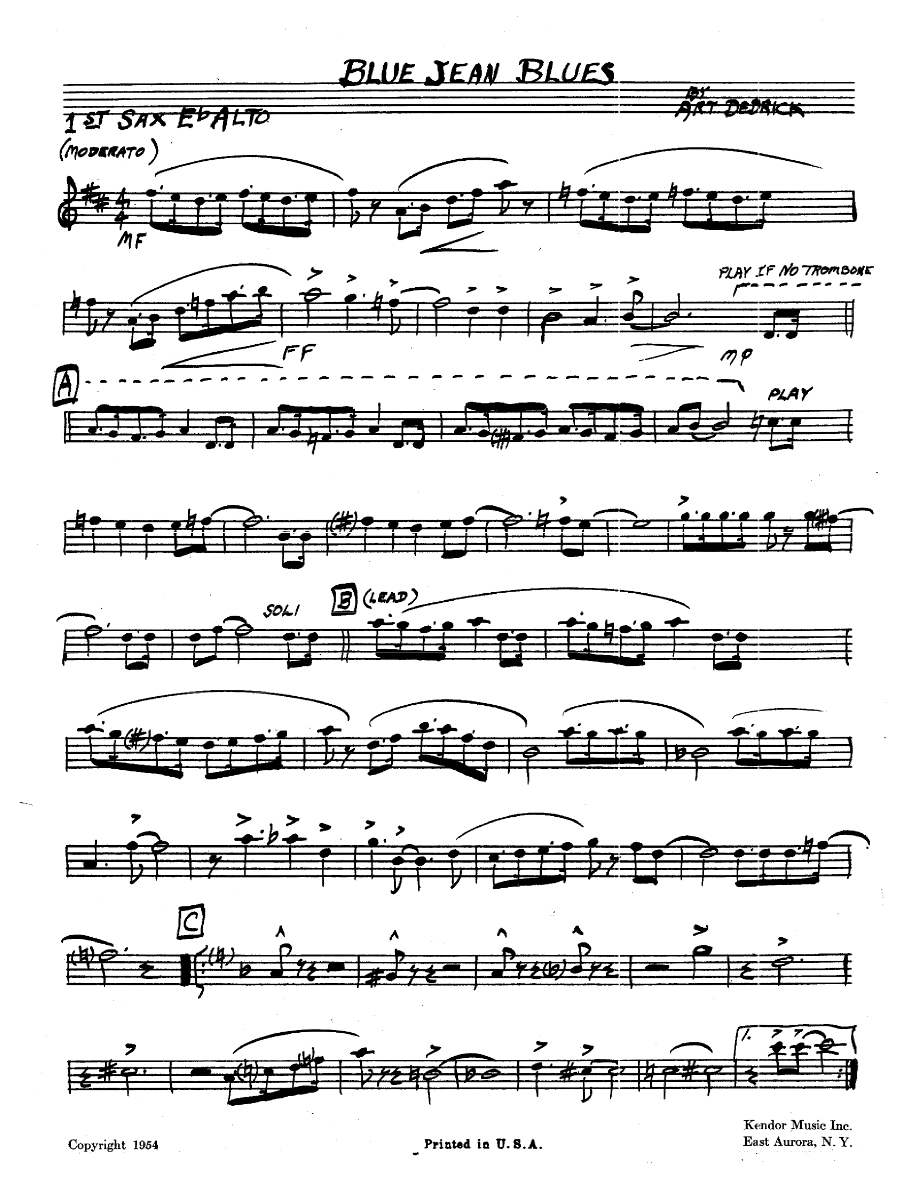
Blue Jean Blues (A.Dedrick)
Composed by Billy Gibbons, Dusty Hill, Frank Beard
Arranged by Art Dedrick
- Ensemble: Big Band
- Style: Jazz Standard
- Pages: 26
- Instruments (16): Alto Saxophone 1, Tenor Saxophone 2, Alto Saxophone 3, Tenor Saxophone 4, Baritone Saxophone 5, Trumpet 1, Trumpet 2, Trumpet 3, Trombone 1, Trombone 2, Trombone 3, Bass Tuba, Bass Viol, Guitar, Drum Set, Piano
- Difficulty: medium
- Content: Individual Parts
- Format: PDF Download (Instant)
- Price: $24.99
"Blue Jean Blues," originally a cornerstone of ZZ Top's iconic 1975 album *Fandango!*, transcends its blues-rock origins in Art Dedrick's masterful big band arrangement, reimagining it as a sophisticated jazz standard. While the original track, penned by Billy Gibbons, Dusty Hill, and Frank Beard, cemented its place in rock history with its gritty, slow blues feel and Gibbons' distinctive guitar work, Dedrick's treatment elevates its inherent harmonic richness and melodic potential into the realm of classic jazz orchestration. This arrangement pays homage to the original's soulful lament while injecting the lush voicings and dynamic contrasts characteristic of the big band tradition, making it a compelling addition to any jazz ensemble's repertoire. It bridges the gap between familiar rock iconography and the intricate world of jazz, offering a fresh perspective on a beloved tune. Art Dedrick's signature arranging style is immediately evident in this chart, transforming the original's raw energy into a polished, yet deeply expressive, slow swing ballad. The piece unfolds at a deliberate tempo, typically around quarter note = 60-70 bpm, allowing for maximum emotional impact and harmonic clarity. Dedrick employs rich, often dense, voicings in the saxophone section, creating a warm, melancholic blanket of sound that underpins the melody. The brass sections contribute with carefully placed sustained chords and tasteful punctuations, avoiding overt aggression to maintain the ballad's reflective mood. A notable feature is the interplay between the sections, with call-and-response figures that build tension and release, leading to a powerful, yet controlled, shout chorus that showcases the full ensemble's dynamic range without sacrificing the piece's inherent bluesy character. The arrangement opens with a haunting saxophone soli, establishing the primary melodic theme with a blend of unison and harmonized lines that immediately draw the listener in. Throughout the piece, the melody is thoughtfully distributed, often passing between lead alto saxophone, trumpet, and trombone, ensuring textural variety. Dedrick provides ample opportunity for improvisation, featuring an extended solo section over the blues form, typically for tenor saxophone or guitar, allowing a soloist to explore the tune's deep blues roots within a jazz context. Technical demands are moderate, focusing more on blend, intonation, and rhythmic precision within the slow swing feel rather than blistering tempos or extreme ranges. The rewarding aspect lies in the ensemble's ability to convey the emotional depth of the blues through sophisticated jazz orchestration, making it an excellent vehicle for developing expressive playing and section cohesion. This arrangement is ideally suited for advanced high school, college, community, and professional jazz ensembles. Its accessible tempo and clear harmonic structure make it a superb teaching tool for developing a mature slow swing feel, while its sophisticated voicings and dynamic requirements challenge more experienced players to achieve a truly polished sound. Bands looking to expand their repertoire with a piece that offers both familiarity and fresh interpretation, blending blues tradition with big band elegance, will find "Blue Jean Blues" to be an exceptionally rewarding and audience-pleasing selection. Approaching "Blue Jean Blues" requires a focus on sustained tone, precise intonation, and a deep, unhurried slow swing feel. The primary technical challenge lies in maintaining the deliberate tempo without dragging, ensuring rhythmic drive even at a slow pace. Conductors should emphasize a relaxed, yet precise, eighth-note subdivision. The saxophone soli sections demand careful attention to blend and balance, particularly in the lower register, to achieve Dedrick's characteristic warmth. Brass players should prioritize a rich, full sound, using mutes sparingly and only where indicated, typically for color rather than volume reduction. Rehearsal time should be dedicated to shaping phrases, especially in the melody and soli sections, allowing the music to breathe and convey its inherent melancholy. Pay close attention to dynamic contrasts, building the shout chorus organically and ensuring a powerful, yet controlled, climax. Q: What instruments and parts are included in this arrangement? A: This big band arrangement is scored for 17 instruments, including Alto Saxophone 1, Alto Saxophone 2, Tenor Saxophone 1, Tenor Saxophone 2, Baritone Saxophone, Trumpet 1, Trumpet 2, Trumpet 3, Trumpet 4, Trombone 1, Trombone 2, Trombone 3, Trombone 4, Piano, Bass, Guitar, and Drums. Q: What is the difficulty level of Art Dedrick's "Blue Jean Blues" arrangement? A: This arrangement is rated as moderate to advanced. While the tempo is slow, it demands excellent ensemble blend, intonation, and a mature understanding of slow swing feel, making it suitable for advanced high school, college, community, and professional jazz bands. Q: What musical style and historical context does this arrangement represent? A: This is a jazz standard arrangement of ZZ Top's "Blue Jean Blues" from 1975. Art Dedrick reinterprets the original blues-rock piece into a sophisticated, slow swing big band ballad, blending its blues roots with classic jazz orchestration. Q: What makes Art Dedrick's treatment of "Blue Jean Blues" unique? A: Dedrick's arrangement is distinctive for its transformation of the blues-rock original into a lush, slow swing ballad, featuring rich saxophone voicings, thoughtful melodic distribution across sections, and a powerful, yet controlled, shout chorus that maintains the original's soulful character within a jazz framework. Q: What is the typical performance duration and tempo for this piece? A: As a slow swing ballad, the typical performance duration for this arrangement is approximately 4-5 minutes, played at a deliberate tempo of around quarter note = 60-70 bpm.
Musicians Also Search For
Blue Jean Blues Art Dedrick PDF • Blue Jean Blues Art Dedrick sheet music • Blue Jean Blues arranged by Art Dedrick • Art Dedrick big band charts • Art Dedrick jazz arrangements PDF • Blue Jean Blues Billy Gibbons, Dusty Hill, Frank Beard sheet music • Blue Jean Blues Billy Gibbons, Dusty Hill, Frank Beard big band arrangement • Billy Gibbons, Dusty Hill, Frank Beard big band charts • Blue Jean Blues big band arrangement • Blue Jean Blues big band PDF download • Blue Jean Blues jazz ensemble sheet music • big band sheet music instant download • Blue Jean Blues conductor score PDF • Blue Jean Blues individual parts download • Blue Jean Blues sheet music with parts • Blue Jean Blues Jazz Standard chart • Jazz Standard big band arrangements • buy Blue Jean Blues sheet music online • download Blue Jean Blues PDF • Blue Jean Blues jazz chart • best Art Dedrick big band arrangements • Billy Gibbons, Dusty Hill, Frank Beard songs arranged by Art Dedrick • Blue Jean Blues printable sheet music • big band repertoire PDF